
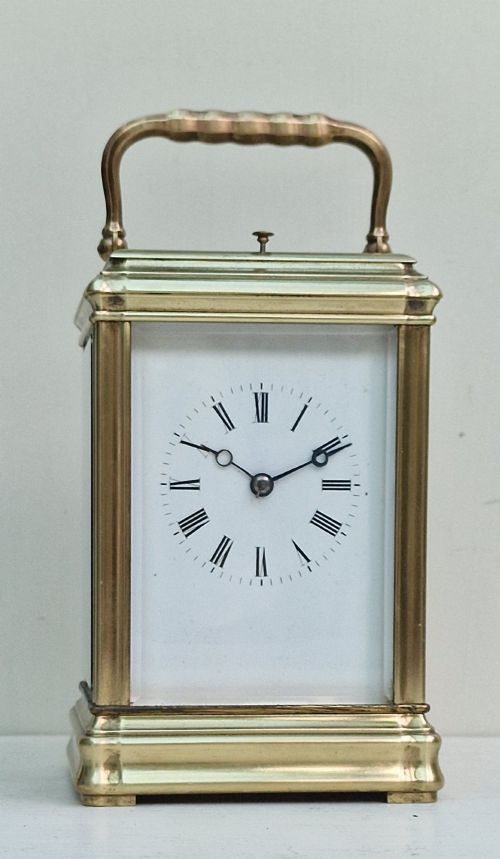


French Gorge Case Clock
A french gorge case clock is a brass-framed timepiece with flat top glass panels, desired for mechanical precision and heavy architectural presence.
French Gorge Case Clock
A french gorge case clock sits within a heavy, stepped brass or gilt bronze housing characterised by distinctive stepped mouldings at the top and base. These timepieces function primarily as carriage clocks, mantle clocks, and four glass clocks originating from nineteenth-century France.
The layout relies on thick bevelled glass panes held in polished metal frames that permit a clear view of the escapement and gear train within. The design prioritises structural weight and precise mechanical capability over ornate wooden cabinetry.
Examples span the middle and late nineteenth century, emerging in various sizes from miniature travelling pieces to giant format striking variants. The case architecture remains uniform while the internal complications and dial configurations alter by maker.
Materials and construction
Makers construct the characteristic frame from solid brass or gilt bronze, casting and machining the heavy components to create rigid housings that protect the delicate internal movement. Thick glass panels fit securely into channels within the metal skeleton, secured by small brackets or integrated bezels.
The internal gear trains utilise steel for pivots and arbors, whilst brass and gilt brass form the plates and wheels driving the escapement and strike trains. Enamel dials carry the numerical markings, often complemented by finely engraved brass masks or detailed floral motifs.
One exceptional timepiece in the archive records race horse interest, proving that even strict horology sometimes plays the turf.
Assessing quality in construction
Superior examples demonstrate heavier gauge brass casework, crisper moulding steps on the gorge profile, and fully fire-gilded surfaces that retain deep lustre. The weight of the metal housing itself signals higher grade output from established Parisian workshops.
Internal sophistication dictates the tier of the piece, moving from simple time-only movements up to complex striking, repeating, alarm, and grand sonnerie mechanisms. Hand-engraved gilt brass dial masks and signed backplates separate standard production from master craftsmanship.
Drocourt·Samuel Marti·Henri Jacot·Joseph Soldano·L Epee·Pons
The French Gorge Case Clock Glossary
- Gorge case
- A distinctively shaped clock housing featuring stepped mouldings at the top and bottom of the brass frame. This profile defines nineteenth-century French carriage clocks.
- Repeating mechanism
- A complication that strikes the hours and quarters upon demand when a plunger is pressed. This allowed owners to check the time in darkness.
- Grand Sonnerie
- A complex striking train that automatically chimes both the hours and the quarters on every quarter hour. It represents a high achievement in horology.
- Escapement
- The internal mechanism that controls the release of power from the mainspring to the gear train. It maintains the steady rhythm of the pendulum or balance wheel.
French Gorge Case Clock: Frequently Asked Questions
What is a gorge case?
A gorge case is a heavy brass carriage clock housing defined by stepped mouldings at the top and base.
These stepped profiles give the frame an architectural weight that distinguishes it from simpler pillared or plain rounded carriage clock designs.
How do repeater clocks work?
Repeating clocks use an internal mechanism activated by pressing a button or pendant on top of the case.
This action triggers gongs to strike the last recorded hour and quarter hour without disturbing the ongoing timekeeping of the movement.
Where were these clocks made?
These pieces were produced primarily in Parisian workshops and factories during the nineteenth century.
Makers exported them across Europe and Britain, frequently retailing them through high-end jewellers and horological houses.
How do I wind my clock?
Wind the movement using the matching key inserted into the arbors located on the underside or backplate of the clock.
Take care not to over-wind the mainsprings, ensuring the winding stops firmly when resistance meets the fully tensioned spring.