
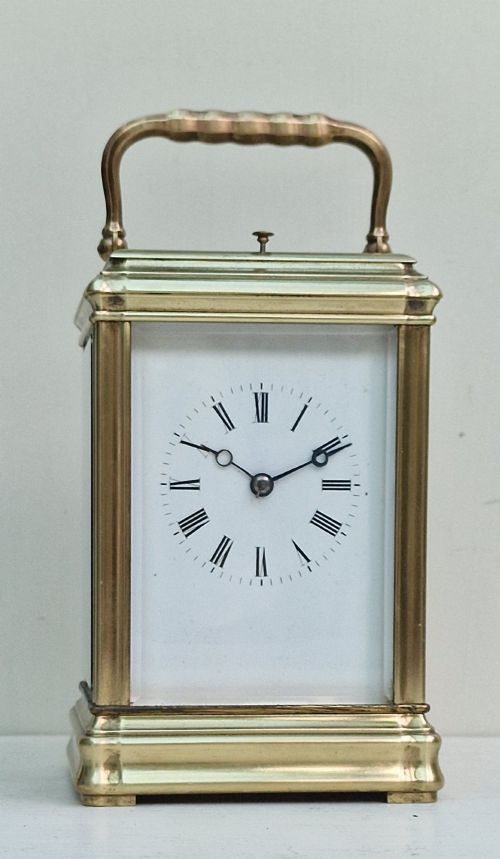


Brass Gorge Case Clock
A brass gorge case clock is a heavy portable timepiece housed in a stepped brass frame with bevelled glass panels, prized for its intricate mechanical complications and architectural presence.
Brass Gorge Case Clock
A brass gorge case clock is defined by its distinct stepped top and base mouldings, which frame bevelled glass windows on all four sides and the top to reveal the movement within. These portable timepieces appear predominantly in French and Victorian horology, spanning the mid-nineteenth century to the twentieth century.
Most examples function as carriage clocks or mantel clocks, often equipped with striking, repeating, or alarm mechanisms. The form originates primarily from French workshops and London makers of the eighteen-fifties through the eighteen-nineties, housed in heavy brass, gilt brass, or gilt bronze cases.
The version most commonly encountered on this page is the nineteenth-century French carriage clock featuring a gorge case, white enamel dial, and an eight-day movement. Collectors search for these pieces to acquire reliable mechanical complexity combined with disciplined architectural styling.
Materials and construction
These clocks are constructed using heavy brass, gilt brass, or gilt bronze to form the structural framework of the gorge case. The metal components are cast, machined, and hand-finished to create the characteristic stepped mouldings that hold the glass panels securely.
Thick bevelled glass panes are fitted into the top and sides of the case, allowing uninterrupted visibility of the brass gear trains and escapements. Dials are typically formed from white enamel with painted Roman numerals, protected beneath further glass or bezel assemblies.
Internal movements combine steel pinions, brass wheels, and occasionally jewelled lever escapements to drive timekeeping, striking trains, and alarm functions. Many cases retain their original gilding, leather travel boxes, and winding keys.
Materials recorded across the archive include gilt bronze, steel, and leather, frequently accompanied by original fitted travelling boxes and winding keys.
Judging quality in a gorge case clock
Quality in these clocks rests upon the complexity of the internal movement and the crispness of the exterior brass casting. Examples featuring grand sonnerie, petite sonnerie, repeaters, or alarm complications represent a higher tier of horological achievement than simple timepieces.
The weight and thickness of the brass case distinguish superior pieces, alongside the precision of the stepped gorge mouldings and the clarity of the bevelled glass. Finer clocks frequently feature finely engraved case frames and enamel dials signed by prominent makers or retailers.
The presence of original matching components, including the winding key and fitted leather travelling case, elevates the standing of a piece. Superior execution is further demonstrated by the clean integration of moon phase displays or calendar work within the heavy brass frame.
Drocourt·Samuel Marti·Dwerrihouse and Bell·Holingue·Henri Jacot·Joseph Soldano·L Epee·Dent·E White
The Brass Gorge Case Clock Glossary
- Gorge case
- A stepped brass carriage clock case with characteristic indented mouldings to the top and base framing glass panels. This architectural housing distinguishes the style from simpler corniche or oval variants.
- Grande sonnerie
- A complex striking mechanism that automatically sounds both the hours and the quarters on every quarter hour. It represents the pinnacle of carriage clock complication.
- Petite sonnerie
- A striking train that sounds the hours on the exact hour and the quarters on the quarter hours without repeating previous strokes. This movement requires precise gear coordination.
- Repeater
- A mechanism operated by pushing a button on the case to repeat the last struck hour and quarters on demand. This function allowed users to check the time in darkness.
- Escapement
- The internal mechanism that controls the unwinding of the clock spring by delivering regulated impulses to the balance wheel. Platform escapements are standard in these portable pieces.
- Enamel dial
- A metal face fused with powdered glass powder fired at high heat to create a smooth white surface for painted numerals. These dials provide a durable and legible display.
Brass Gorge Case Clock: Frequently Asked Questions
What is a gorge case?
A gorge case is a heavy brass carriage clock housing featuring distinct stepped mouldings around the top and base. These architectural steps frame bevelled glass panels on all sides.
The design provides both structural rigidity and visual access to the moving brass gears inside. It remains one of the defining silhouettes of nineteenth-century horology.
How do repeating mechanisms work?
A repeating mechanism allows the clock to chime the last elapsed hour and quarters when a button on the top of the case is depressed. This function relied on intricate racks and snails hidden behind the dial.
Owners utilised this feature during the night before electric lighting existed. It required careful adjustment by skilled makers to ensure the strikes matched the hand position precisely.
How do I identify the maker?
Makers and retailers typically signed their names on the white enamel dial, the backplate of the brass movement, or both. Initials and trademarks are often stamped into the movement plates near the escapement.
Examining the backplate under magnification reveals maker's marks that link the clock to workshops in Paris or London. Comparing these stamps against historical horological records confirms attribution.
Were these clocks meant for travel?
Carriage clocks were originally built as portable timepieces for officers and travellers during the nineteenth century. They were housed in sturdy brass frames and transported inside fitted leather boxes.
The heavy gorge case protected the delicate gear train and platform escapement from transit shocks. Winding keys and locking levers secured the movement during journeys.
What is the difference between striking and sonnerie?
A standard striking clock chimes the hours on the hour, and sometimes the half-hours, using a single bell or gong. Sonnerie clocks automatically chime the quarters as well as the hours without human intervention.
Grande sonnerie systems strike the current hour every time a quarter-hour passes, alongside the quarter strikes. These movements demand significantly more power and intricate gear train design.