


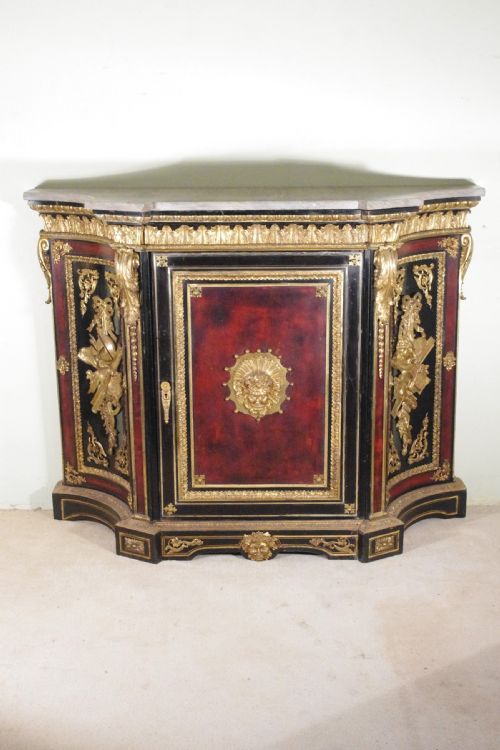


French Empire Style Sideboard
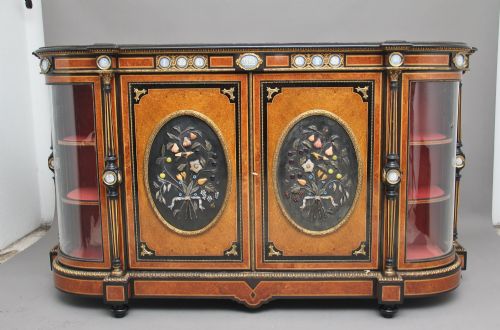
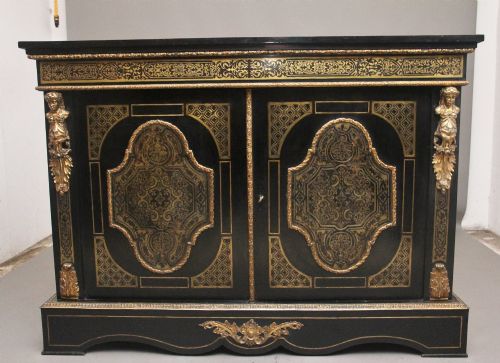
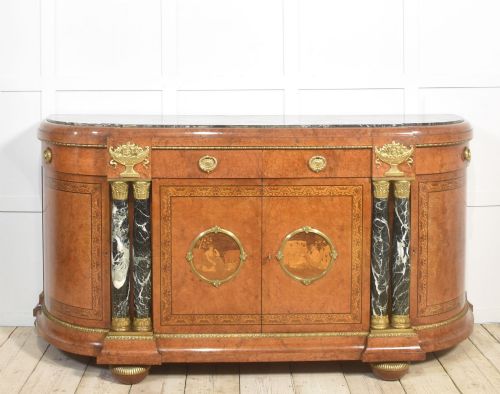
These french empire style sideboard pieces bring formal neoclassical presence and rich timber grain to a room.
French Empire Style Sideboard
A french empire style sideboard provides grounded storage with classical architectural restraint and symmetry.
The pieces on this page span the nineteenth century into the early twentieth century, taking forms such as sideboards, chiffoniers, enfilades, and side cabinets.
Makers drew on French Empire and Neoclassical vocabularies, frequently pairing dark timbers with polished stone tops.
How they were made
Cabinet makers utilised dense timbers like mahogany and ebonised wood, often accented with contrasting veneers.
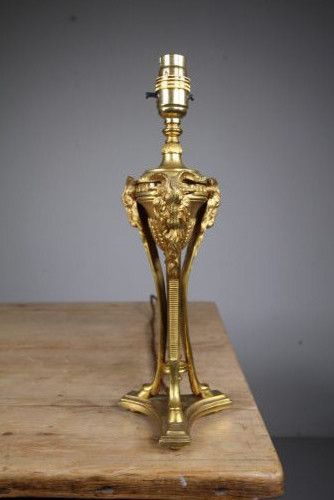
Cast mounts in ormolu, gilt bronze, and brass define the hardware and structural highlights, while heavy marble slabs form the upper surfaces.
Listings feature nineteenth-century and early twentieth-century examples constructed from mahogany, ebonised wood, marble, and ormolu.
What varies in quality
Quality rests on the crispness of the cast metal mounts and the depth of figure in the mahogany or ebonised surfaces.
The weight and matching of the marble top, alongside the precision of carcass joinery, separate standard production from finer work.
The French Empire Style Sideboard Glossary
- Ormolu
- Gilt bronze mounts applied to furniture and lighting. The technique involves a mercury-gilding process that gives a warm golden lustre.
- Chiffonier
- A tall standing cabinet with doors enclosing shelves. This form emerged during the nineteenth century as a practical storage piece.
- Commode a porte
- A low cabinet with doors enclosing interior space, often surmounted by a marble slab. It combines display surfaces with concealed storage.
French Empire Style Sideboard: Frequently Asked Questions
What is an enfilade?
An enfilade is a long sideboard featuring multiple doors arranged in a line along the front.
These pieces were built for formal dining rooms to store tableware and linens.
How do I clean marble tops?
Marble surfaces require simple wiping with a damp cloth and mild neutral soap.
Avoid acidic cleaners that can etch the polished stone over time.
Where were these cabinets placed?
Sideboards and chiffoniers stood against dining room or reception room walls.
They anchored the room while holding serving items and decorative objects.
How do I date a piece?
Dating relies on timber selection, construction methods, and the style of the cast mounts.
Nineteenth-century examples show hand-cut joinery and traditional French polishing techniques.