


French Empire Bed
A french empire bed brings grand neoclassical proportions and rich mahogany timbers directly into a bedroom.
French Empire Bed
A french empire bed stands as a commanding focal point in a bedroom, defined by its architectural lines and classical silhouette. When buyers search for this phrase, they encounter monumental wooden frames that often incorporate distinct boat-shaped profiles or striking flat headboards and footboards.
The versions most commonly met on this page span the nineteenth century and later revivals, ranging from generous king and super-king sizes down to single widths and daybeds. These pieces frequently appear alongside matching bedside cabinets or as part of larger bedroom furniture suites.
How they were made
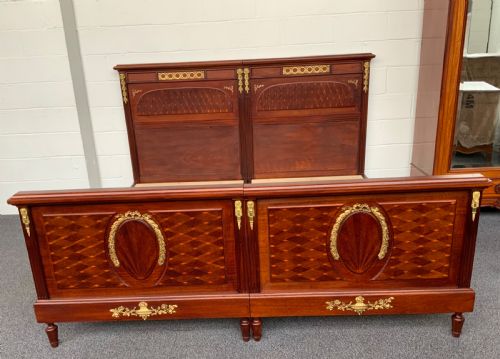
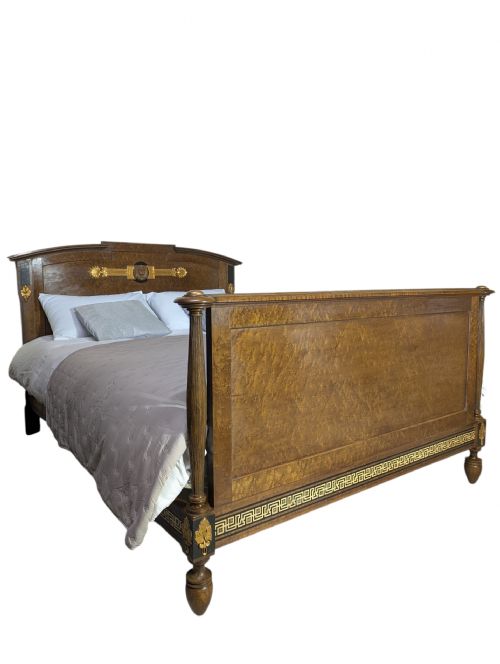
Cabinetmakers built these frames using dense timbers like mahogany, plum pudding mahogany, fruitwood, and burr walnut, sometimes applying parquetry or delicate inlay to the primary surfaces. Painted wood variations also appear, offering an alternative finish to the dark polished grains.
Cast or chased ormolu and polished brass mounts provide the signature metallic detailing characteristic of the neoclassical taste. Upholstered elements in damask and other textiles soften the heavy wooden structures, appearing frequently on headboards and footboards.
Listings feature pieces spanning the nineteenth century through the nineteen-thirties, utilising mahogany, burr walnut, and damask upholstery.
What varies in quality
The distinction between standard examples and superior pieces rests upon the crispness of the bronze or brass mounts and the selection of the timber veneer. Finer frames display deeply figured wood grains, such as plum pudding mahogany, paired with finely cast ormolu details that retain sharp definition.
Proportional harmony and structural integrity separate simpler production from ambitious workshop commissions. Pieces that integrate matching side cabinetry or preserve original painted surfaces demonstrate a higher level of intended design coherence.
The French Empire Bed Glossary
- Lit Bateau
- A traditional French boat bed featuring scrolled head and foot boards of equal or near-equal height that curve outward like the sides of a vessel. This form provides an enclosed, cocoon-like sleeping space.
- Ormolu
- A gilded bronze technique used extensively for decorative mounts and decorative details on nineteenth-century furniture. It gives a bright gold-coloured metallic accent against dark mahogany surfaces.
- Neoclassical
- An artistic movement drawing inspiration from the classical art and culture of ancient Greece and Rome. This aesthetic governs the symmetry, columns, and architectural motifs found on empire frames.
- Parquetry
- A geometric mosaic of wood pieces used for decorative surfacing on floors and furniture. Makers applied this technique to highlight the natural grain and colour variations of the timber.
- Plum pudding mahogany
- A highly prized wood cut showing a distinctive mottled grain pattern resembling traditional Christmas pudding. Cabinetmakers utilised this dense timber for prominent display surfaces.
French Empire Bed: Frequently Asked Questions
How do I fit modern mattresses?
Many continental frames differ slightly from standard modern sizing norms. Checking the exact internal length and width dimensions listed for each piece ensures a proper fit.
Custom mattress makers or specialists in European dimensions can supply bases that drop securely into these antique wooden frames without altering the original structure.
Are these beds easy to assemble?
Most nineteenth-century and revival frames employ traditional knockdown construction utilising metal bolts and slot-in side rails. This design allowed large furniture to travel easily between rooms and residences.
Having two people handle the assembly ensures the heavy mahogany components and delicate ormolu mounts align safely without sustaining impact damage.
How do I care for polished mahogany?
Routine maintenance requires only a soft, dry cloth to remove dust and prevent particulate buildup on the polished timber surfaces. Avoiding direct sunlight protects the deep reddish-brown tones from fading over time.
Periodic application of a quality wax helps nourish the wood grain and preserves the subtle sheen characteristic of period furniture.
What defines the revival style?
Revival pieces date from later periods, such as the late nineteenth or early twentieth century, when makers deliberately copied the monumental forms of the early eighteen-hundreds. These later interpretations utilise the same mahogany materials and brass mounts.
Distinguishing original period pieces from later revivals relies on examining construction techniques, joinery, and secondary woods hidden beneath the primary surfaces.