



French Country Hallway Table
A French country hallway table brings honest timber and provincial utility straight to your entrance.
French Country Hallway Table
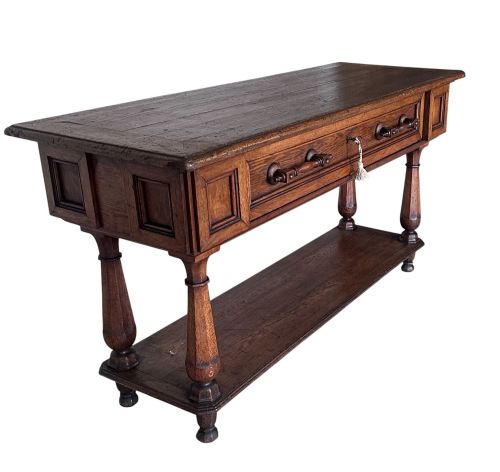
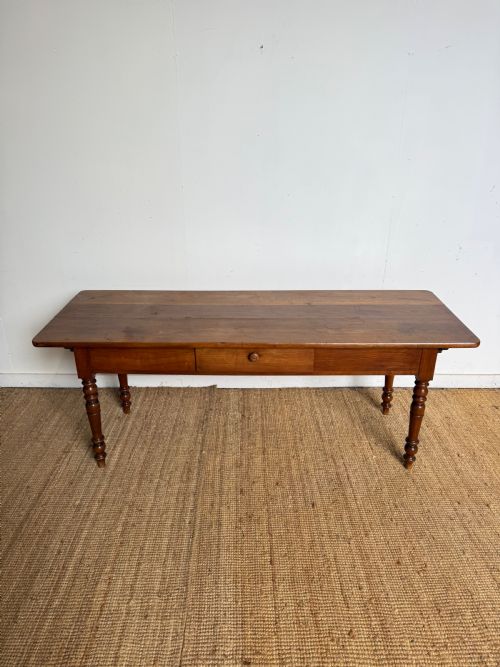
A french country hallway table provides a practical surface in an entrance hall, taking the form of console tables, serving tables, and trestle tables. These pieces originate predominantly from the nineteenth century, including specific dates like 1860, 1880, 1890, and 1930.
The versions you meet most frequently on this page are constructed from oak, pine, cherrywood, and walnut, often featuring practical drawers for storage. Styles range from French Provincial and French Country to English Country House and Neoclassical Revival.
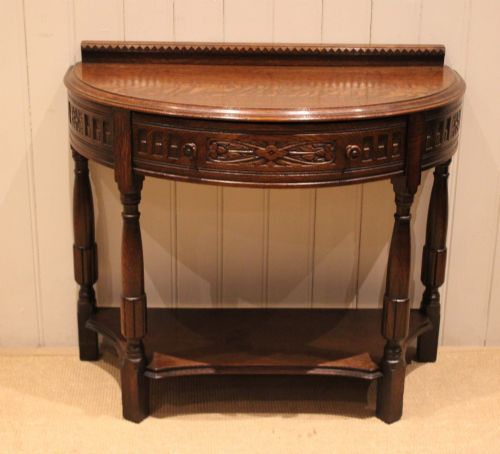
Makers and builders shaped these items to serve daily domestic life, resulting in forms like the demi lune table, the long painted pine console, and the potboard trestle table. Each piece carries the distinct structural footprint of its regional French origin.
How they were made
These tables rely on solid hardwoods and softwoods like oak, cherrywood, pine, and walnut, often enhanced with painted surfaces or bleached finishes. Brass hardware appears on drawer fronts, while marble tops provide durable working surfaces on specific console variations.
Carpenters utilised traditional joining methods to build sturdy frames capable of withstanding heavy daily use in farmhouses and chateaux. Carved details adorn select oak pieces, showing hand-chiselled ornamentation on friezes and legs.
What varies in quality
The grade of timber and the integrity of the construction define the upper tier of these tables. Dense, old-growth oak or carefully selected cherrywood with original patination stands apart from lesser or later timber selections.
Proportion and the handling of carved details also distinguish finer examples. Crisp joinery in the drawers and well-balanced stretcher bases indicate superior workshop standards.
The French Country Hallway Table Glossary
- Console table
- A table designed to stand against a wall, frequently fixed with brackets or supported by front legs. These pieces suit narrow hallways where floor space is limited.
- Serving table
- A long table historically used for holding dishes before or after a meal. In a hallway, it functions well as a narrow surface for keys and post.
- Trestle table
- A table consisting of two or more supports connected by a longitudinal beam. This form provides stable support and legroom underneath.
- Demi lune
- A half-moon shape used for console tables designed to sit flat against a wall. This profile minimises the table's projection into a narrow passage.
- Potboard
- An open lower shelf on a table or dresser, originally intended for storing pots and pans. On these tables, it adds structural rigidity and display space.
French Country Hallway Table: Frequently Asked Questions
How do I use a console table in a small hallway?
A narrow console table sits flush against the wall, offering a surface for everyday items without blocking foot traffic. Models with drawers help keep the entrance tidy by concealing small objects.
Choosing a piece with slender legs or an open base, such as a trestle design, maintains a sense of light and space in a restricted hallway.
What is the difference between an oak and a pine console?
Oak tables offer a heavier, dense structure with a pronounced grain pattern that tolerates robust daily handling. They often feature carved details and a darker natural tone.
Pined tables are lighter in weight and frequently carry painted surfaces or bleached finishes. They bring a softer, rustic character suited to brighter interiors.
Can I use a serving table as a hallway desk?
Serving tables provide a generous length and a stable surface, making them suitable for occasional writing or laptop use in an entryway. Their shallow depth keeps them from dominating the room.
Consider the height of the apron and drawers underneath to ensure adequate leg clearance if you plan to sit at the table.
How do I identify a nineteenth-century French console?
Nineteenth-century French pieces typically display regional timber selection like cherrywood, walnut, or local oak, combined with hand-cut joinery in the drawer construction. Look for authentic signs of age in the wood grain and surface patination.
Stylistic cues such as provincial carvings or simple farmhouse lines separate these older items from later reproductions.