
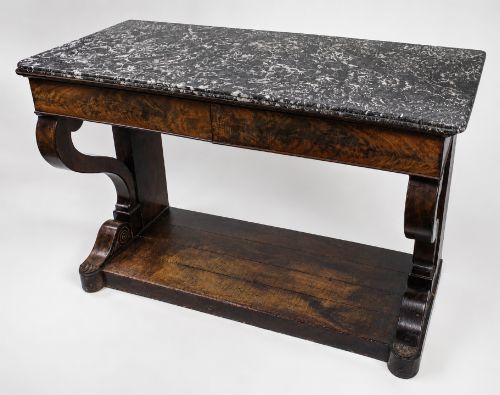


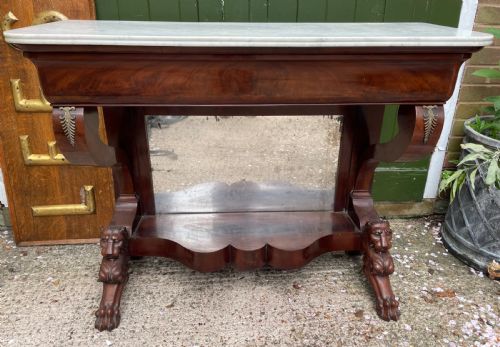


Period French Console Table
A period french console table brings architectural elegance to a hallway, combining rich timbers and marble tops with classical proportions.
Period French Console Table
A period french console table typically appears from the nineteenth century, encompassing Empire, Charles X, and Restauration styles alongside earlier Louis XVI influences. These tables serve as monumental pier pieces or wall-mounted surfaces, often paired with matching mirrors or standing proudly beneath windows.
The selection here ranges from grand flame mahogany and walnut examples to fruitwood and cherry variations, sometimes featuring carved gilt-wood or parcel gilt details. Alongside dedicated console tables, the evidence includes related forms such as sofa tables, dressing tables, and occasional tables.
Originating predominantly from French workshops, these pieces showcase the shifting tastes of the eighteenth and nineteenth centuries. Buyers encounter both austere neoclassical lines and richly figured veneers that define the period french console table aesthetic.
Materials and construction
Cabinetmakers constructed these tables using a carcase of solid timber such as mahogany, walnut, or fruitwood, applied with choice veneers like flame mahogany or plum pudding mahogany. Carrara marble tops provide a cool, heavy contrasting surface that sits neatly within the wooden frame.
Ormolu and brass mounts punctuate the timber surfaces, cast and chased in classical motifs typical of the French Empire and Restauration periods. Parcel gilt and carved gilt-wood treatments further enrich the decorative vocabulary of select pieces.
Listings feature mahogany, walnut, fruitwood, and cherry timbers paired with carrara marble, ormolu, and brass.
Distinctions in quality
Quality rests upon the selection of timber veneers and the crispness of any carving or gilt-wood work. Figures in flame and plum pudding mahogany exhibit superior depth when the cabinetmaker matched the grain across the entire top and frieze.
The integration of original marble tops and high-grade cast ormolu mounts separates standard pieces from exceptional ones. Heavier structural integrity and refined proportions distinguish works attributed to skilled makers from more utilitarian regional outputs.
Jean-Joseph Chapuis
The Period French Console Table Glossary
- Ormolu
- Gilt bronze ornamentation applied to furniture and clocks. This technique involved applying a finely ground high-carat gold mercury amalgam to a bronze base before firing.
- Console table
- A table supported by wall brackets or consoles, designed to stand against a wall. They frequently feature rectangular or serpentine marble tops.
- Parcel gilt
- Partially gilded woodwork or metalwork where gold leaf is applied only to specific carved details. This creates a striking contrast against the dark mahogany or walnut body.
- Restauration
- A French decorative arts period spanning the reigns of Louis XVIII and Charles X. It bridges the transition from heavy Empire grandeur to lighter, more domestic forms.
- Pier table
- A table designed to stand against the wall between two windows, directly beneath a pier glass mirror. They share a very similar form to standard console tables.
Period French Console Table: Frequently Asked Questions
Where should I place a console table?
These tables find their traditional home in entrance halls or against main living room walls, often anchored beneath a large mirror or painting.
Because of their shallow depth, they occupy minimal floor space while providing a functional surface for lamps or decorative objects.
Are the marble tops original?
Many tables retain their original carrara or coloured marble slabs, which should fit snugly within the wooden rebates of the top frame.
Slight variations in edge profiling and natural veining help confirm authenticity against later replacements.
How do I care for mahogany surfaces?
Regular dusting with a soft, dry cloth preserves the patina and prevents abrasive particles from dulling the French polished finish.
Avoid placing the table in direct sunlight or near heat sources to protect the underlying timber and delicate veneers.
What defines the French Empire style?
The Empire style draws heavily on classical Roman and Greek motifs, favouring dark mahogany timbers contrasted with bright ormolu mounts.
Forms remain architectural, solid, and symmetrical, reflecting the imperial tastes of the early nineteenth century.