


French Champleve Enamel
French champleve enamel brings vibrant coloured glass into deeply carved metal recesses, creating ornate decorative objects that define late nineteenth-century interiors.
French Champleve Enamel
When searching for french champleve enamel, buyers encounter a rich assortment of decorative household items and timepieces produced predominantly during the nineteenth century. These objects stem from periods including the Victorian era, Second Empire, and Belle Epoque, reflecting ornate French design aesthetics.
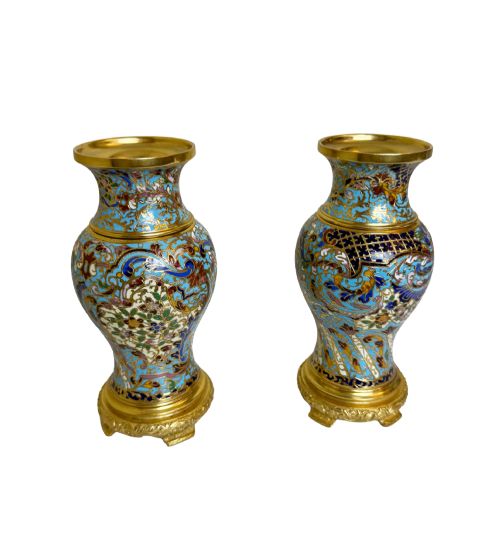
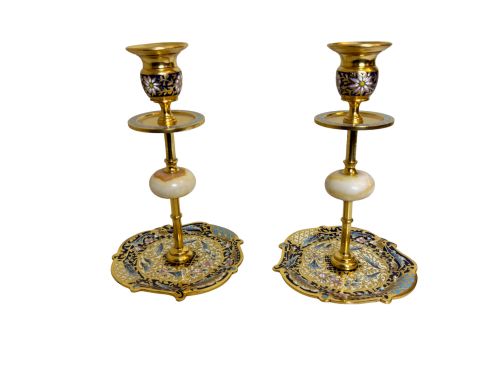
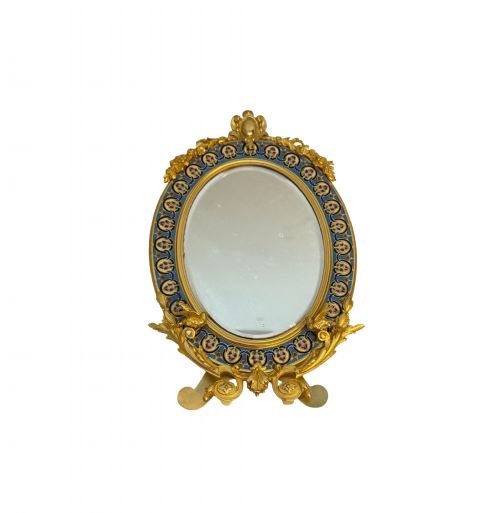
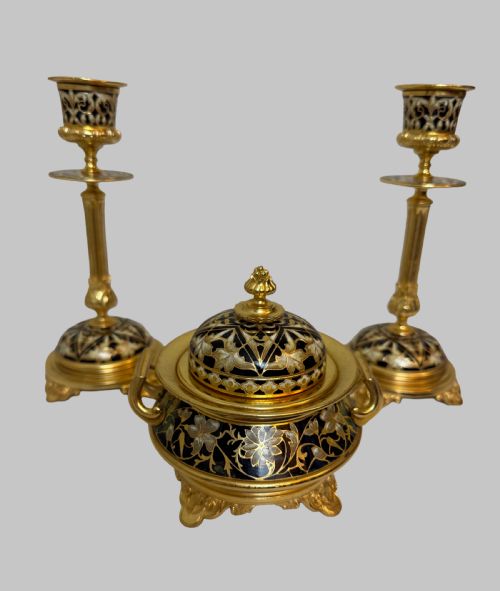
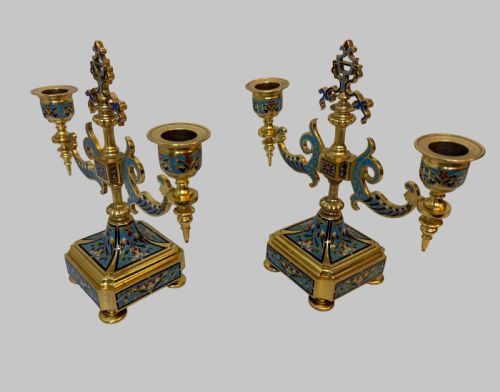
The most common forms on this page include mantel clocks, carriage clocks, candelabra, and desk accessories such as inkwells and trays. Many items combine vibrant enamel work with heavy metal mounts and stone elements like onyx or marble.
Makers and workshops produced these works to serve as functional yet highly decorative centrepieces for bourgeois and aristocratic homes. The surviving pieces demonstrate the high demand for decorative arts in France throughout the 1870s, 1880s, 1890s, and early 1900s.
How french champleve enamel was made
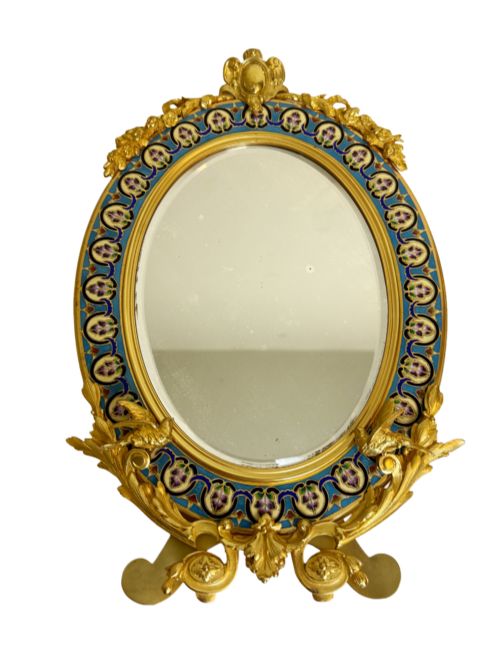
Artisans created champleve enamel by carving or casting troughs and recesses directly into a metal base, typically gilt bronze, brass, or ormolu. They then filled these hollowed compartments with powdered glass mixed with metal oxides before firing the piece in a kiln to fuse the vitreous paste.
Once cooled, the surface was ground flat and polished so the metal partitions stood flush with the hardened enamel design. This technique allowed makers to achieve sharp outlines and intricate geometric or floral patterns across clocks, vases, and frames.
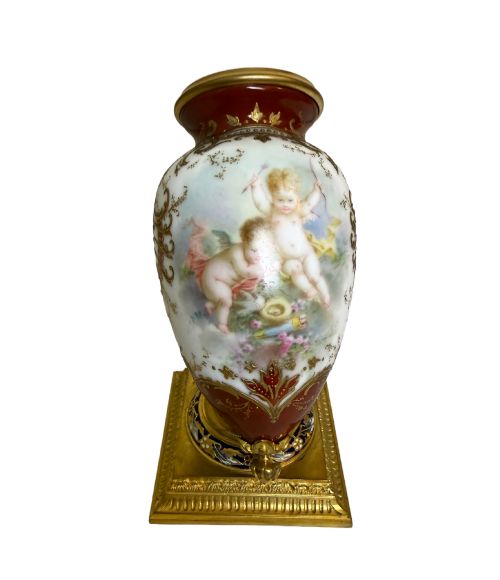
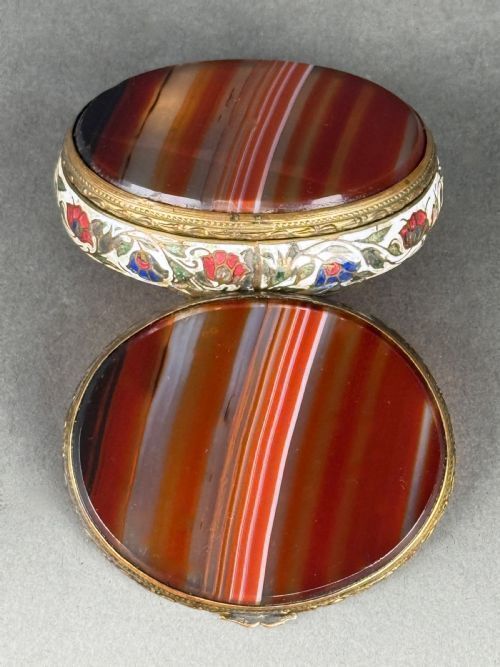
Makers frequently combined the enamelled metal components with other luxury materials recorded in the listings, including Sevres porcelain, banded agate, crystal glass, and carved onyx. The metal foundations were often gilded to enhance the rich visual effect of the coloured enamel panels.
Listings feature 19th-century French pieces including mantel clocks, candelabra, and desk items constructed from gilt bronze, onyx, and champleve enamel.
What varies in quality
The standard of french champleve enamel depends heavily on the precision of the metal carving and the complexity of the enamel palette. Superior examples display crisp, deeply channelled metalwork alongside richly varied, carefully blended enamel colours rather than flat, single-tone fills.
Integration of materials also dictates the calibre of a piece. Finer items successfully marry the enamelled sections with cast ormolu, gilt bronze, and auxiliary stones such as onyx or porcelain without awkward joins or mismatched styles.
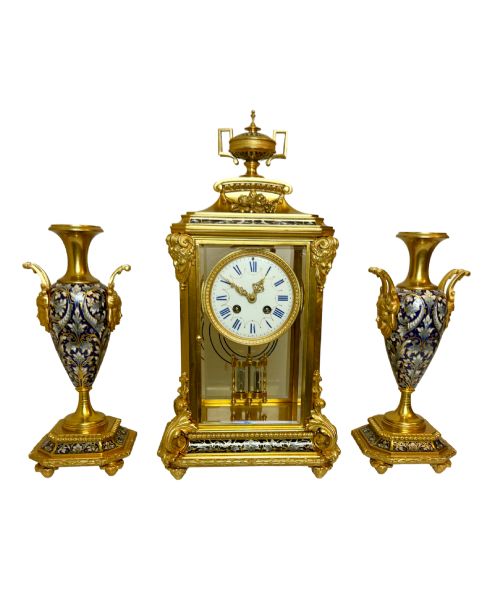
The intricacy of the overall object, whether a multi-piece clock garniture or a simple pill box, determines its place in the hierarchy. Comprehensive sets with matching candelabra and clocks represent more ambitious manufacturing than standalone items.
Le Roy and Fils·Samson
The French Champleve Enamel Glossary
- Champleve enamel
- A technique where troughs are dug into a metal surface to hold coloured glass paste before firing. This method produces robust patterns defined by metal dividing lines.
- Ormolu
- Gilded bronze or brass created through a mercury amalgamation process common in French decorative arts. It provides a bright, lasting golden finish to metal mounts.
- Gilt Bronze
- Bronze metal treated with a thin layer of gold or gold-coloured alloy. It serves as the primary structural frame for many enamelled objects.
- Clock Garniture
- A matching set consisting of a central mantel clock flanked by matching ornaments such as candelabra or vases. These sets were designed to sit harmoniously on a fireplace mantel.
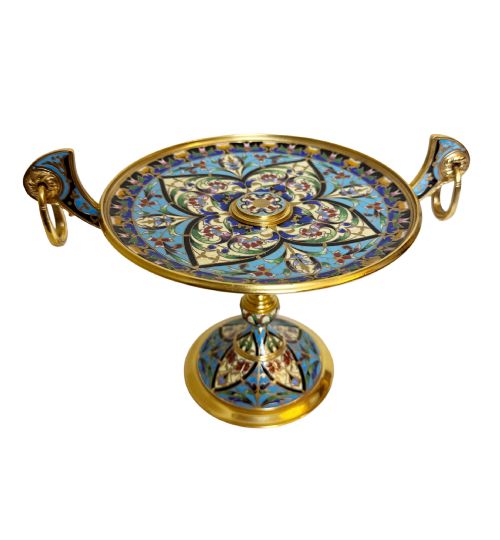
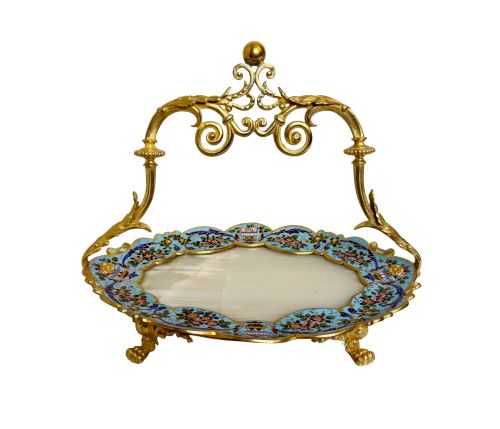
- Tazza
- A shallow saucer or bowl raised on a stem and foot, used for display or serving. In these listings, they appear as decorative gilt bronze and enamelled display pieces.
French Champleve Enamel: Frequently Asked Questions
What is champleve enamel?
Champleve enamel is an artistic technique where metal is gouged or cast with depressions that are subsequently filled with powdered glass paste. The piece is then fired in a kiln until the glass melts, after which the surface is polished smooth.
This method creates distinct coloured patterns separated by thin walls of exposed metal, giving objects like clocks and vases their characteristic vibrant decoration.
How do I date a French enamel clock?
Dating these clocks involves examining the movement style, case materials, and manufacturing signatures recorded on the dial or mechanism. Pieces from the 1870s and 1880s often display Second Empire or early Victorian design influences, while those from the 1890s and 1900s lean towards Belle Epoque or transitional styles.
Makers' marks and registration numbers stamped on the bronze framework also help pinpoint the exact period of production in France.
How were clock garnitures used?
Clock garnitures served as prominent decorative centerpieces on drawing room mantelpieces, accompanied by matching side pieces such as candelabra or urns. They established a symmetrical, balanced display that reflected the formal interior design tastes of the nineteenth century.
Beyond telling time, these coordinated sets demonstrated the owner's taste and wealth through their elaborate gilt bronze and enamelled construction.
What is a crystal regulator?
A crystal regulator is a type of mantel clock featuring glass panels on all four sides, allowing a clear view of the mechanical movement suspended inside. These clocks often incorporate enamelled dials and delicate champleve enamel frames around the glass.
Introduced during the nineteenth century in France, they combined precision horology with light, airy case designs that showed off the interior brass gears.