
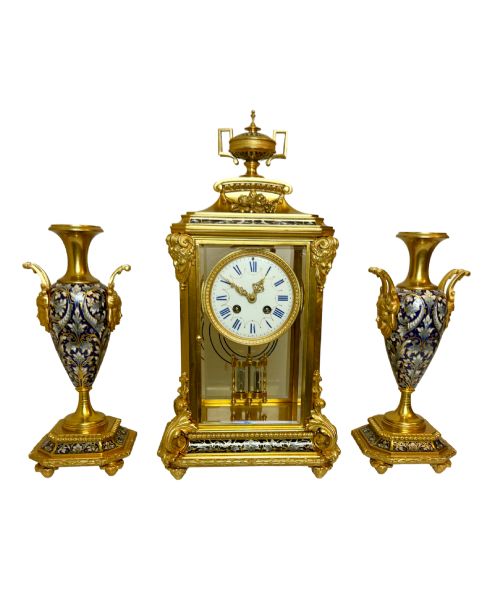


Champleve Clock French
These champleve clock french pieces combine bright enamel with polished metal work to sit prominently on a mantelpiece.
Champleve Clock French
When you search for a champleve clock french, you encounter timepieces produced across the nineteenth century and into the early twentieth century, spanning periods from Napoleon III and Victorian to Belle Epoque.
The most common forms on this page include mantel clocks, four-glass regulators, and carriage clocks, often accompanied by garniture sets.
Makers such as Le Roy and Fils, Samuel Marti, and Vincenti appear in the historical record alongside unsigned pieces originating from French workshops.
Materials and construction methods
These clocks rely on brass, gilt bronze, or ormolu housings that provide structural support and a golden metallic finish.
Makers cut depressions directly into the metal surface, filling these troughs with coloured enamel powders before firing and polishing the panels flat.
Glass panels protect delicate hand-painted dials and allow visibility into the mechanical movements, while onyx and porcelain elements occasionally form part of the cases.
Materials span brass, gilt bronze, ormolu, glass, and champleve enamel.
Factors separating examples
The precision and depth of the enamel work set certain pieces apart, with multi-colored flower designs and complete enamel bandings showing greater artisan involvement.
The substantial weight of cast ormolu and bronze mounts, combined with complex mechanisms like repeating carriage movements, distinguishes superior examples from simpler brass models.
Le Roy and Fils·Samuel Marti·Vincenti·Leroy Paris
The Champleve Clock French Glossary
- Champleve Enamel
- A technique where troughs are dug into a metal surface and filled with vitreous enamel before firing.
- Ormolu
- Gilded bronze applied to ornamental metalwork on clock cases and furniture.
- Garniture Set
- A mantel clock accompanied by matching side ornaments such as urns or vases.
- Crystal Regulator
- A mantel clock housed in glass panels held by a brass or bronze framework, revealing the escapement and pendulum.
Champleve Clock French: Frequently Asked Questions
What is a champleve clock french?
A champleve clock french is a nineteenth-century timepiece originating from France, decorated with recessed enamel designs set into brass or gilt bronze frames.
These pieces range from portable carriage clocks to large mantel clocks and four-glass regulators.
How do I wind these clocks?
Most of these clocks utilise a key inserted into winding holes on the dial or back plate to tension the internal springs.
Careful winding ensures the mechanical movement keeps time without overwinding the springs.
Where should I place a mantel clock?
These clocks sit securely on flat, level surfaces such as mantelpieces, tabletops, or bespoke bronze plinths.
Keeping them away from direct sunlight and drafts protects the enamel and mechanical components.
How do I identify the period?
Stylistic cues such as French Rococo Revival curves or Belle Epoque details help date the pieces between 1870 and 1910.
Signatures on dials and movements, alongside materials like onyx or ormolu, provide further context for the production era.