
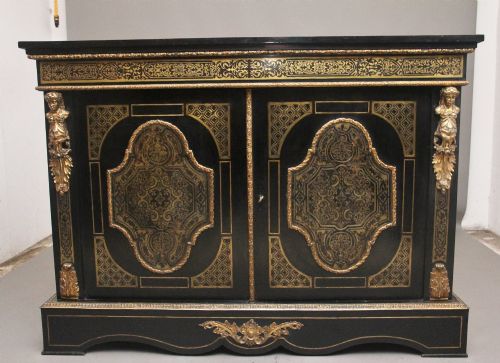
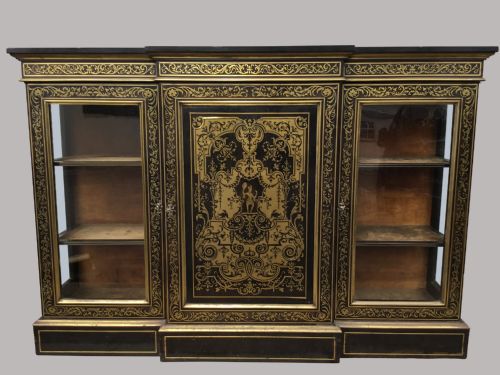


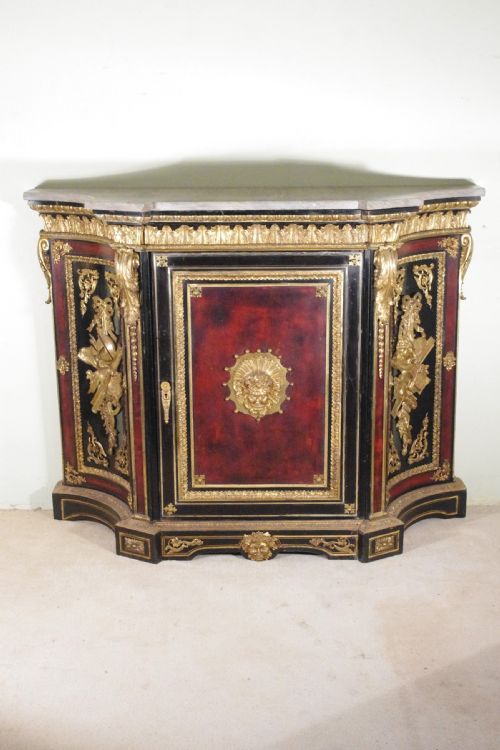
French Boulle Sideboard
A french boulle sideboard brings magnificent tortoiseshell and brass marquetry into a room, offering grand storage through opulent nineteenth-century craftsmanship.
French Boulle Sideboard
A french boulle sideboard represents elaborate nineteenth-century case furniture built primarily as credenzas, side cabinets, and display cabinets. These pieces combine sweeping serpentine fronts with striking inlaid surfaces designed to anchor a formal interior.
Most examples found here date from the nineteenth century, spanning Victorian and French Napoleon III periods alongside French Revival aesthetics. Makers utilised ebony, ebonised wood, and occasionally rosewood as dark grounds for intricate metal and shell decoration.
Buyers encounter credenzas and breakfront side cabinets featuring glazed doors, marble tops, and substantial proportions intended for displaying fine objects. The form serves as both a functional storage base and a dramatic decorative centrepiece.
Materials and construction methods
The distinctive surface decoration relies on intricate brass and tortoiseshell marquetry, often cut in counterpart and direct patterns known as first-part and contre-partie. Artisans set these delicate panels into dark timber carcasses made from ebony or ebonised wood.
Gilt bronze and ormolu mounts punctuate the corners, framing doors and edging marble tops with heavy cast metal detailing. Glass panels appear on display cabinets, held within timber frames that complement the elaborate metalwork.
The listings on this site feature nineteenth-century pieces incorporating marble tops, ebonised wood, and gilt bronze mounts.
Assessing quality in boulle work
The precision of the brass and tortoiseshell cutting dictates the visual clarity of the marquetry across the facade. Finer examples display tight joints and crisp engraving within the metalwork, whereas lesser pieces show wider gaps and simplified lines.
The weight and chasing of the ormolu mounts separate standard production from superior workshops. Crisp, deeply sculpted gilt bronze mounts with defined foliage and masks elevate a cabinet far above pieces carrying flat, thinly cast metal fittings.
The French Boulle Sideboard Glossary
- Boulle
- Marquetry technique utilising tortoiseshell and brass inlay developed during the seventeenth century and revived extensively in the nineteenth century. The method creates contrasting metallic patterns against a dark organic background.
- Ormolu
- Gilded bronze mounts applied to furniture edges, corners, and feet for ornamental emphasis. The material adds sculptural depth and protects vulnerable timber corners from damage.
- Serpentine
- A curved cabinet front that gently undulates with a convex centre flanked by concave ends. This shaping requires advanced carpentry and adds dynamic movement to large sideboards.
- Marquetry
- Decorative veneer patterns assembled from pieces of wood, metal, or shell to form elaborate pictorial designs. Craftsmen glue these veneers onto the carcase timber to cover large structural surfaces.
- Ebonised
- Timber stained or painted black to imitate expensive ebony wood. This finish provides a high-contrast dark background that makes bright brass inlay stand out.
French Boulle Sideboard: Frequently Asked Questions
What is a french boulle sideboard?
A french boulle sideboard is a nineteenth-century storage cabinet decorated with intricate brass and tortoiseshell marquetry.
These pieces typically feature rich ormolu mounts and serve as focal points in formal dining rooms or drawing rooms.
How do I care for tortoiseshell and brass inlay?
Keep these sensitive cabinets away from direct sunlight and sudden temperature changes to prevent the tortoiseshell from drying and cracking.
Dust gently with a soft dry cloth and avoid harsh chemical polishes that can damage the delicate metal and shell surfaces.
Are these cabinets purely decorative?
While highly ornate, these pieces provide substantial interior shelving and surface space for storing and displaying objects.
Many examples include enclosed cupboards and glass-fronted display areas behind their decorative facades.
How do I distinguish Napoleon III pieces?
Napoleon III boulle furniture dates from the mid to late nineteenth century during the French Second Empire.
This style heavily reinterprets earlier baroque designs with lavish gilt bronze mounts and dense marquetry patterns.