
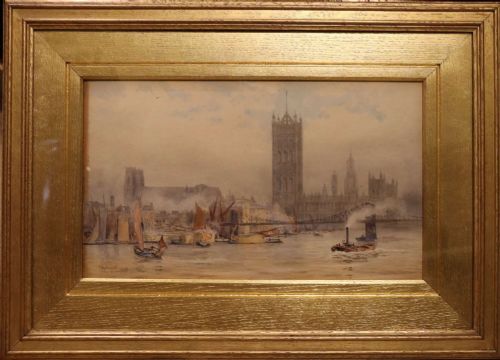
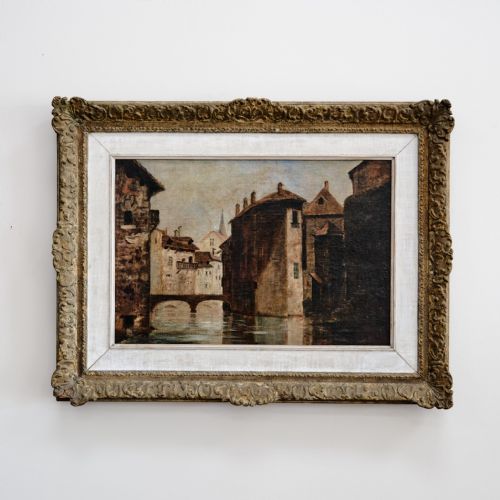
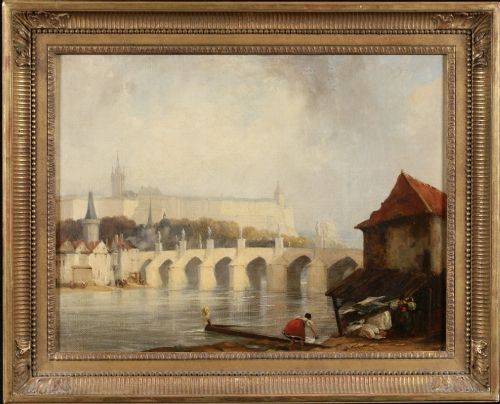


Framed River View Painting
A framed river view painting brings moving water and open banks onto a wall, offering a window into quiet stretches of the Thames, Seine or local waterways.
Framed River View Painting
A framed river view painting captures watercourses, bridges, and bustling banks through the eyes of artists working from the seventeenth century through the mid-twentieth century. These works range from grand topographical records of city waterways to intimate watercolours of rural backwaters and secluded streams.
The selection on this page centres on oil paintings and watercolours housed in traditional wood and gilt frames. Buyers encounter British and continental scenes, spanning Victorian academic traditions, impressionist treatments of light on water, and mid-century modern interpretations.
Works depict recognisable landmarks such as the Houses of Parliament, Prague Castle, and Eton College alongside quiet rural vistas. Each piece reflects the specific handling of light and atmosphere favoured in its period, whether the careful detail of nineteenth-century British art or the looser brushwork of the Edwardian era.
How They Were Made
Artists painted primarily with oil paint on canvas or board, or applied watercolour pigments onto paper, utilising the reflective qualities of the support to capture water's surface. Canals, rivers, and coastal docks demanded a mastery of fluid brushstrokes to render reflections, ripples, and changing atmospheric conditions.
Frames play a structural and aesthetic role, constructed from wood and frequently finished with gilt layers to complement the palette of the canvas or paper within. Glass protects delicate works on paper and watercolours, while oil paintings on canvas remain unglazed to show the direct texture of the paint.
Listings feature works created across three centuries, using canvas, paper, and wood.
What Varies in Quality
The strength of a composition depends on how effectively the artist manages perspective and the fall of light across water and architecture. Superior works demonstrate a confident handling of tone that draws the eye naturally along the river channel towards the distance.
Condition and originality separate exceptional pieces from standard examples, particularly regarding the preservation of the pigment and the authenticity of the period frame. Intact surfaces without excessive overpainting retain the immediate touch of the artist.
H. Medlycott·Henry John Kinnaird·Ron Folland·Stanley Leader·George Hilditch·Noel Harry Leaver·Robert Anderson·George Willis Pryce·Henry H Parker·Edward Fletcher·Godwin Bennett·Peter Greenham·Maud Raphael Jones·Jacob Knyff·R. Allan·John Joseph Cotman·Julius Caeser Ibbetson
The Framed River View Painting Glossary
- Watercolour
- A painting method where fine pigment is suspended in a water-based, translucent solution, typically applied to paper. This medium allows for luminous washes that suit the depiction of shimmering river surfaces.
- Impressionist
- A style focusing on the accurate depiction of light and its shifting qualities rather than fine detail. Artists working in this manner used rapid, visible brushstrokes to capture transient moments on the water.
- Canvas
- A heavy woven fabric stretched tightly across a wooden frame to form the primary support for oil paintings. Its textured surface holds layers of oil paint effectively.
- Gilt Wood
- Wood carved and coated with a thin layer of gold leaf or metallic gilt paint. It provides traditional framing that enhances the brightness of the painting within.
Framed River View Painting: Frequently Asked Questions
How do I hang a heavy framed oil painting?
Secure the hanging wire or D-rings directly into wall studs using appropriate fixings rated for the weight of the wood and canvas.
Ensure the painting hangs level at eye level to properly appreciate the perspective of the river scene.
Should watercolour river paintings be kept out of direct sunlight?
Sunlight fades the delicate pigments and paper supports typical of antique watercolours over time.
Position these works on walls away from direct windows or utilise glass with ultraviolet filtering.
How do I clean an antique oil painting frame?
Dust the carved wood and gilt surfaces gently with a soft, dry brush to remove loose particles.
Avoid liquid cleaners and commercial polishes, which can strip the historic finish from the wood.
What is the difference between oil on canvas and watercolour?
Oil paint offers a thick, textured finish on a canvas support that does not require protective glass.
Watercolour utilises thin washes on paper and requires glazing to protect the surface from moisture and dust.