

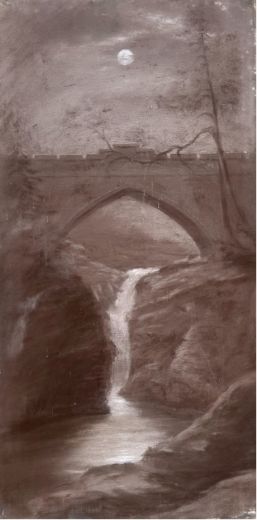
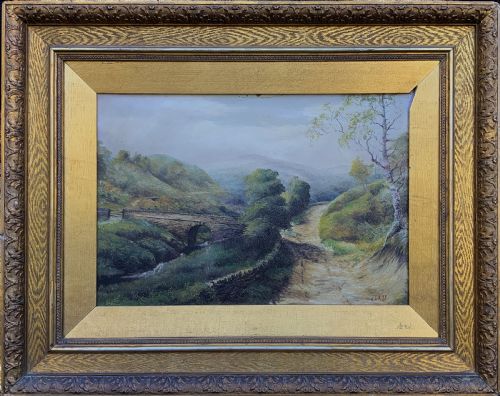


Victorian Stone Bridge Landscape
These Victorian stone bridge landscape works capture scenic river crossings and rustic spans across the nineteenth century.
Victorian Stone Bridge Landscape
A victorian stone bridge landscape brings nineteenth-century rural scenery and architectural masonry into domestic spaces. These pieces primarily take the form of paintings, spanning both watercolours and oil works on canvas, wood panel, and paper.
The subjects range from Scottish highlands and Welsh valleys to Italianate scenes, frequently featuring figures beside rivers or crossing ancient arches. Most examples on this page belong to the nineteenth century, reflecting romantic and regional British school traditions.
Materials and methods
Artists of this era utilised traditional mediums, applying oil paint or watercolour paint onto prepared canvas, wood panels, paper, and card. Gilt frames often complement these works, adding a formal nineteenth-century presentation to the rural subject matter.
Techniques varied from fine watercolour washes to heavier oil applications on canvas and wood, sometimes influenced by broader artistic movements like the Norwich School or nineteenth-century romanticism.
Victorian Stone Bridge Landscape Retail Price Guide 2026
Typical asking prices for victorian stone bridge landscape among the pieces listed under this phrase on Sellingantiques today, from the lower quarter to the upper quarter. They describe what is for sale here now, not the wider market.
Listings feature works spanning the nineteenth century, utilising oil paint, watercolour paint, and charcoal across canvas, wood, and paper.
Assessing quality and execution
Quality in a victorian stone bridge landscape rests on the confidence of the brushwork and the handling of atmospheric light. Stronger pieces demonstrate careful attention to architectural detail in the stonework and natural integration of figures within the wider scenery.
The choice of support also influences the character of the piece, with well-preserved oil paintings on canvas or wood panel offering different textural qualities compared to delicate nineteenth-century watercolours on paper.
H Wallace·J Barclay·Thomas Lound·H Church·James H Hulse
The Victorian Stone Bridge Landscape Glossary
- Watercolour paint
- A water-based medium using finely ground pigments suspended in a water-soluble binder. It is typically applied to paper to create luminous, translucent effects.
- Oil paint
- A slow-drying paint made by mixing pigments with a drying oil such as linseed. This medium allows for rich blending and textured impasto work on canvas or wood panel.
- Norwich School
- A regional group of artists inspired by the landscapes of Norfolk during the nineteenth century. Their work often emphasises local scenery and naturalistic lighting.
- Italianate style
- An artistic approach influenced by the landscapes, architecture, and warm light of Italy. British artists frequently applied these classical compositional elements to domestic rural scenes.
Victorian Stone Bridge Landscape: Frequently Asked Questions
What periods do these bridge paintings cover?
The available works span the nineteenth century, with specific pieces dated from around eighteen-fifty through to the eighteen-eighties and eighteen-nineties.
Most examples reflect Victorian tastes, capturing romantic or regional British landscape traditions from distinct decades within this timeframe.
What surfaces were these artworks created on?
Artists used a variety of traditional supports depending on the medium chosen. Surviving examples employ canvas, paper, and wood panels.
Watercolours generally appear on paper supports, whereas heavier oil compositions are found on stretched canvas or wooden boards.
How do I care for antique watercolours?
Works on paper require careful placement away from direct sunlight to prevent fading of the pigments. Framing with acid-free mounts helps protect the paper from degradation over time.
Maintaining stable indoor humidity levels also preserves both the paper and any accompanying gilt frame.
What subjects usually accompany stone bridges?
These landscapes frequently incorporate rivers, figures on riverbanks, and mountainous backdrops from locations such as Scotland, North Wales, and Italy. Architectural elements like masonry arches serve as focal points within broader pastoral scenery.