





Framed Cottage Watercolour Art
Framed cottage watercolour art brings the quiet charm of rural life indoors through delicate pigment on paper.
Framed Cottage Watercolour Art
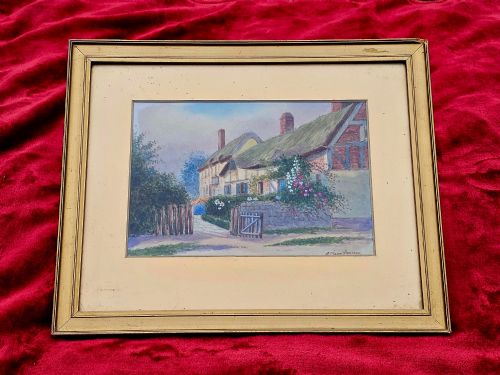
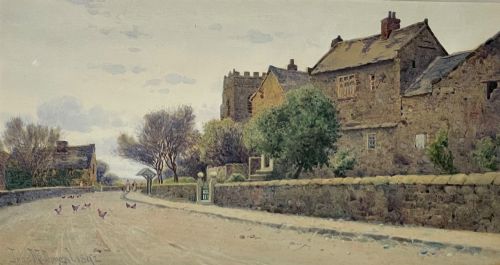
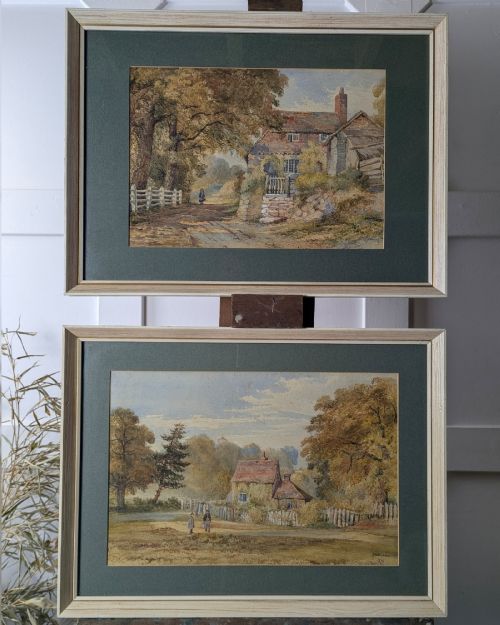
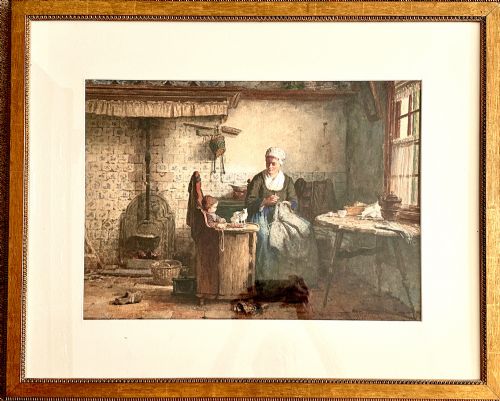
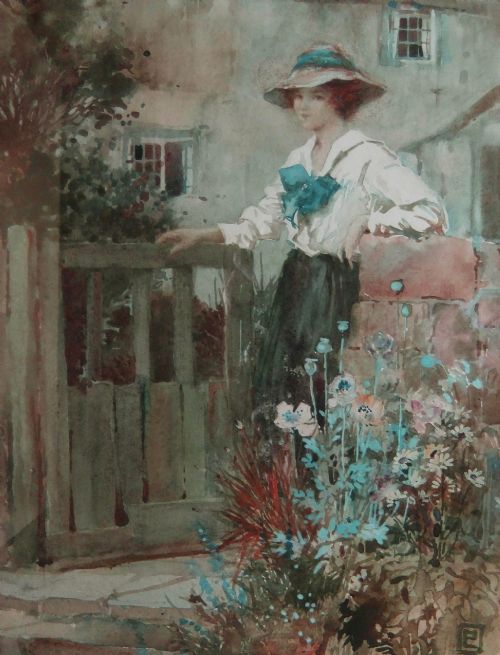
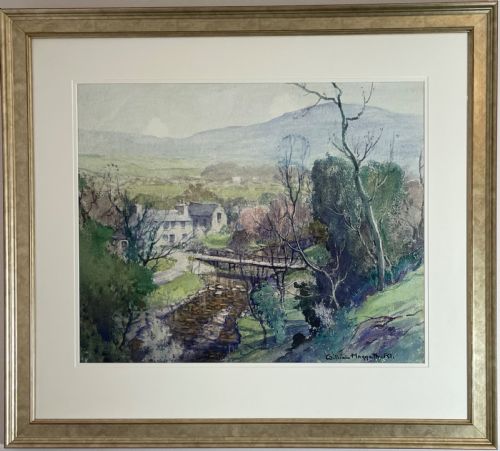
Framed cottage watercolour art covers landscape paintings and rural genre scenes executed on paper using watercolour pigment, originating primarily from the nineteenth and twentieth centuries. These works capture domestic rural life, cottage gardens, and village architecture across various British and European localities.
The selections available here span Victorian and Edwardian periods, stretching from the 1890s through the 1940s. Typical compositions feature thatched cottages, garden pathways, and daily rural activities rendered by named artists of the era.
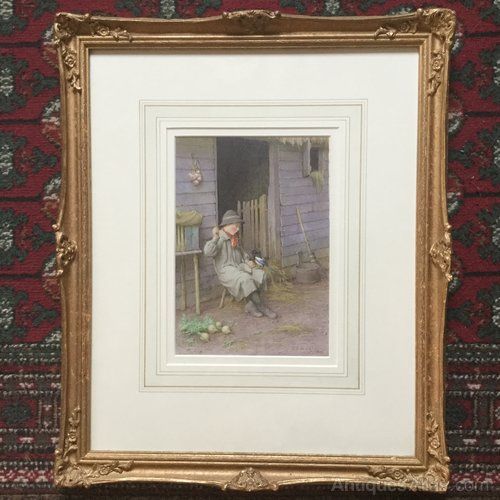
Most items arrive set behind protective glass within wooden or gilt wood frames that complement the delicate nature of the medium. These wall art pieces range from intimate sketches to larger framed fine art paintings.
Materials and techniques
Artists apply watercolour pigment suspended in water onto heavy paper sheets, building colour through washes and fine brushwork. This technique allows for translucent layering that catches light beneath the protective glass of the frame.
The works are housed in wooden frames, sometimes finished with gilt to accent the visual depth of the painting. Paper provides the primary substrate for the watercolour medium across all recorded periods.
Materials recorded across the inventory include watercolour pigment, paper, wood, glass, and gilt wood.
Judging quality in watercolour paintings
Quality rests upon the artist's command of light, composition, and brushwork detail within the painted scene. Master painters achieve a natural luminosity and precise architectural or botanical rendering that elevates the work above standard topographical illustration.
The preservation of the paper and the vibrancy of the watercolour pigment determine the visual strength of the piece. Intact framing, original glass, and minimal fading from light exposure preserve the integrity of the artwork.
A. Marie Parsons·John McDougal·Robert A. Nottingham·Hendrik Valkenberg·Percy Lancaster·Charles Edward Wilson·Fred Lawson·J S Ainley·William Hoggatt·James Hardy Junior·Theresa Stannard·Helena Maguire·Owen Bowen·Lilian Stannard·Harry Sylvester Stannard·Henry Charles Fox·Will Anderson·Thomas James Lloyd·B. Kaufmann·David Woodlock·Henry Spernon Tozer·Joseph Kirkpatrick·Henry Sylvester Stannard·J.V.R.Parsons·Arthur Claude Strachan
The Framed Cottage Watercolour Art Glossary
- Watercolour pigment
- The finely ground colour particles suspended in a water-soluble binder used by artists on paper.
- Gilt wood
- Wood framing treated with gold leaf or a metallic gold finish to create a decorative border.
- Victorian pastoral
- A nineteenth-century artistic style focusing on idealized rural scenes, agricultural life, and idyllic cottage settings.
- Fine art painting
- An original creative work executed by a trained artist rather than a mechanical reproduction or print.
- Lithograph
- A planographic printmaking process used to reproduce original compositions onto paper.
Framed Cottage Watercolour Art: Frequently Asked Questions
What periods do these watercolours come from?
The collection spans the nineteenth and twentieth centuries, with significant representation from the Victorian and Edwardian eras. Pieces date from the early 1800s through to the 1940s.
Works from the 1890s and early 1900s dominate the selection, reflecting a strong period interest in rural and pastoral themes.
How should I hang watercolour art?
Watercolour paintings require placement away from direct sunlight to prevent the pigments from fading over time. Maintaining a stable indoor environment protects both the paper and the wooden frame.
Ensure the artwork hangs securely using appropriate wall fixings suitable for the weight of the framed piece.
What subjects are typically depicted?
Common subjects include thatched rural cottages, cottage gardens filled with flowers, and coastal village scenes. Figures engaged in daily countryside tasks frequently appear within the landscapes.
Artists drew inspiration from specific British locales, including Devon, Somerset, and the Isle of Man.