

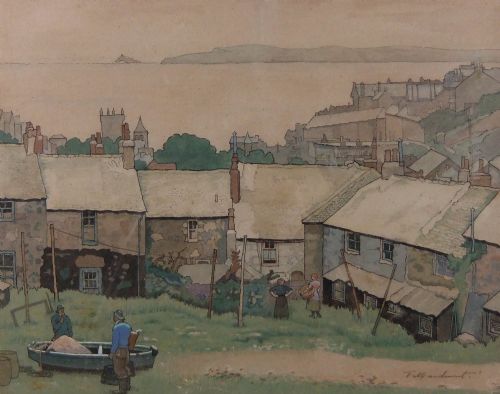


Coastal Village Picture
A coastal village picture brings the salt air and sheltered harbours of the British shoreline straight into a room through watercolours and oils.
Coastal Village Picture
A coastal village picture captures maritime settlements, working harbours and shorelines from the nineteenth and twentieth centuries. These works record specific coastal locations across Britain, from Cornish fishing ports to Scottish estuaries and Welsh inlets.
The pieces on this page appear in various mediums, predominantly watercolours on paper and oil on canvas. Most are framed securely in wood, often with gilt touches, preserving the paper or canvas beneath.
Victorian examples sit alongside Edwardian pieces and later mid-century works. These paintings document the shifting character of seaside life and maritime trade over several decades.
Materials and construction
Watercolour pigment on paper forms a significant portion of these works, capturing the translucent light and damp air of the shore with fluid washes. Artists laid down these pigments directly onto heavy paper sheets, often fixing them behind protective glass.
Oil on canvas provides a richer, more textured surface for works from the nineteenth and twentieth centuries. Painters applied thick layers of oil pigment with brushes and knives to build up the forms of boats, water and stone buildings.
Wood frames, frequently enhanced with gold leaf and gilt wood, enclose both the oil paintings and the works on paper. These surrounds protect the edges of the canvas or paper while complementing the tones of the composition.
Several scenes feature humble donkeys standing patiently by the waters edge, reminding us that coastal transport once relied on four legs rather than four wheels.
Judging quality in coastal scenes
The handling of natural light and atmospheric moisture distinguishes superior works from simpler topographical records. Master painters capture the specific quality of sea mists and low sun without relying on heavy outlines.
Compositional balance and the confidence of the brushwork reveal the hand of a trained artist. Strong pieces integrate human figures and boats naturally into the surrounding cliffs, water and village architecture rather than treating them as afterthoughts.
The preservation of the paper, canvas and original frame affects the integrity of the piece. Works that retain their fresh pigment tones and clean paper grounds without excessive fading show better survival over time.
Edward Mills·Thomas Maidment·Arthur Tucker·James Watson·John McDougal·Denys Garle·Carleton Grant·John J. Hamer
The Coastal Village Picture Glossary
- Watercolour
- A paint consisting of soluble pigment suspended in a water-based solution, applied to paper to create translucent washes of colour. It requires a swift and decisive hand because mistakes cannot easily be painted over.
- Oil on canvas
- A painting technique using pigments bound with a drying oil, applied to a stretched cloth surface. This method allows for rich textures and deep colour saturation.
- Gilt wood
- Wood carved and coated with a thin layer of gold leaf or metallic powder to create a bright, reflective surface. It frequently frames nineteenth-century paintings to add warmth and emphasis.
- Pastel
- A dry drawing medium composed of powdered pigment and a binder, shaped into sticks. It produces velvety colours with a soft texture that requires protection behind glass.
- British Impressionism
- A painting style influenced by French movements but adapted by British artists to capture local light and everyday scenes outdoors. Practitioners focused on broken brushstrokes and fleeting atmospheric effects.
Coastal Village Picture: Frequently Asked Questions
What periods do these paintings come from?
The works span from the Victorian era and the late nineteenth century through the Edwardian period and into the mid-twentieth century. This timeline covers shifting artistic approaches to maritime and rural subjects across Britain.
Different decades brought distinct palettes and painting methods, moving from detailed topographical watercolours to freer impressionistic oil sketches.
How should I care for a watercolour painting?
Watercolours require protection from direct sunlight to prevent the pigments and paper from fading over time. Keeping them away from damp environments ensures the paper remains stable beneath the glass.
Ensure the hanging wall does not experience extreme temperature fluctuations to protect both the paper and the wooden frame.
How do I distinguish an oil painting from a watercolour?
Oil paintings feature a textured surface where thick layers of pigment sit visibly on woven canvas. They have a rich depth and do not require glass for protection.
Watercolours present a flat, smooth appearance on paper, usually displayed behind glass to shield the delicate pigments from moisture and touch.
Where were these coastal scenes typically painted?
Artists painted these views directly in working fishing villages and harbours around the British coastline. Locations include St Ives and Polperro in Cornwall, Staithes in Yorkshire, and sites in Wales and Scotland.
These communities attracted painters drawn to the dramatic cliffs, maritime activity and unique coastal light.