



Framed Beach Scene
A framed beach scene captures coastal life through oil and watercolour, bringing historic shores and seaside traditions directly onto the wall.
Framed Beach Scene
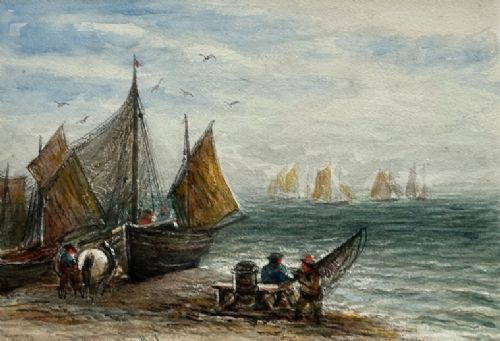
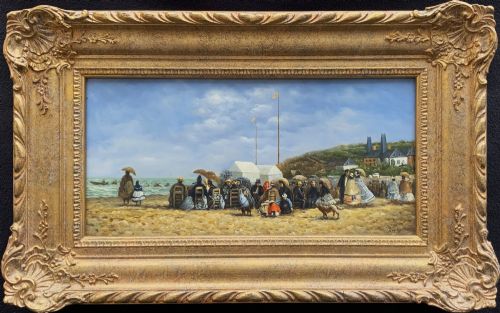
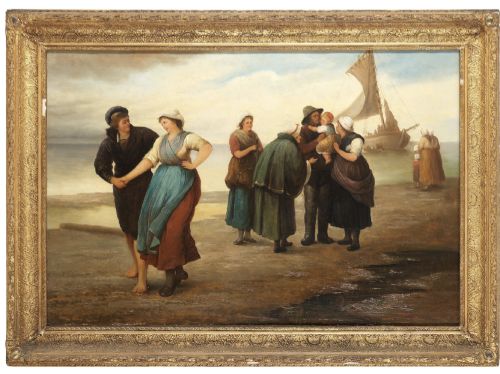
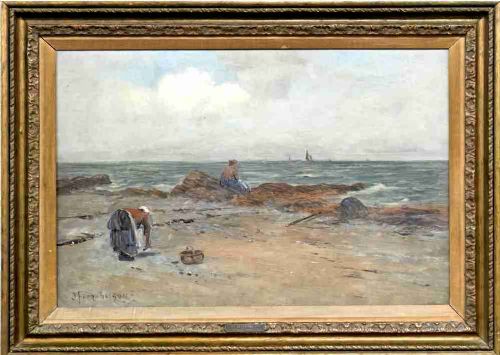
A framed beach scene on this page typically presents a coastal view, harbour, or shore captured in oil paint or watercolour. Buyers encounter works ranging from 19th-century Victorian marine watercolours to mid-20th-century impressionist beach scenes.
The subjects span traditional British coastal locations such as St Ives, Whitby, and Brighton, alongside French and Scottish marine landscapes. These pieces record maritime activity, including fishing boats, kelp gatherers, and children playing on the sand.
Most selections feature period framing in wood or gold leaf, occasionally with hand-enamelled polychrome or ebonised details. The visual styles encompass British Impressionism, Post-Impressionism, and the Hague School.
How They Were Made
Artists painted these coastal subjects primarily using oil paint on canvas or board, and watercolour on paper, utilising the materials available to their respective periods. Oil pigments provided depth and texture for turbulent seas and heavy skies, whilst watercolour allowed for luminous, transparent washes of light on coastal sand.
The physical presentation relied on traditional joinery techniques for wooden frames, frequently finished with applied gold leaf or gilding to complement the artwork. Glazed watercolours required protective glass alongside paper supports, whereas oil paintings on canvas were stretched over wooden frames and secured within heavier decorative housings.
Several artists clearly preferred getting salt spray on their boots while recording hardworking fisher folk at low tide.
What Varies in Quality
The calibre of a framed beach scene rests on the artist's handling of light, atmospheric perspective, and the fluidity of brushwork or wash. Works by established painters demonstrate a confident grasp of coastal topography and human figures, whereas lesser examples show stiffer compositions and weaker tonal contrast.
Material preservation also sets works apart, particularly the original condition of the canvas, paper support, and the accompanying giltwood or wooden frame. Pieces retaining their period frames and stable paint surfaces without extensive restoration represent the higher end of the range.
James Orrock·William Banks Fortescue·Joseph Farquharson·George Morland·George Hamilton Constantine·James Webb·Sir William Russell Flint·Frederick William Hattersley·Ernest F. Hill·Sir David Murray·Jeffrey Pratt·William Shayer·Owen Bowen·Robert Macaulay Stevenson·Madeline Hughes·William Greaves·William Edward Webb·George Smith·GM de L'Aubiniere·Daniel Sherrin·Yves Brayer·Markey Robinson·Charles McAuley·Thomas Bush Hardy
The Framed Beach Scene Glossary
- Watercolour
- A painting method where fine pigment is suspended in a water-soluble binder and applied to paper. This medium creates translucent washes suited to capturing shifting coastal light.
- Oil on Canvas
- A technique utilising pigments bound in drying oil applied to a stretched woven fabric support. This combination permits thick impasto texture and deep colour saturation.
- Giltwood
- Wood carved and coated with a thin layer of gold leaf or gold powder. It frequently surrounds 18th- and 19th-century paintings to enhance their visual weight.
- Impressionism
- An art style focused on the accurate depiction of light and its shifting qualities. Practitioners often employed visible brushstrokes and open compositions.
- Marine Landscape
- A genre of art depicting the sea, ships, and coastal views. These works document maritime trade, fishing communities, and coastal weather.
Framed Beach Scene: Frequently Asked Questions
How do I date an old beach painting?
Dating relies on stylistic clues, framing methods, and artist signatures recorded in the listing details.
Victorian pieces often display heavier giltwood frames and traditional academic realism, while 20th-century examples tend toward impressionist brushwork.
Where should I hang a coastal artwork?
These pieces suit living rooms, studies, or hallways where natural light can illuminate the brushwork.
Keep watercolours away from direct sunlight to prevent fading of the paper supports.
What is the difference between oil and watercolour?
Oils use pigment suspended in drying oil on canvas or board, offering rich textures and deep tones.
Watercolours use water-soluble pigments on paper under glass, producing a lighter, more transparent finish.
Are these works original or prints?
The inventory consists primarily of original hand-painted works in oil and watercolour, alongside occasional signed prints.
Checking the medium listed helps confirm whether a piece is a unique painting.