

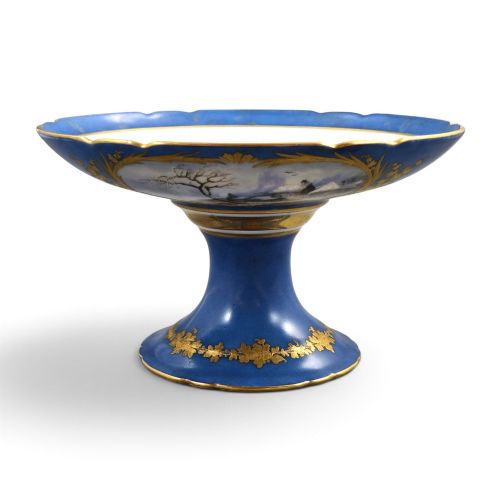
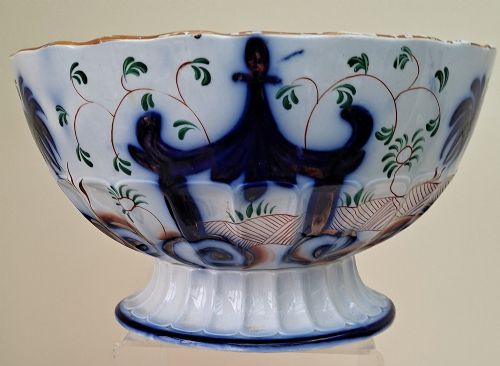
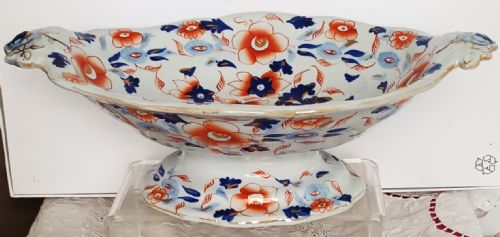


Footed Porcelain Fruit Bowl
A footed porcelain fruit bowl brings architectural height to a table, offering a pedestal for fruit or floral arrangements across Georgian to Edwardian periods.
Footed Porcelain Fruit Bowl
A footed porcelain fruit bowl elevates fruit or decorative arrangements above the surface of a table, using pedestals, bases, or raised feet to create height. These pieces appear in forms such as comports, tazzas, centrepieces, and pedestal bowls spanning Georgian, Victorian, and Edwardian eras.
The versions most commonly met on this page include nineteenth-century English ironstone and earthenware comports, French porcelain basket bowls, and decorated Victorian examples. Makers such as Ridgway, Wedgwood, Mason's, and Royal Worcester shape the range of styles from blue and white transferware to Rococo Revival and French Empire aesthetics.
Objects catalogued under this heading serve as decorative bowls or centrepieces, utilising glazes, enamel, and gilding. The forms bridge functional tableware and ornamental displays, incorporating applied figures or lattice work.
Materials and production
Production relies on porcelain, ironstone, and earthenware shaped into bowls and raised on feet or pedestals. Kiln-fired bodies receive glazes and enamel painting before secondary firings for gilding or gold leaf.
Techniques range from blue and white transfer printing to hand-painted enamel and applied three-dimensional elements such as roses and putti. Gilt bronze mounts occasionally combine with porcelain bodies to support the elevated structure.
Footed Porcelain Fruit Bowl Retail Price Guide 2026
Typical asking prices for footed porcelain fruit bowl among the pieces listed under this phrase on Sellingantiques today, from the lower quarter to the upper quarter. They describe what is for sale here now, not the wider market.
Listings feature 19th-century, Georgian, and Victorian pieces alongside Edwardian examples, constructed from porcelain, ironstone, and earthenware.
Factors of quality
Quality rests in the precision of the porcelain body, the crispness of moulded or applied details, and the execution of hand-painted enamels or gilding. Pieces featuring intricate hand-modelling, such as applied flowers and figures, demonstrate greater sculptural ambition than standard transfer-printed wares.
The integration of the foot or pedestal with the bowl body affects the balance and proportion of the piece. Superior examples maintain clean lines in the glaze and precise registration in patterns like Japan or Pagoda.
Sèvres·Ridgway·Schierholz Plaue·Mason·Wedgwood·Royal Worcester·Samson
The Footed Porcelain Fruit Bowl Glossary
- Comport
- A raised dish or bowl used for serving fruit or sweetmeats at the table. These pedestal vessels sit higher than standard bowls.
- Tazza
- A shallow saucer-like dish mounted on a stem and foot. This Italian-derived form functions similarly to a footed comport.
- Ironstone
- A type of durable earthenware patented in the nineteenth century. It bridges the gap between refined porcelain and heavy pottery.
- Gilding
- The application of gold leaf or gold powder to the surface of porcelain. This decorative layer highlights rims, handles, and pedestal bases.
- Transferware
- Pottery or porcelain decorated by printing a design from an engraved copper plate onto tissue paper, then transferring it to the ceramic body before glazing.
Footed Porcelain Fruit Bowl: Frequently Asked Questions
What is a footed fruit bowl used for?
These bowls provide an elevated vessel for holding fruit, floral arrangements, or sweetmeats on a dining table or sideboard. Their raised form creates height and visual focus in a room.
Historically, they served practical functions during formal meals for display and service. Today, they remain decorative centrepieces that showcase ceramic artistry and period design.
How do I date a porcelain bowl?
Dating relies on maker marks, ceramic bodies, and stylistic indicators such as transfer-print patterns or applied decorative motifs. Nineteenth-century pieces often display specific ironstone stamps or hand-painted factory signatures.
Comparing the glaze texture and painting technique against known production periods helps narrow the manufacturing era. Georgian, Victorian, and Edwardian pieces each carry distinct aesthetic markers.
How do I care for antique porcelain?
Antique porcelain requires gentle hand washing in lukewarm water using mild soap, avoiding abrasive scrubbers that damage gilding and enamel. Sudden temperature changes should be avoided to prevent thermal shock.
Displaying bowls away from direct sunlight and handling them by the main body rather than delicate handles or feet ensures long-term preservation.