
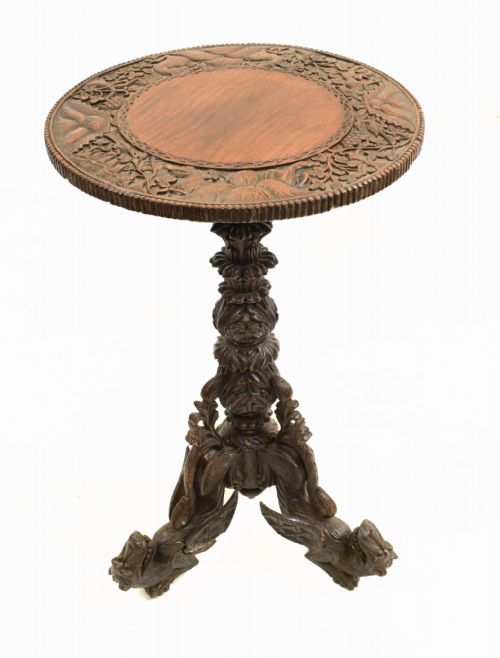
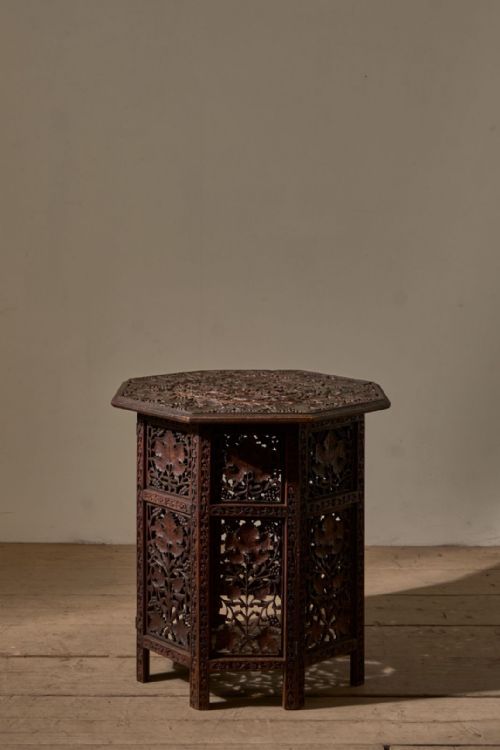


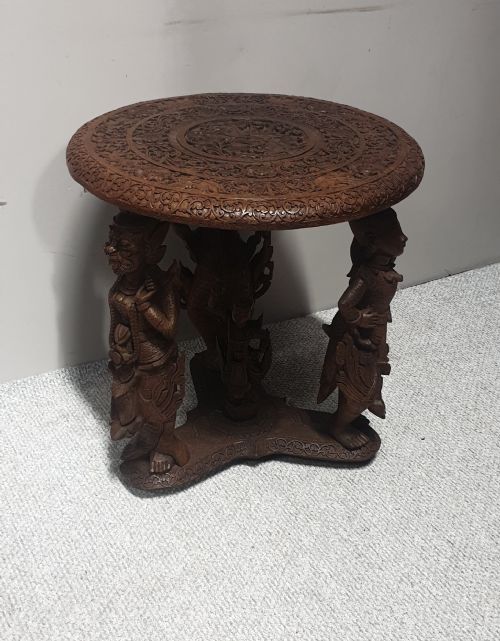

Foliate Carved Occasional Table
A foliate carved occasional table brings intricate craftsmanship into a room, offering surface space through deeply chiselled floral motifs.
Foliate Carved Occasional Table
A foliate carved occasional table is a small, moveable piece of furniture defined by its surface decoration of leaves, foliage, and natural motifs. These tables appear frequently as side tables, window tables, or tip-top designs originating from Anglo-Indian, Anglo-Burmese, and Victorian workshops.
The pieces seen here span from the nineteenth century into the early twentieth century, including examples in teak, rosewood, padauk, and hardwood. Buyers most often encounter side tables and occasional tables featuring brass inlay or bone inlay alongside dense hand-carving.
Origins vary across regional traditions, encompassing Anglo-Indian Colonial styles, Burmese craftsmanship, and Victorian interpretations. Each form serves as a compact surface for lamps, drinks, or display while showcasing the sculptural capabilities of exotic timbers.
How they were made
Cabinetmakers and carvers utilised dense tropical hardwoods such as teak, padauk, and rosewood, which provided the structural stability required for deep relief carving. These timbers were worked by hand to create intricate foliage patterns that cover tops, aprons, and supports.
Certain examples incorporate contrasting materials, inserting brass wire or bone inlay directly into the wooden ground to delineate geometric and botanical borders. Folding mechanisms and collapsible frames appear in campaign and occasional formats, relying on precise joinery rather than permanent fixtures.
Listings feature woods including teak, rosewood, padauk, and hardwood, spanning the nineteenth and early twentieth centuries.
What varies in quality
Quality rests in the depth, crispness, and continuity of the hand-carving across the surface. Superior examples display undercut foliage and sharply defined leaf motifs that retain their geometric symmetry without softening.
The selection and stability of the timber also separate pieces, particularly where dense padauk or figured rosewood has been joined with tight, enduring tolerances. Inlaid elements demonstrate skill through precise fitting into the wood grain rather than simple surface adherence.
The Foliate Carved Occasional Table Glossary
- Foliate
- Decorated with leaves, foliage, and plant motifs. This style of carving defines the surface ornamentation of these tables.
- Occasional table
- A small, moveable table designed for general use in a room. These pieces function as side stands, tea tables, or lamp supports.
- Padauk
- A heavy, durable tropical hardwood with a reddish hue. Cabinetmakers utilised this timber for its strength and rich grain.
- Tip-top table
- A table with a hinged top that pivots to a vertical position for storage. This mechanism allows the piece to be tucked against a wall when not in use.
- Campaign table
- Portable furniture designed for travel and easy dismantling. These pieces often feature collapsible frames or removable tops.
Foliate Carved Occasional Table: Frequently Asked Questions
What is a foliate carved occasional table?
It is a small, moveable wooden table decorated with carved leaf and plant motifs. These pieces function as side tables or display stands.
Most examples originate from nineteenth-century Anglo-Indian or Burmese traditions, utilising dense hardwoods like teak and rosewood.
How were these tables used originally?
They served as flexible surface furniture in sitting rooms and parlours for lamps, books, or tea service. Their moveable nature allowed them to be placed wherever needed.
Some portable campaign versions were built to be folded or dismantled for transport during travel.
How do I care for a hardwood table?
Keep the wood conditioned with appropriate furniture wax and avoid placing the piece near direct heat sources or strong sunlight. Dust the carved recesses gently with a soft brush.
Protect the surface from moisture by using coasters beneath glasses or plant pots.
How do I tell the periods apart?
Nineteenth-century examples often display deeper relief carving and heavier tropical timbers like padauk or rosewood. Pieces from the early twentieth century may show transitional forms or simpler construction.
Inlay materials such as bone or brass also help indicate regional workshops and stylistic periods.