



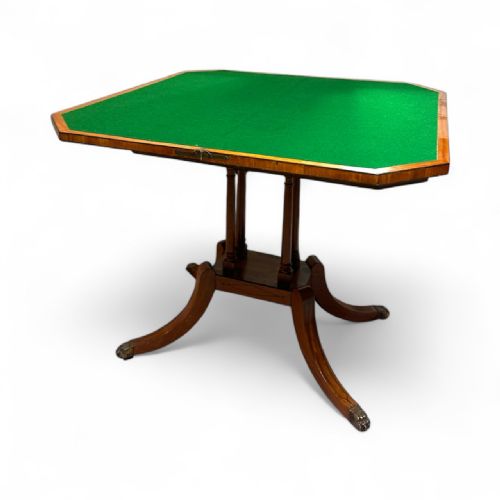


Folding Baize Card Table
A folding baize card table brings the rich social rituals of past centuries directly into a modern room.
Folding Baize Card Table
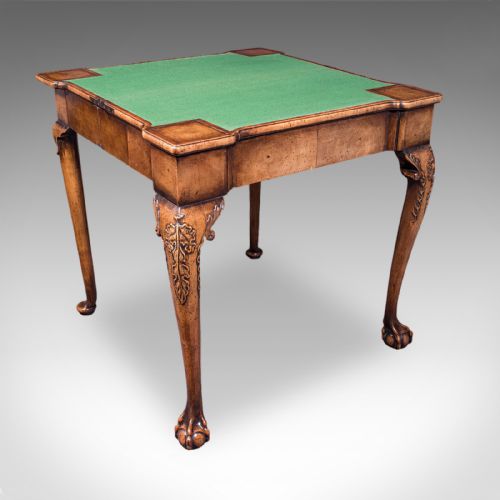
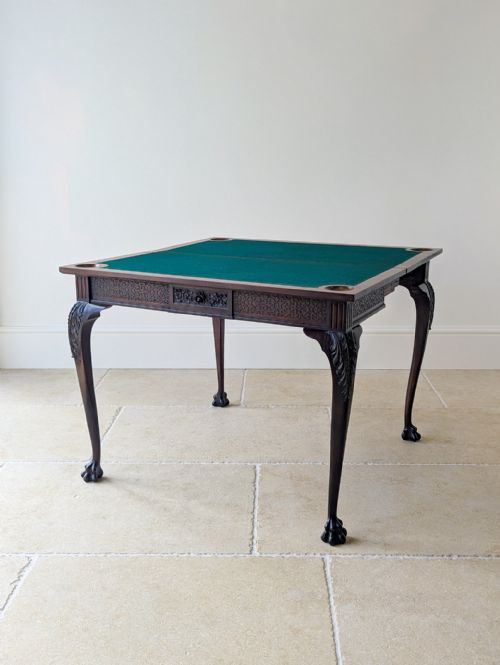
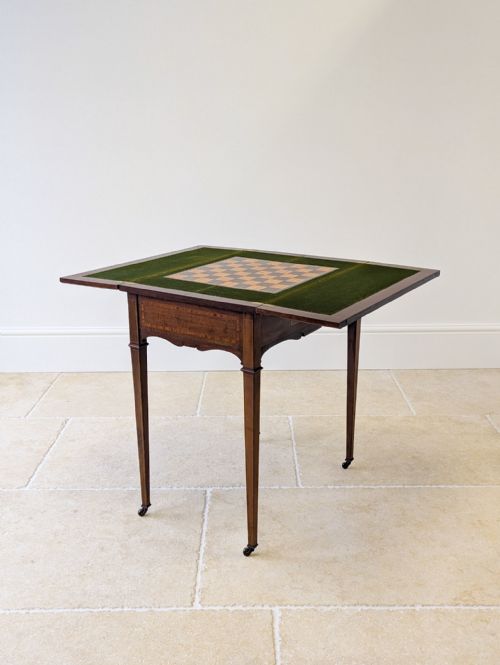
A folding baize card table provides a clever surface designed specifically for gaming and social evenings, featuring a textile lining that protected counters and cards. These pieces emerge across Georgian, Regency, William IV, Victorian, and Edwardian periods, demonstrating how domestic entertainment evolved across generations.
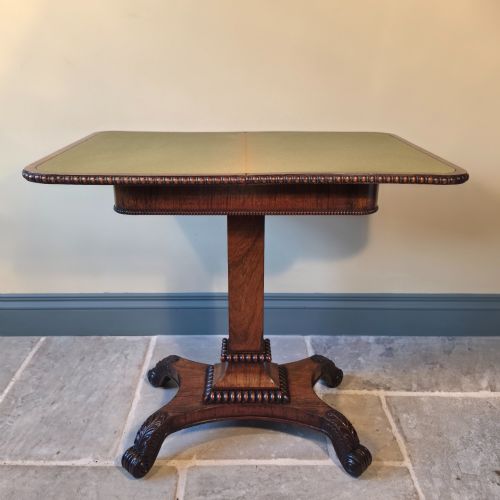
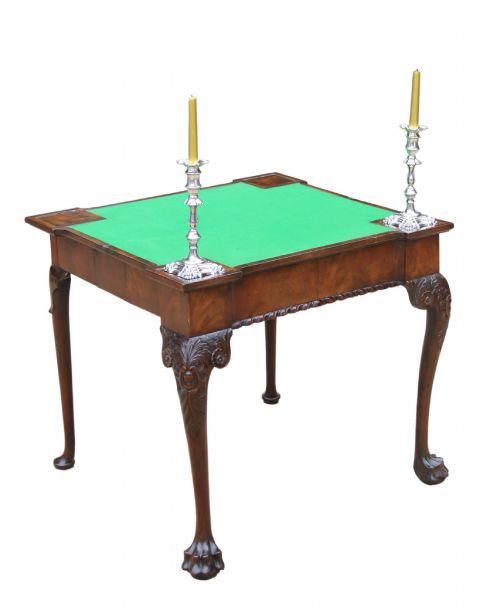
The most common examples on this page are mahogany and rosewood fold-over designs from the Georgian and Victorian eras. Buyers also encounter specialist forms like envelope tables with rotating leaves, demi-lune consoles, and concertina action tables.
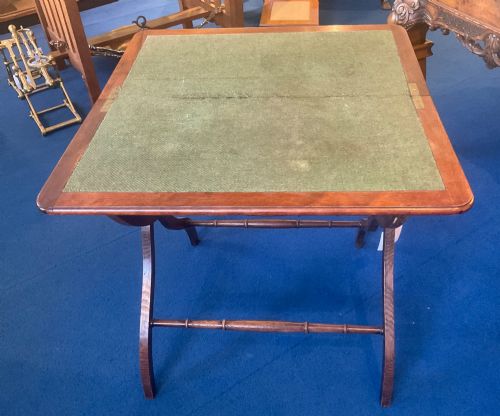
Makers utilised various timbers including walnut, satinwood, and burr walnut, often pairing them with brass accents and intricate inlay work. Alongside dedicated games tables, occasional forms and tea trolleys occasionally appear with the signature baize lining.
Assessing Craftsmanship and Materials
Superior examples distinguish themselves through the selection of finely figured timbers and the precision of internal pivoting or concertina actions that support the open leaf. Finer pieces demonstrate seamless joint work where the folded top aligns perfectly with the frieze.
The quality of secondary details, such as hand-tooled borders on the wool baize, parcel gilt highlights, and intricate brass hardware, separates standard production from exceptional cabinet work. Proportion and balance in the pedestal or leg supports also dictate the overall refinement of the piece.
Card tables had to keep secrets: hidden wells and clever pivoting leaves stored counters safely away until the stakes were raised.
James Shoolbred & Co.·Gillows·Lamb of Manchester·Edwards & Roberts
The Folding Baize Card Table Glossary
- Baize
- A coarse woollen material resembling felt, traditionally used to line the playing surfaces of gaming furniture. This textile provided a soft, non-slip area that dampened the sound of rolling dice and protected delicate wooden counters.
- Concertina action
- An ingenious frame mechanism that expands when the table top unfolds, providing four matching legs to support the open leaf evenly. This engineering feat is typically found on earlier Georgian tables.
- Demi-lune
- A half-moon shape used for table tops and console bases, allowing the closed furniture to sit flat against a wall. When opened out, these semi-circular surfaces form a complete round or oval playing area.
- Envelope table
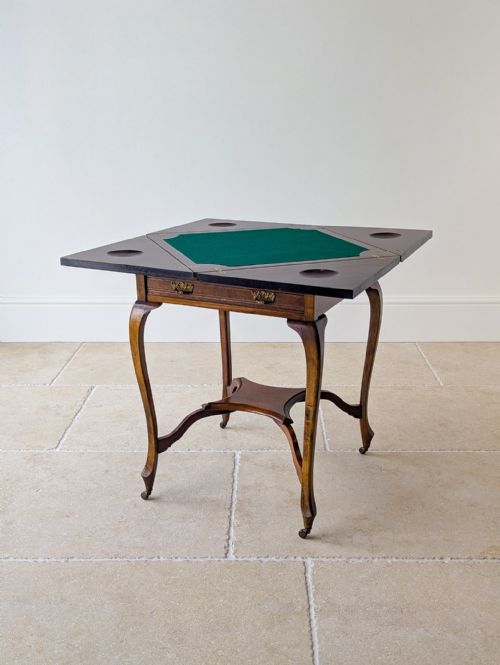
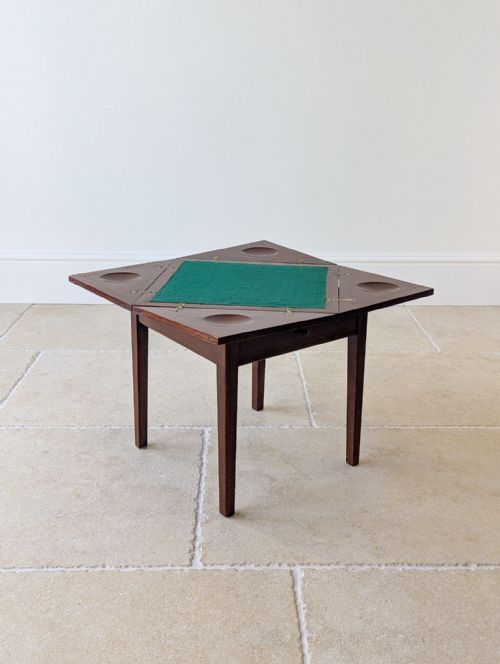
- A square card table design featuring four triangular flaps that rotate and fold outwards simultaneously like an envelope. This clever mechanism reveals a baize-lined interior surface often accompanied by small corner wells.
- Parcel gilt
- A decorative technique where specific carved details or mouldings are selectively covered in thin gold leaf. It highlights particular architectural elements against a dark wood or ebonised background.
Folding Baize Card Table: Frequently Asked Questions
How do I use a folding baize card table today?
These tables function brilliantly as occasional or console furniture against a wall when closed, expanding readily when guests gather for board games or card evenings. Their compact closed footprint suits modern living spaces while retaining historical charm.
Care should be taken to protect the wool baize surface from sharp objects and excessive moisture. Using coasters and gentle cleaning methods preserves the original textile.
How do I tell a Georgian card table from a Victorian one?
Georgian tables often feature cleaner architectural lines, plain or carved mahogany timber, and sophisticated mechanisms like the concertina action to support the open leaf. They tend to reflect classical proportions and restrained ornamentation.
Victorian pieces frequently embrace darker woods, burr walnut veneers, inlaid marquetry, and heavier pedestal or cabriole leg designs. The manufacturing methods also shift towards mass workshop production during the later nineteenth century.
What is an envelope card table?
An envelope table is an ingenious Edwardian form where the top consists of four triangular leaves that pivot outward from a central point. As one leaf is lifted, the others automatically follow to form a square baize-lined surface.
These tables often include small wells in the corners for holding counters or coins during play. Their clever mechanical action makes them fascinating examples of late period furniture design.
Can I replace the baize on an antique card table?
Replacing worn fabric is a common conservation step, though many collectors value surviving original cloth even if it shows signs of age. Professional restorers can source traditional wool baize matching historical weights and colours.
When replacement is necessary, matching the texture and fastening method used in the original period helps maintain the historical integrity of the interior well.