
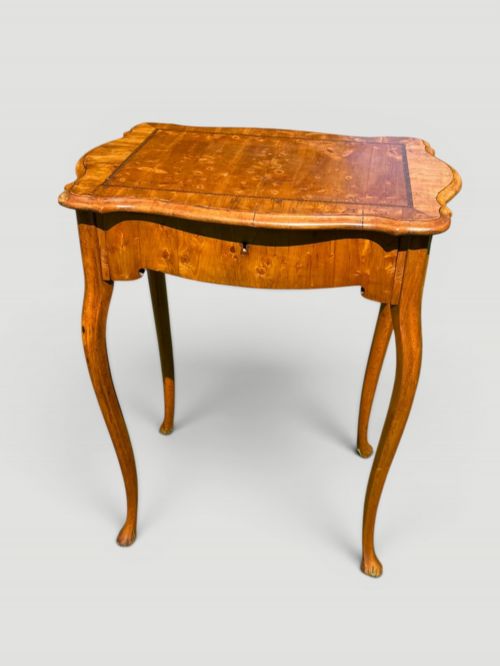


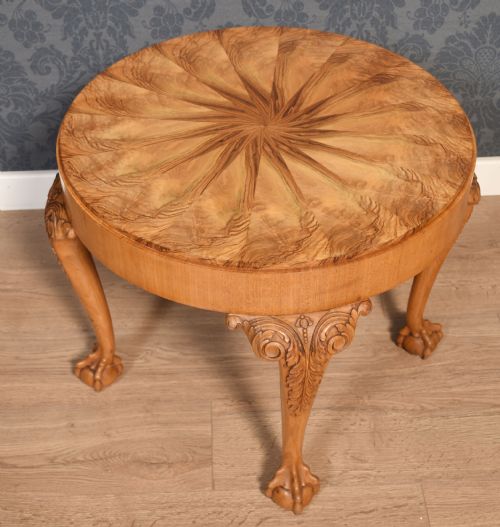


Walnut Veneer Tea Table
These walnut veneer tea tables bring rich, figured grain and functional folding tops straight into a sitting room.
Walnut Veneer Tea Table
A walnut veneer tea table sits among a diverse selection of occasional, coffee, side, and games tables spanning the nineteenth and early twentieth centuries. These pieces appear in styles ranging from Georgian and Queen Anne revivals to Art Deco designs.
The nineteenth-century examples include demi-lune folding card tables with games drawers alongside burr wood tripod tables. Twentieth-century pieces lean towards low coffee tables and occasional tables utilising burr walnut veneers.
How they were made
Cabinet makers applied thin sheets of walnut and burr walnut veneer over solid timber foundations to create striking decorative patterns on the top surfaces. Burr maple and mahogany also appear as supporting materials in the construction of these tables.
Joinery techniques matched the period, from nineteenth-century folding mechanisms on card tables to the clean, geometric lines found on Art Deco coffee tables from the nineteen-twenties and nineteen-thirties.
Card tables often conceal secret games drawers beneath their folding tops, ready for an impromptu evening of whist.
What varies in quality
The visual impact depends largely on the choice of timber, with highly figured burr walnut veneer commanding attention through intricate grain patterns. Plain walnut veneers offer a more subdued appearance.
Execution of revival styles or Art Deco geometry dictates the elegance of the silhouette. Tables that retain their original folding mechanisms and operational games drawers demonstrate superior functional preservation.
The Walnut Veneer Tea Table Glossary
- Burr walnut
- A prized wood harvested from walnut tree growths, producing swirling, knotty grain patterns used for decorative veneer. It adds depth and texture to table surfaces.
- Demi-lune
- A half-moon shape characteristic of certain card and side tables designed to sit flat against a wall. These often feature folding tops.
- Veneer
- A thin layer of fine wood applied over a base timber to give the appearance of solid costly material. This technique allowed cabinet makers to display dramatic grain patterns.
- Tripod table
- A small freestanding table supported by a central pillar resting on three legs. Nineteenth-century examples often tilt for storage.
Walnut Veneer Tea Table: Frequently Asked Questions
How do I use a folding card table?
These tables feature tops that unfold to reveal a larger surface, often supported by a swing leg or internal mechanism. They were traditionally used for evening card games.
Today, you can keep them folded against a wall as an occasional table and open them fully when hosting guests or needing extra surface space.
Are these tables sturdy enough for daily use?
Most occasional and coffee tables from the nineteenth and early twentieth centuries handle everyday placement of cups and books easily. Care should be taken with folding mechanisms on older card tables.
Placing coasters on the veneer protects the polished surface from moisture rings and heat marks over time.
How do I tell Art Deco from Georgian revival?
Art Deco pieces from the nineteen-twenties and thirties favour streamlined geometric shapes and unadorned burr walnut surfaces. They reflect a modern aesthetic.
Georgian revival tables draw on eighteenth-century vocabulary, often incorporating cabriole legs or traditional bracket details that mimic earlier eras.
What is the difference between burr walnut and plain walnut?
Burr walnut comes from the gnarled outgrowth of a tree, creating dense, swirling clusters of knots in the grain. It provides a highly decorative finish.
Plain walnut displays a straighter, more uniform grain pattern without the intense optical movement characteristic of burr variations.