
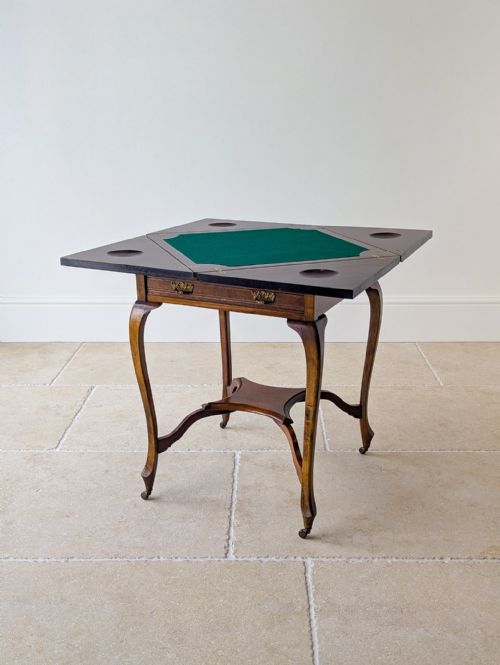
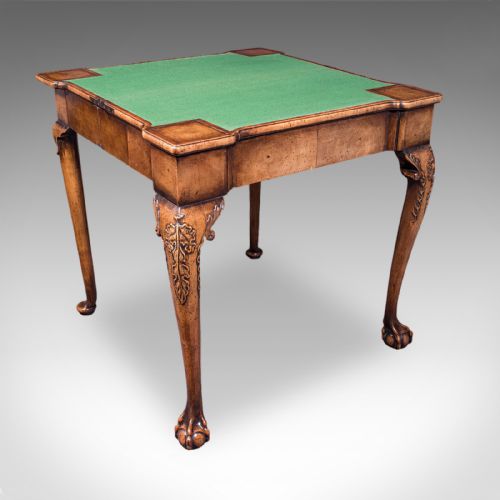
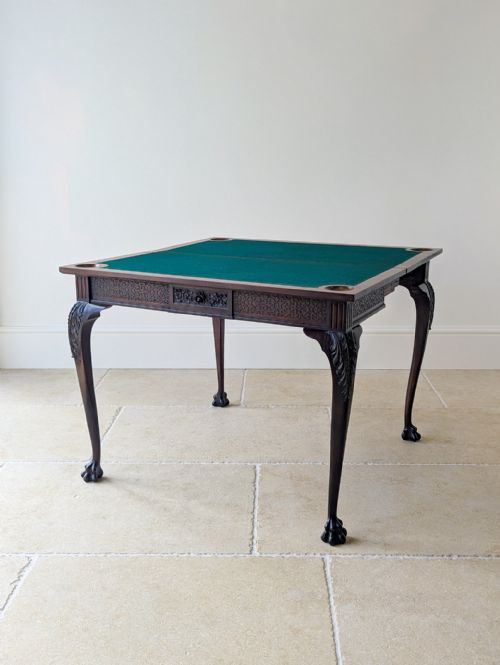

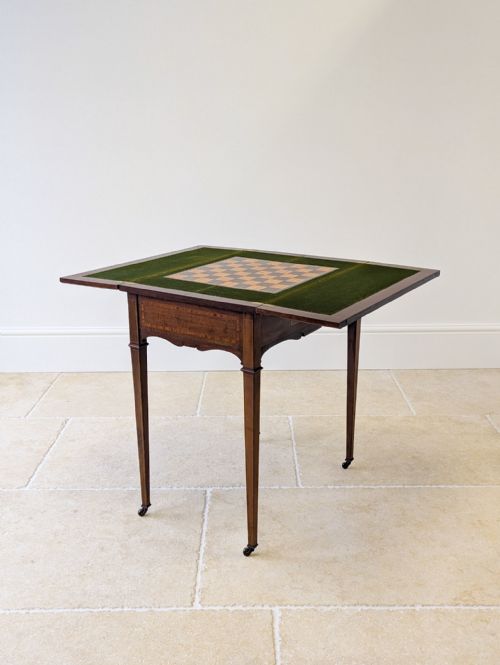
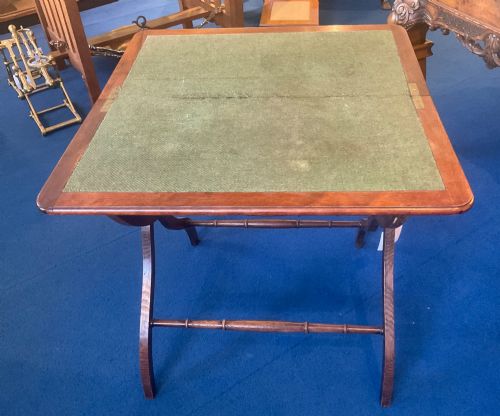


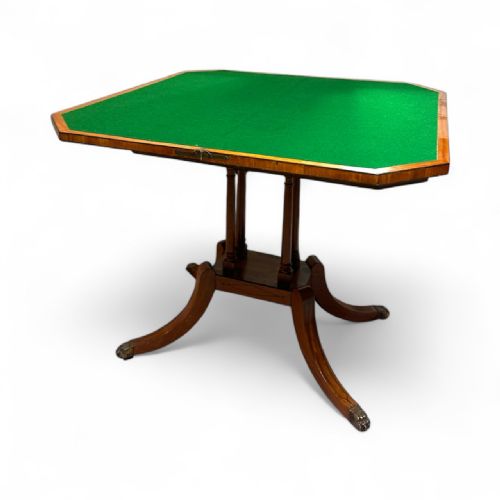


Green Baize Games Table
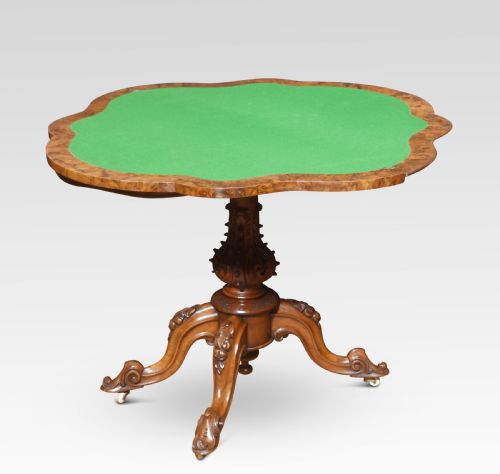
A green baize games table is a dedicated piece for cards and board play, offering a folding surface lined with wool baize that brings period craft directly into the modern room.
Green Baize Games Table
A green baize games table arrives in forms ranging from envelope card tables and fold-over bridge tables to concertina action models and gaming tables. These pieces span the Georgian, Regency, William IV, Victorian, and Edwardian periods, alongside specific dates from the eighteenth and nineteenth centuries.
The most common examples on this page are mahogany and walnut fold-over card tables from the Victorian and Edwardian eras. Makers and workshops such as James Shoolbred & Co., Edwards & Roberts, and Lamb of Manchester appear among these domestic forms.
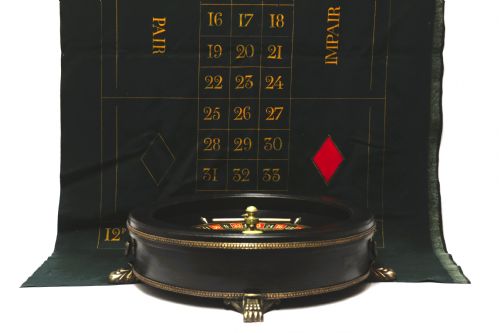
Alongside standard English card tables, the selection includes occasional gaming tables, French roulette wheels with original felt cloths, and triangular bentwood pieces by Thonet. These accommodate various pastimes, from chess and cards to general gaming antiques.
Materials and construction
Cabinet makers utilised dense timber foundations of mahogany, walnut, rosewood, and satinwood, frequently applying burr walnut veneer, amboyna, or ebonised wood surfaces. Parcel gilt details and mother of pearl inlay appear on select papier mâché examples.
Surfaces feature wool baize or felt linings inset into the folding or revolving tops. Supporting structures rely on concertina actions, folding mechanisms, and solid turning to manage the weight of the timber leaves.
Materials recorded across these tables include mahogany, walnut, rosewood, satinwood, amboyna, ebonised wood, and wool baize.
Quality variations
The calibre of a piece rests on the selection of timber veneers and the crispness of inlaid details, such as satinwood banding or mother of pearl. Superior examples display precise grain matching across the fold-over leaves.
Mechanical execution separates standard production from finer workshop output, particularly in the smoothness of concertina actions and envelope opening mechanisms. The integration of the wool baize lining within the wooden rebate dictates the overall finish.
James Shoolbred & Co.·Edwards & Roberts·Thonet·Lamb of Manchester
The Green Baize Games Table Glossary
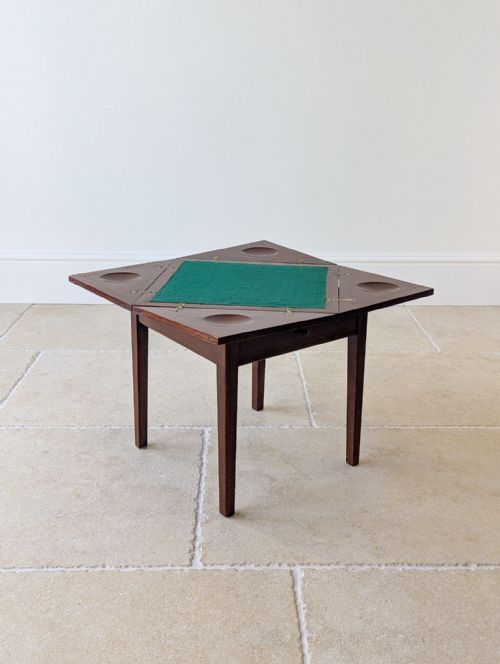
- Envelope card table
- A square table with four triangular flaps that rotate and fold open simultaneously to reveal a baize-lined playing surface. This design gained popularity during the Edwardian period.
- Concertina action
- An expanding frame mechanism that allows a card table to pull out evenly from a console position to support a double leaf top. This construction is typical of eighteenth-century English mahogany pieces.
- Demi-lune
- A half-moon shape utilised for folding card tables designed to stand flat against a wall when closed. The top unfolds to form a full circle for play.
- Baize
- A coarse woollen fabric, traditionally dyed green, used to line the playing surfaces of gaming furniture. It provides a smooth texture for dealing cards.
- Parquetry
- Geometric mosaic woodwork patterns applied as a veneer to tabletops. Makers utilised contrasting timbers to create decorative surfaces.
Green Baize Games Table: Frequently Asked Questions
What is a green baize games table?
A green baize games table is a piece of antique furniture designed specifically for card playing and board games, featuring a folding or rotating top lined with wool baize.
These pieces range from Georgian card tables to Edwardian envelope models, combining domestic utility with period cabinet making.
How do fold-over card tables work?
Fold-over card tables utilise a hinged top that opens out to double the surface area, supported by a swinging rear leg or a concertina frame.
When closed, the table functions as a console or side table against a wall, concealing the baize playing surface entirely.
How do I identify a Georgian games table?
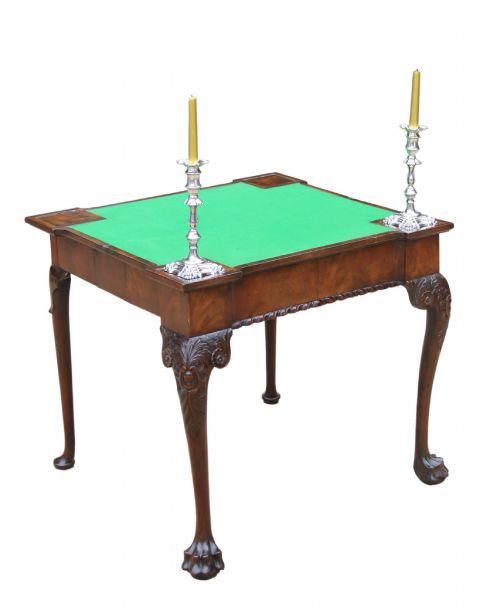
Georgian games tables typically feature solid mahogany or rosewood construction, crisp carved details such as ball and claw feet, and concertina extension actions.
They date from the eighteenth century through the Regency era, displaying restrained proportion and classical joinery techniques.
How do I care for wool baize?
Wool baize requires gentle brushing and protection from direct sunlight to preserve its green colour and texture.
Keep the surface dry and avoid heavy chemical cleaners, utilising professional textile care for any accumulated dust.