


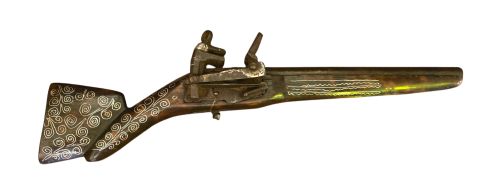


Flintlock Horse Pistol
These flintlock horse pistols are substantial sidearms designed for mounted use, prized for their historical mechanics and period craftsmanship.

Flintlock Horse Pistol
A flintlock horse pistol is a robust firearm developed for cavalry and military service during the seventeenth, eighteenth, and early nineteenth centuries. When searching for a flintlock horse pistol, you encounter examples spanning British military service pieces, Georgian dragoon models, and decorative Balkan or Ottoman variants.
The pieces listed on this page originate predominantly from the eighteenth century and the Napoleonic era, reflecting both British ordnance and continental European production. Common forms include heavy holster pistols, long-barrelled dragoon sidearms, and officer service variants featuring steel and brass furniture.
You are most likely to meet British Tower ordnance pieces alongside regional Ottoman and Italian flintlocks. These items range from plain government-issued service arms with walnut stocks to ornate silver-mounted examples adorned with intricate wire inlay.
Construction and Materials
Makers constructed the stocks of these pistols primarily from walnut or dense wood, often enhancing the grips with carved details or silver wire inlay. Metal components combined forged steel barrels and locks with cast brass or iron furniture.
Locks relied on traditional flintlock mechanisms to generate a spark against the frizzen, while barrels ranged from smoothbore steel to decorated cast bronze and brass. Craftsmen integrated silver mounts, grotesque butt caps, and engraved brass plates to finish higher-status civilian and military pieces.
Flintlock Horse Pistol Retail Price Guide 2026
Typical asking prices for flintlock horse pistol among the pieces listed under this phrase on Sellingantiques today, from the lower quarter to the upper quarter. They describe what is for sale here now, not the wider market.
Styles represented include Georgian military, Ottoman, Balkan, and Napoleonic era service arms alongside British Tower ordnance.
Judging Quality
Quality in these sidearms rests upon the crispness of the lock mechanism, the integrity of the wooden stock, and the precision of the metal engraving. Superior examples retain clear maker signatures, government proof marks, and unpolished furniture that display the original hand-finishing of the period.
The distinction between standard military issue and bespoke officer or civilian pieces dictates much of the variation. Fine London-made arms display balanced proportions and refined silver wire work, whereas service pistols prioritize robust utility and interchangeability of parts.
T. Potts·Thomas Anelli·R. Willoughby·Dumarest·Dutton·Wilson
The Flintlock Horse Pistol Glossary
- Flintlock
- A firearm ignition mechanism that uses a piece of flint held in a cock to strike a steel frizzen, creating sparks to ignite the priming powder. This system dominated personal firearms technology for over two centuries.
- Holster pistol
- A large sidearm designed to be carried in a saddle holster rather than on a belt. These pieces formed standard equipment for cavalrymen and officers on horseback.
- Frizzen
- The vertical steel plate struck by the flint to produce sparks and cover the priming pan. It represents a vital component of the ignition sequence.
- Snaphaunce
- An early type of flintlock mechanism utilising a manually operated pan cover and a separate steel spring. It bridges the transition between wheel-lock and true flintlock systems.
- Dragoon
- A mounted soldier equipped to fight on foot or horseback. Dragoon pistols were scaled appropriately for service use by these troops.
Flintlock Horse Pistol: Frequently Asked Questions
How were flintlock horse pistols used?
These pistols served as primary and secondary firearms for cavalry troopers, officers, and travellers on horseback during close-quarters engagements. Their size and weight suited them for retention in saddle holsters rather than personal belts.
Troopers relied on them when reloading a musket on horseback proved impractical. They delivered a single decisive shot before the user transitioned to a sword or sabre.
What is the difference between dragoon and holster pistols?
Dragoon pistols were built to strict military specifications for government service, featuring robust construction and minimal decoration. They prioritized durability under harsh campaign conditions.
Holster pistols encompass both military and civilian or officer variations. They frequently incorporate finer detailing such as silver mounts, engraved brass furniture, and walnut stocks with intricate wire inlay.
How do I date an eighteenth-century flintlock pistol?
Dating relies on inspecting government proof marks, maker signatures, and stylistic shifts in lock and stock design. Crown stamps and monarchical ciphers like the GR mark provide precise chronological markers for British ordnance.
Barrel shapes, mounting styles, and the evolution of the flintlock cock also help narrow down the period of manufacture. Surviving records and maker directories confirm active working dates.
How should I care for a historic flintlock pistol?
Display or store these pieces in a stable environment away from excess humidity and direct sunlight. Metal surfaces require light, regular application of preservative oil to prevent active corrosion.
Wooden stocks benefit from occasional gentle conditioning to maintain their natural grain. Avoid aggressive cleaning that might remove patination or historic wear.