
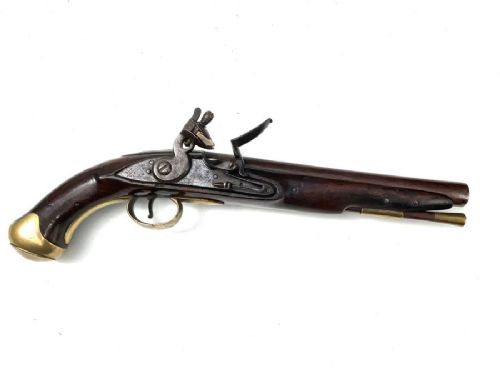


Brass Mounted Flintlock
These brass mounted flintlock pieces are functional firearms and military artefacts combining iron mechanisms with decorative metalwork for collectors of historical weaponry.
Brass Mounted Flintlock
The objects take the form of pocket pistols, heavy dragoon sidearms, regulation cavalry pieces, and longer shoulder arms such as muskets and blunderbusses. British regulation service weapons from makers like Tower sit alongside continental European pieces and Balkan or North African regional variations.
How they were made
Makers constructed stocks from dense timbers such as walnut and general wood, shaping them to house steel lock mechanisms and iron barrels. Metal furniture, including trigger guards, butt caps, and side plates, was cast or beaten from brass.
Many items incorporate additional decorative techniques including silver inlay, bone elements, and mother-of-pearl panels. Lock plates frequently feature engraved details or official workshop stamps.
Brass Mounted Flintlock Retail Price Guide 2026
Typical asking prices for brass mounted flintlock among the pieces listed under this phrase on Sellingantiques today, from the lower quarter to the upper quarter. They describe what is for sale here now, not the wider market.
Some Balkan flintlocks earned the delightful nickname rat-tail due to the distinctive tapering spine forged onto the top of the lock plate.
What varies in quality
Quality separates standard military issue arms from bespoke civilian duelling pieces by renowned gunmakers through the crispness of the lock mechanism and the finesse of the metal engraving. Superior examples display precise stock-to-metal fit and harmonious proportions.
The grade of enrichment also divides the range, moving from plain service brass furniture to deeply engraved mounts, elaborate silver wire inlay, and the integration of scarce materials like mother-of-pearl.
HARRISON OF LONDON·Henry Nock·Sargant and Son·Thomas Henshaw·Thomas Anelli·I Parr
The Brass Mounted Flintlock Glossary
- Flintlock
- A firearm ignition mechanism that uses a piece of flint held in a cock to strike a steel frizzen, creating sparks to ignite the priming powder. This system dominated military and civilian arms for over two centuries.
- Mounts
- Metal fittings such as trigger guards, side plates, and butt caps attached to the wooden stock of a firearm. On these pieces, they are characteristically cast or formed from brass.
- Snaphaunce
- An early type of flintlock mechanism preceding the standard French lock, featuring a separately moving frizzen and priming pan cover. It appears frequently on seventeenth-century and Balkan regional arms.
- Turn-off barrel
- A barrel designed to be unscrewed from the breech for easier loading, commonly found on eighteenth-century Queen Anne pocket pistols. This design eliminates the need for a ramrod.
- Miquelet
- A form of flintlock mechanism utilising an external mainspring and a combined steel and pan cover, widely used in Spain, Italy, and Ottoman territories. It provides a robust ignition system suited to harsh environments.
Brass Mounted Flintlock: Frequently Asked Questions
How do these flintlocks work?
The mechanism relies on a piece of chipped flint clamped in the jaws of the cock. When the trigger is pulled, the cock falls sharply against the vertical steel frizzen, generating sparks that drop into the priming pan.
The resulting flash travels through a small vent hole into the barrel breech, igniting the main gunpowder charge and propelling the lead ball forward.
Were these used in the military?
Many examples served as official regulation arms for cavalry troopers, infantrymen, and naval personnel during the Georgian and Napoleonic conflicts. Government contracts required standard specifications, often marked with crown inspection stamps.
Other pieces were privately purchased by officers or civilians for personal defence, travel, and dueling, lacking military acceptance marks but displaying finer decorative work.
How do I date an antique piece?
Dating relies on maker signatures, proof marks, barrel styles, and the evolution of the lock mechanism and brass furniture shapes. Official military contracts stamped with royal cyphers provide precise periods of manufacture.
Stylistic shifts in woodwork, such as the transition from full-stocked martial arms to lighter pocket configurations, also help narrow down the decade of production.
How should I care for wood and metal?
Keep the pieces in a stable environment away from excessive humidity and direct sunlight to prevent the walnut stocks from drying out or cracking. Light application of museum-grade wax helps protect the wood surface.
Metal parts require only a very thin coating of neutral oil to prevent active oxidation while preserving the historical patina on the brass mounts and steel locks.