

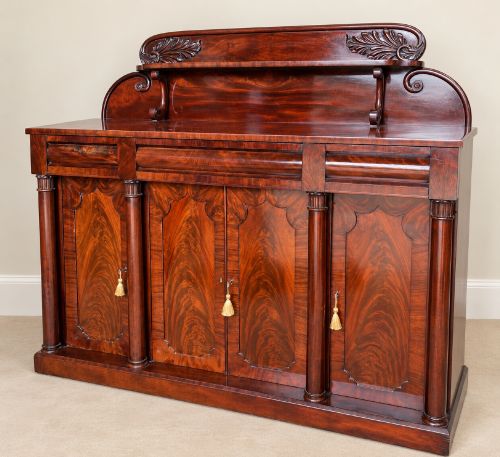
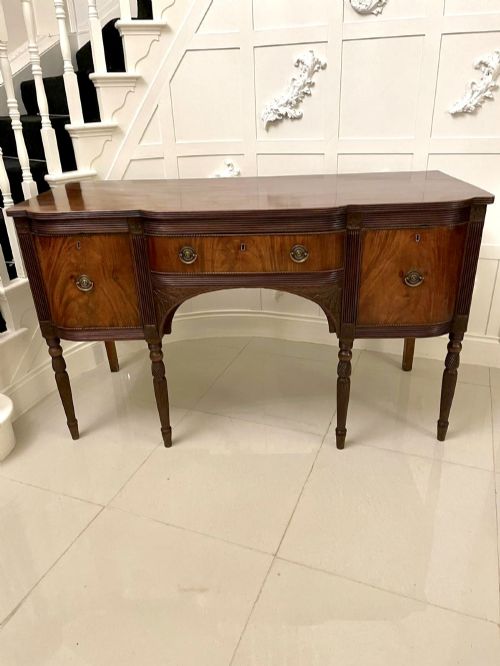
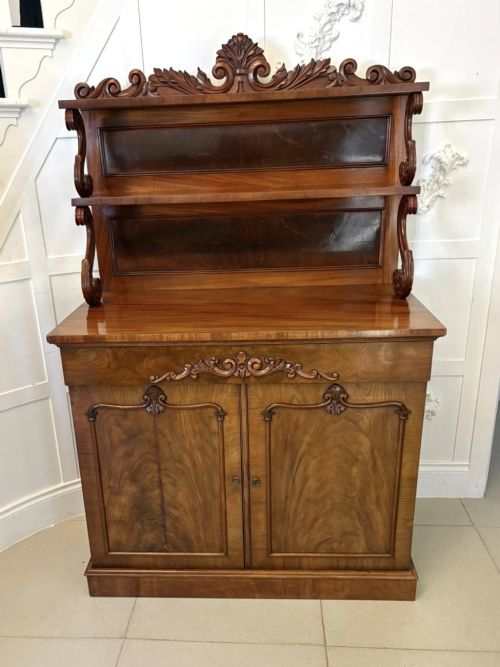
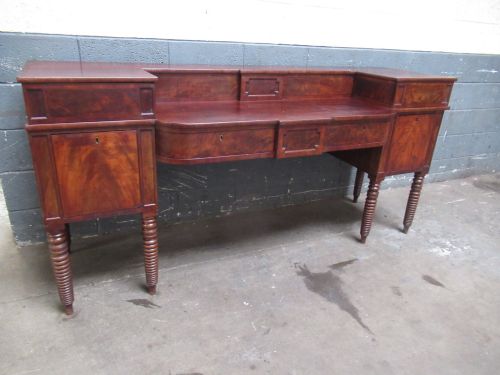
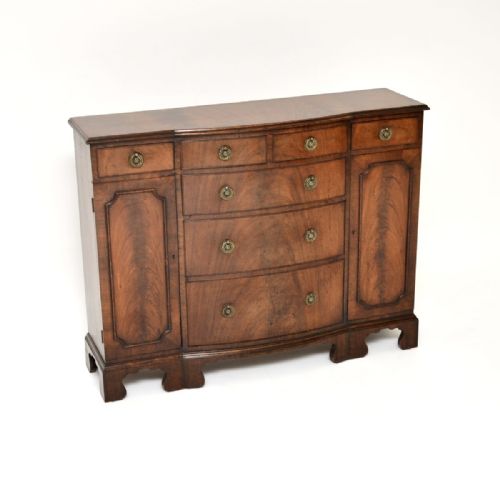
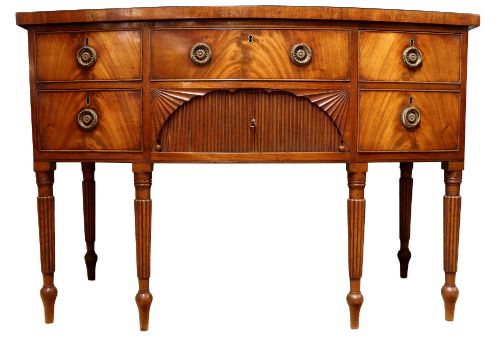
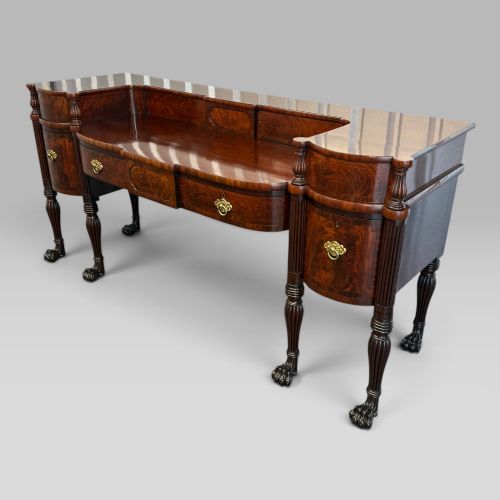
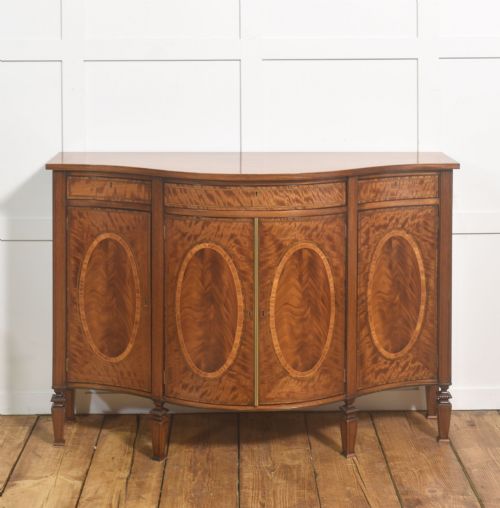
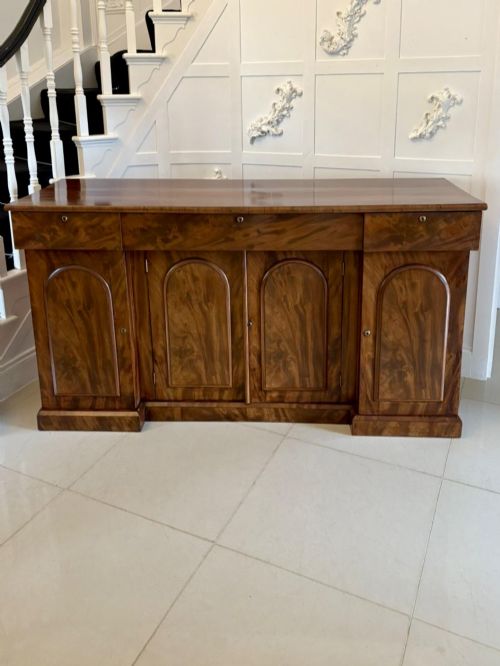
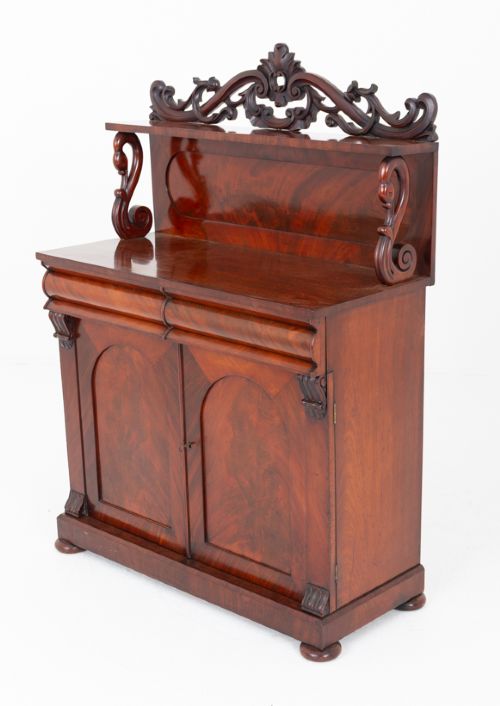
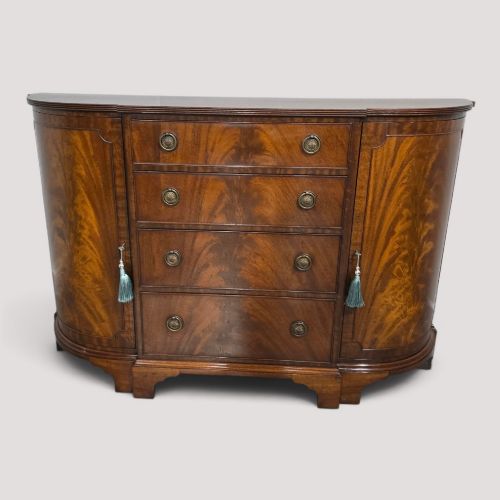
Flame Mahogany Sideboard Server
A flame mahogany sideboard server brings striking wood grain and deep British craftsmanship to a dining room or hallway.
Flame Mahogany Sideboard Server
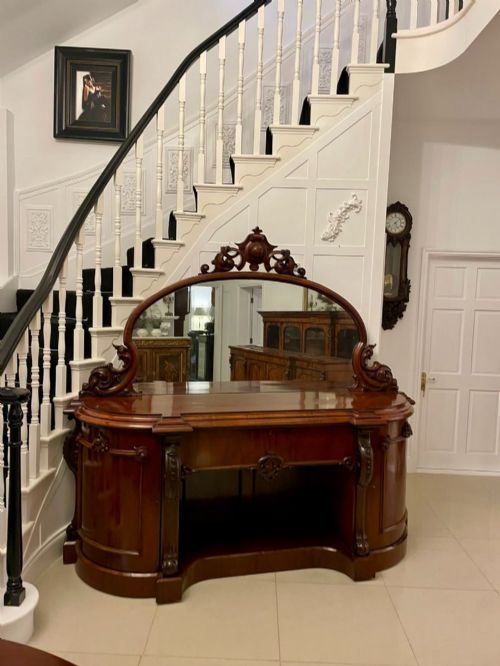
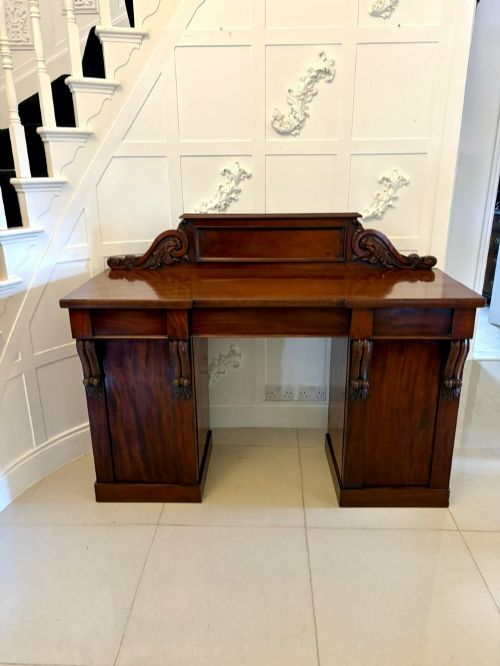
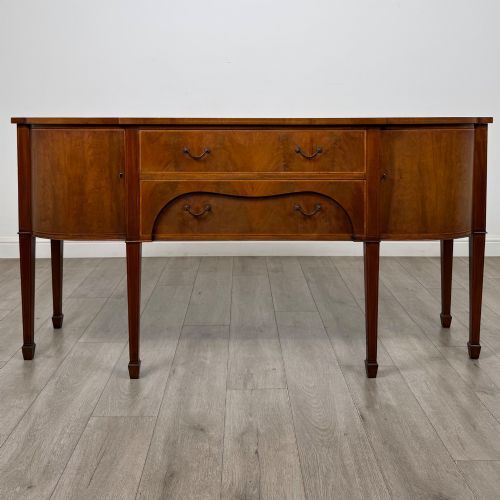
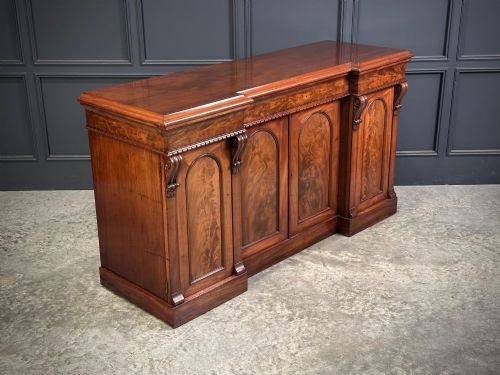
A flame mahogany sideboard server is a substantial dining room or hallway piece designed for storage and serving, taking forms such as breakfronts, bow fronts, and pedestals.
The pieces appearing on this page span Georgian, Regency, William IV, and Victorian periods, alongside Edwardian and later interpretations.
Most examples show the characteristic rich figure of flame mahogany veneer or solid mahogany, often complemented by satinwood, boxwood, and brass details.
Materials and construction
Cabinet makers applied carefully selected flame mahogany veneer over structural timber to create dramatic figured patterns across drawer fronts and cupboard doors.
Inlaid stringing in boxwood and satinwood frequently outlines the panels, while brass handles, gallery rails, and occasionally lion paw feet complete the construction.
Listings feature mahogany, flame mahogany veneer, satinwood, and boxwood across Georgian, Regency, and Victorian periods.
Factors in quality
The visual impact of the timber figure dictates much of the distinction, with symmetrical flame patterns commanding attention across larger breakfront and four-door surfaces.
Precision in the cabinetry, such as tight joints on bow fronts and finely executed inlaid stringing, separates standard production from exceptional examples.
The Flame Mahogany Sideboard Server Glossary
- Flame mahogany
- A timber veneer displaying a rippled, flickering grain pattern resembling flames, achieved by cutting across the branch forks of the mahogany tree.
- Breakfront
- A cabinet design where the central section projects forward from the flanking outer sections.
- Bow front
- A convex, curved cabinet front that swells outward in the centre.
- Chiffonier
- A compact sideboard or low cabinet, frequently fitted with shelves or a mirrored back in Victorian examples.
- Inlay
- A technique where contrasting woods like boxwood or satinwood are inserted into recesses in the primary mahogany surface to form linear patterns.
Flame Mahogany Sideboard Server: Frequently Asked Questions
What is a flame mahogany sideboard server used for?
These pieces function as dining room servers for storing crockery, cutlery, and serving dishes while providing a surface for food and drink during meals.
They also serve as prominent display and storage furniture in grand hallways and living spaces.
How do I date a mahogany sideboard?
Dating relies on identifying stylistic markers, such as the curved pedestals of the Regency era or the carved mirror backs typical of Victorian pieces.
Construction methods and secondary woods inside drawers also help establish whether a piece originates from the Georgian period or later.
What is the difference between a sideboard and a server?
While the terms often overlap in listings, servers traditionally lean toward serving food during meals with simpler proportions.
Sideboards generally offer more extensive enclosed cupboard and drawer storage for dining room paraphernalia.
How do I care for flame mahogany furniture?
Protect the polished wood surface by keeping the piece away from direct sunlight and maintaining stable room humidity.
Apply a traditional beeswax polish occasionally to nourish the grain and preserve the deep reddish-brown finish.