


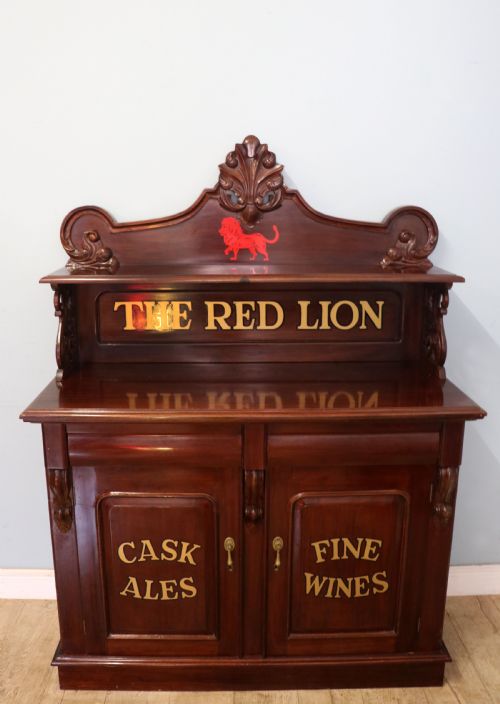


Red Mahogany Sideboard Server
A red mahogany sideboard server anchors a dining room with rich timber and deep period presence.
Red Mahogany Sideboard Server
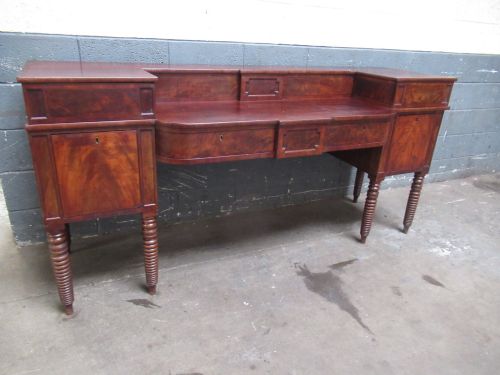
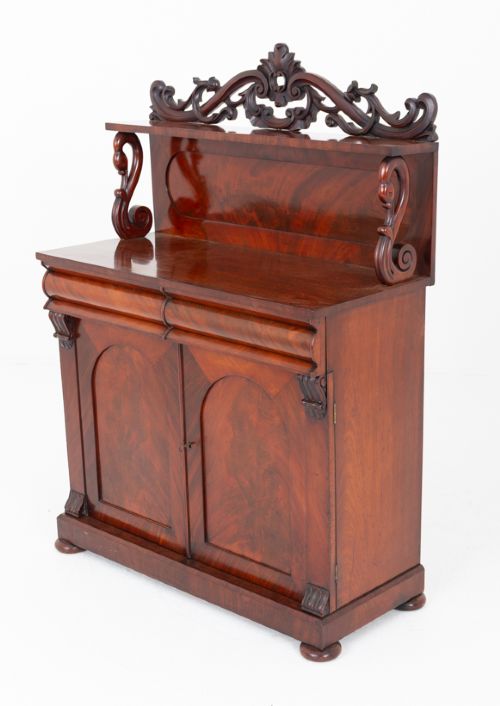
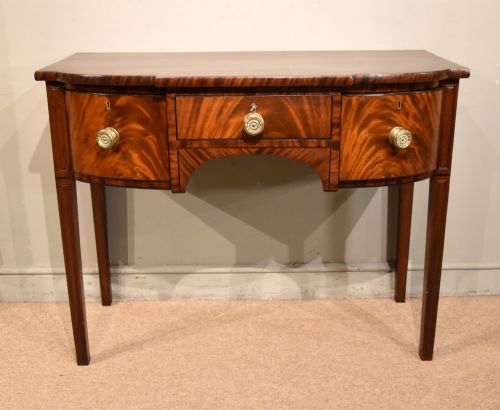
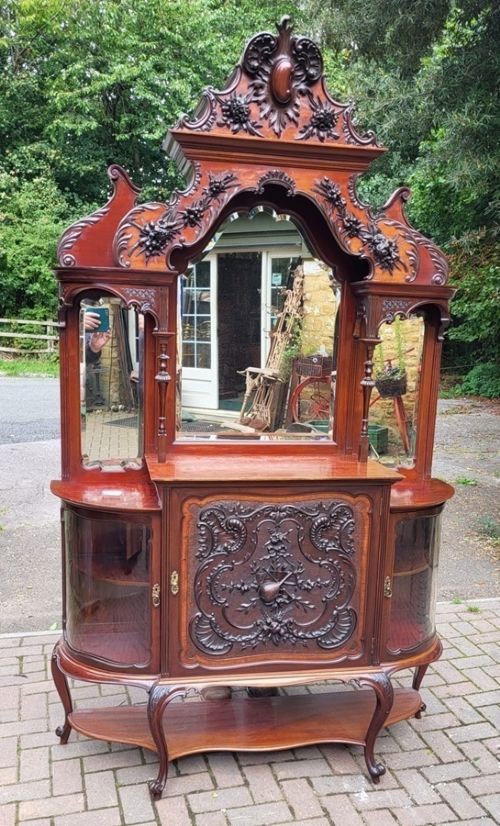
A red mahogany sideboard server represents the substantial dining room furniture produced across the nineteenth and early twentieth centuries. Pieces matching this search phrase span Georgian, Regency, Victorian, and Edwardian eras, taking the form of large pedestal sideboards, chiffoniers, buffets, and bow-front cabinets.
The version most commonly met on this page is the Victorian mahogany sideboard, often featuring multiple doors or pedestal cupboard bases. Alongside these, buyers find Georgian bow-form examples, Scottish stage-back designs, and later Edwardian variations incorporating inlaid details.
Makers utilised dense timbers and expansive tops to serve dining and entertaining needs in formal houses. The function remains largely unchanged, providing generous surface space for serving food and deep interior storage for dining silver and linen.
Materials and construction methods
Cabinetmakers built these pieces using solid mahogany and flame mahogany veneer applied to secondary framing timbers. The figured grain of flame mahogany veneer creates distinctive swirling patterns across drawer fronts and cupboard doors.
Secondary materials appear selectively to enhance utility and decoration, including brass hardware, mirror glass, and rouge marble tops. Structural elements rely on traditional joinery techniques suited to large case furniture.
Listings feature pieces spanning the Georgian, Regency, Victorian, and Edwardian periods, constructed from solid mahogany, flame mahogany veneer, and rouge marble.
Judging quality in period sideboards
The choice of timber grain sets the visual hierarchy, with book-matched flame mahogany veneers commanding higher regard than plain solid boards. Timber selection dictates the depth of colour and reflectivity across the primary facade.
Proportion and architectural detailing distinguish finer examples from standard production. Well-executed carving, substantial brass mounts, and balanced pedestals or stage-backs reflect the ambition of the original workshop.
James Shoolbred & Co
The Red Mahogany Sideboard Server Glossary
- Flame mahogany veneer
- A thin slice of timber cut from where a branch joins the main trunk, producing a fiery, feathered grain pattern. Cabinetmakers laid these veneers over stable core woods to create decorative fronts.
- Pedestal sideboard
- A large dining room format featuring two flanking cupboards beneath a central surface, common in Regency and Victorian periods. These units provide substantial interior space while maintaining architectural symmetry.
- Bow form
- A convex curved front contour that softens the rigid geometry of a case piece. This curved profile requires skilled joinery to shape the drawers and doors correctly.
- Stage-back
- A raised stepped superstructure at the rear of a sideboard surface used for displaying plate and serving dishes. Scottish Georgian examples frequently employ this elevated tier.
- Chiffonier
- A compact sideboard or cabinet featuring lower enclosed storage and often a shelf or mirror superstructure. They served smaller dining rooms and parlours during the Victorian era.
Red Mahogany Sideboard Server: Frequently Asked Questions
How do I date a red mahogany sideboard?
Dating relies on stylistic markers, timber characteristics, and construction methods visible in the piece. Georgian and Regency pieces tend to show lighter proportions and specific bracket or pillar feet, while Victorian examples often present heavier pedestal bases and arched panel doors.
Secondary woods and drawer linings also offer clues, as machine-sawn timbers generally point to the later nineteenth century. Comparing the hardware and internal framing against documented examples helps narrow down the decade of manufacture.
Will a large pedestal sideboard fit my dining room?
These pieces were built for substantial nineteenth-century dining spaces and require generous wall clearance and floor space. Depth and length vary significantly, particularly on pedestal and serpentine forms that project further into the room.
Measuring both the intended wall space and access routes such as doorways and stairwells is essential before acquisition. Allowance must be made for opening heavy cupboard doors and drawers fully.
How should I care for flame mahogany veneer?
Maintaining flame mahogany requires consistent indoor humidity and protection from direct sunlight to prevent veneer lifting and colour fading. Regular dusting with a soft, dry cloth preserves the polished surface without abrasive build-up.
Application of traditional wax polish helps nourish the timber and maintain its characteristic lustre. Modern silicone sprays should be avoided as they penetrate the aged finish and damage the wood.
What is the difference between a buffet and a sideboard?
Buffets and sideboards both serve dining room storage and display functions but often differ in internal configuration and proportion. A buffet frequently incorporates tiered shelving or cabinet superstructures designed specifically for presenting dishes.
Sideboards generally emphasise enclosed cupboard storage and drawer capacity beneath a flat top surface. The distinction can blur in nineteenth-century cataloguing, where makers used the terms interchangeably.