

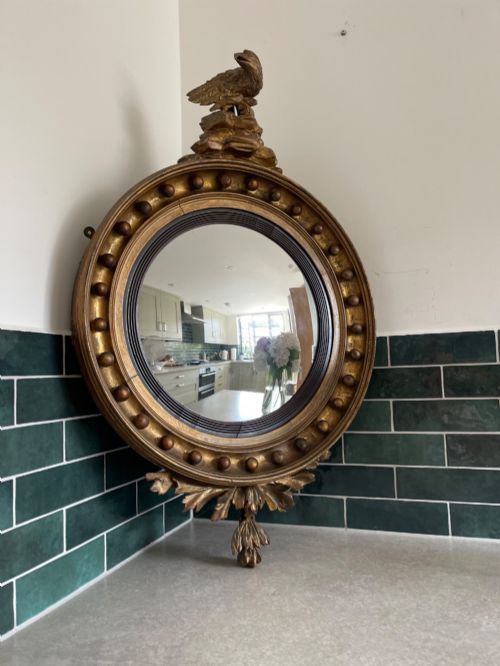


Fish Crest Mirror
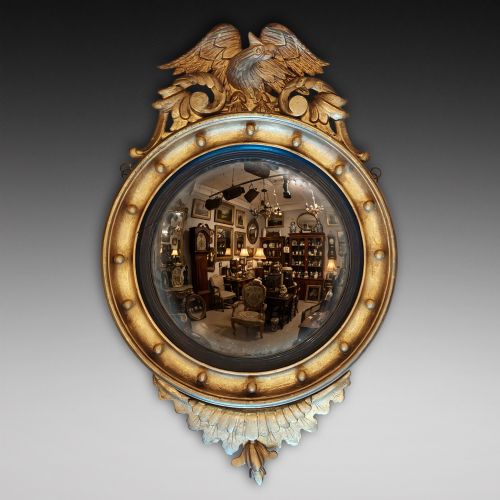
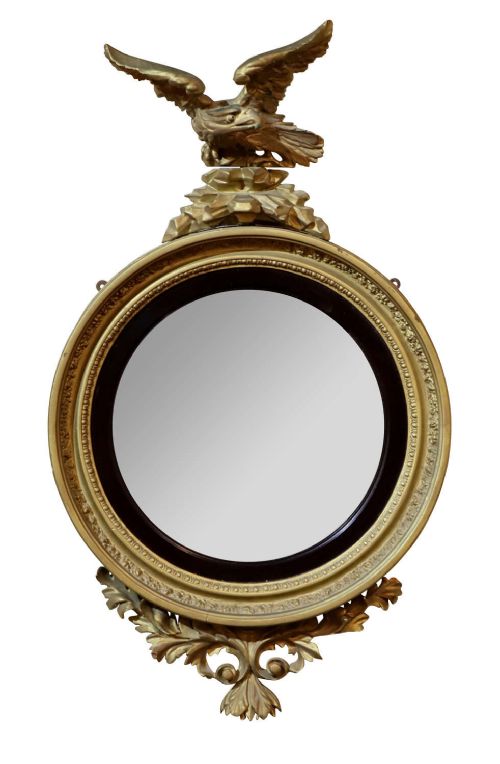
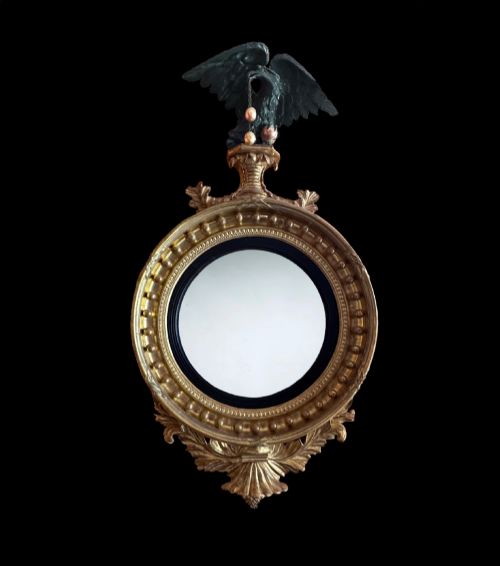
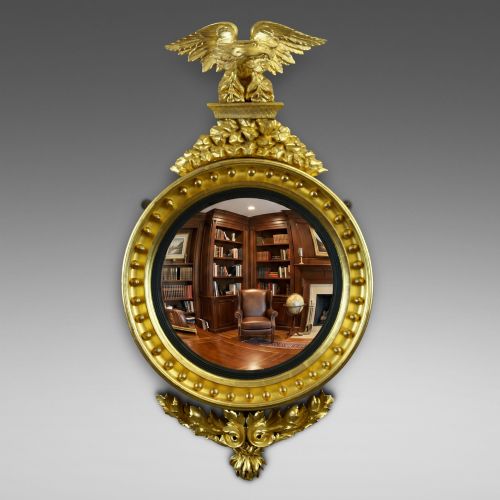
These fish crest mirror pieces are convex wall mirrors with eagle crests, bringing light and depth to a room through curved glass.
Fish Crest Mirror
A fish crest mirror is a circular convex wall glass typically framed in carved giltwood and surmounted by an eagle or bird crest. Buyers searching this phrase look for these round looking glasses designed to catch and scatter light across an interior space.
Most examples found here date from the Regency period, the early nineteenth century, and the Victorian era. These wall mirrors range from small domestic pieces to large focal points with detailed gilt frames and timber construction.
How they were made
Makers shaped timber and applied gesso before layering gold leaf to create the bright giltwood finishes seen on these convex frames. Mirrored glass was blown or cast then curved to produce the distinct bulging surface that reflects a wide angle of the room.
Brass fittings and ebonised wood details frequently accent the primary gilt structure, while carved birds such as eagles form the characteristic surmount at the top of the frame.
Fish Crest Mirror Retail Price Guide 2026
Typical asking prices for fish crest mirror among the pieces listed under this phrase on Sellingantiques today, from the lower quarter to the upper quarter. They describe what is for sale here now, not the wider market.
Materials recorded across these items include giltwood, ebonised wood, brass, and mirrored glass set in circular timber frames.
What varies in quality
The fineness of the wood carving on the eagle surmount and the depth of the gesso detail separate the better convex mirrors from simpler examples. Crisp definition in the leaf motifs and animal figures shows the hand of a skilled carver rather than mass production.
The clarity and integrity of the original mirrored glass, alongside the preservation of the early gold leaf surface, dictate the standing of a piece within its period.
The Fish Crest Mirror Glossary
- Convex mirror
- A curved circular looking glass that reflects a wide panoramic view of an interior. These glasses distort perspective to make rooms appear larger.
- Giltwood
- Timber coated with a thin layer of gold leaf over a prepared gesso ground. This finish provides a bright metallic sheen that catches ambient light.
- Girandole
- A wall mirror fitted with candle arms or branches attached to the frame. These brackets allowed reflected candlelight to illuminate the room further.
- Ebonised wood
- Timber stained or treated to imitate dense black ebony. This dark material often provides contrast against gilt mouldings.
Fish Crest Mirror: Frequently Asked Questions
What is a fish crest mirror?
A fish crest mirror is a circular convex wall glass featuring a carved bird or eagle surmount atop a giltwood frame.
These pieces reflect a wide, curved view of a room and were used as decorative focal points in nineteenth-century interiors.
How do I hang a convex mirror?
Because these wall mirrors are heavy due to their timber and gesso construction, they require secure fixings into solid wall anchors.
Positioning them at eye level allows the curved glass to properly capture light from opposing windows.
How do I date a Regency mirror?
Regency mirrors typically date from the early nineteenth century and feature classical motifs, ball-accented frames, and eagle crests.
Examining the construction of the backboards and the composition of the gesso helps confirm the period.
Are these mirrors fragile?
The giltwood frames and curved glass require careful handling to prevent chipping of the delicate gesso and gold leaf.
Keeping them away from direct moisture and handling the frames by their structural timber preserves the finish.