


Fete Galante Porcelain
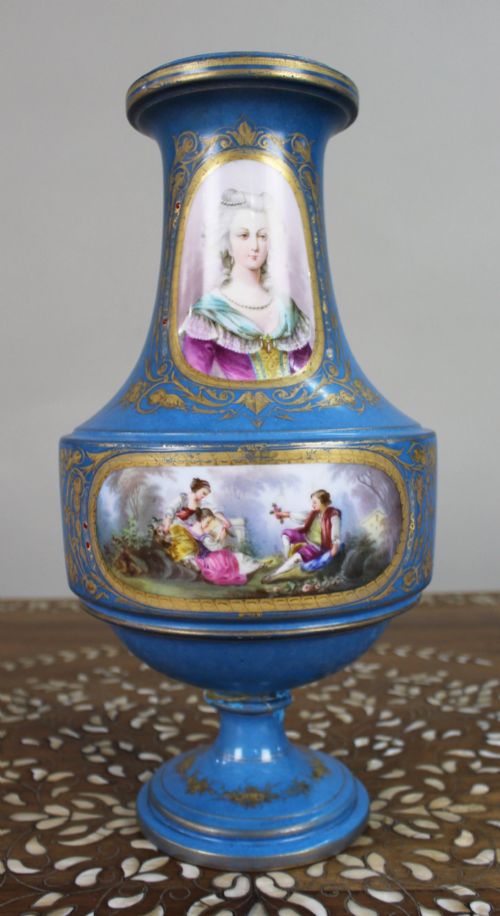
Fete galante porcelain pieces bring pastoral court scenes into the room, capturing eighteenth-century leisure through painted pastoral vignettes on glazed ceramic bodies.
Fete Galante Porcelain
When you search for fete galante porcelain, you encounter ceramic objects decorated with pastoral court scenes reminiscent of Watteau and Boucher. These pieces span the eighteenth century and the nineteenth-century revivals, including the Victorian era.
The items listed on this page appear predominantly as vases, lidded ginger jars, garniture sets, cabinet plates, and trinket boxes. Many examples display French influence, such as Sèvres-style bleu céleste or bleu royale grounds.
German manufactories also produced significant quantities in these styles, often featuring hand-painted gallant scenes mounted in ormolu, gilt bronze, or brass. You will find both hard-paste porcelain plates and large table lamps adapted from earlier decorative vases.
Assessing quality in fete galante porcelain
Quality rests on the fineness of the hand-painted figures and the precision of the underlying porcelain form. Superior pieces exhibit delicate brushwork in the gallant scenes, capturing facial expressions and fabric folds with clarity.
The integration of metalwork also defines the tier of the piece. Heavy, chased ormolu or gilt bronze mounts that fit the porcelain snugly indicate higher workshop standards than light brass attachments.
Listings feature hard-paste porcelain forms decorated with hand-painted gallant scenes, spanning the eighteenth century through to the late nineteenth-century Rococo Revival.
Meissen Porcelain·Samson Paris·Wolfsohn Dresden
The Fete Galante Porcelain Glossary
- Fête galante
- A term describing eighteenth-century paintings that show figures of the aristocracy enjoying leisure in parklands. These pastoral court scenes form the central motifs on this porcelain.
- Bleu céleste
- A bright sky-blue enamel ground colour associated with Sèvres porcelain. This distinctive hue appears across many nineteenth-century French and revival pieces.
- Ormolu
- Finely ground high-carat gold applied in a mercury amalgam to bronze. It provides ornamental mounts for vases, urns, and boxes.
- Hard-paste porcelain
- A true ceramic composition fired at high temperatures, consisting of kaolin and petuntse. It produces a dense, durable body resistant to scratching.
- Garniture set
- A matching group of three or more ornamental vases designed to sit on a mantelpiece or cabinet. They typically feature central lidded jars flanked by matching smaller vessels.
Fete Galante Porcelain: Frequently Asked Questions
Are these pieces eighteenth century?
The selection includes genuine eighteenth-century items alongside nineteenth-century revival pieces made in the Sèvres or Meissen style. Nineteenth-century makers frequently adopted earlier aesthetic forms and historical marks.
Examining the paste, glaze condition, and mount construction helps differentiate original eighteenth-century production from later Victorian or 1880s interpretations.
What is an AR mark?
The AR mark stands for Albrechts Regia and appears on eighteenth-century Meissen pieces intended for the royal court. Later German factories, such as Wolfsohn in Dresden, also utilised this mark on revival ceramics.
Context and the quality of the hand-painted pastoral scenes help determine whether an AR-marked piece originates from the early period or the nineteenth century.
How were garniture sets displayed?
Garniture sets were placed along mantelpieces, console tables, or cabinetry in elite interiors to demonstrate wealth and taste. The central large vase or jar was flanked by symmetrical smaller vessels.
In modern rooms, these sets work well spread across a large sideboard or grouped together on a dedicated display surface.