




Feather Inlay Walnut Drawers
These feather inlay walnut drawers are magnificent early storage pieces, combining rich timber and crisp banding that bring warmth to any traditional interior.
Feather Inlay Walnut Drawers
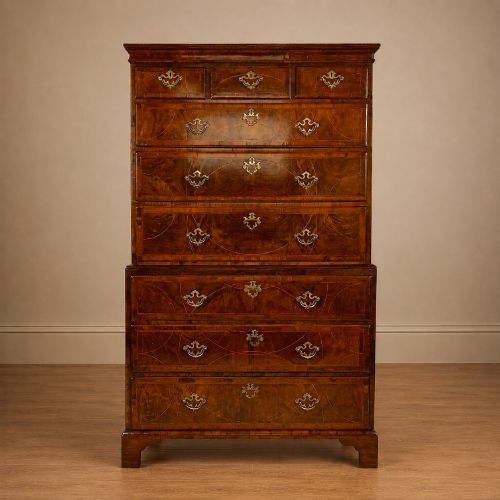
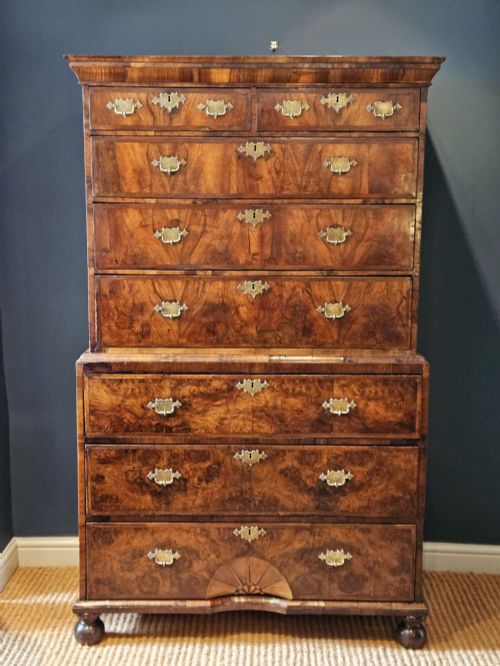
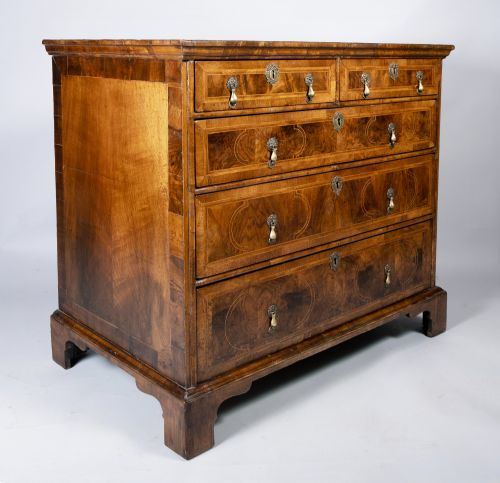
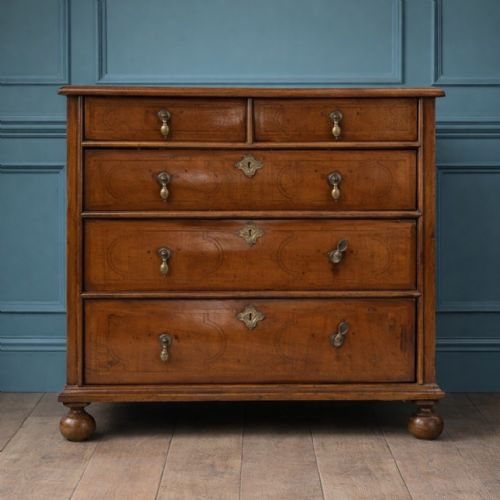
When you search for feather inlay walnut drawers, you encounter substantial storage furniture spanning the late seventeenth century through the mid-eighteenth century. These pieces include low chests of drawers, taller examples, and imposing chest on chest forms.
The aesthetic is rooted in the reigns of William and Mary, Queen Anne, George I, and George II. Walnut serves as the primary timber, often displaying rich figuring across the principal surfaces.
You meet variations in scale and configuration, from compact three-drawer variants to monumental tallboys. The defining characteristic across these forms remains the meticulous application of banded borders framing the drawer fronts.
Materials and construction
Cabinetmakers constructed these pieces using solid and veneered walnut, frequently selecting burr walnut for its dynamic grain patterns on the primary facades. Secondary timbers such as oak commonly provide structural stability for the drawer linings and internal framing.
The distinct banding involves cutting thin slices of veneer and laying them diagonally to create a herring-bone pattern often termed feather banding. Brass handles and escutcheons, usually cast in drop-handle or later willow-pattern plate formats, complement the dark timber tones.
The listings span the late seventeenth and eighteenth centuries, incorporating Georgian, Queen Anne, and William and Mary stylistic eras.
Assessing quality in early walnut furniture
Quality rests upon the selection and matching of the veneer figures across the front elevation. Superior examples exhibit continuous grain alignment and precise execution of the inlaid borders without visible timber shrinkage.
The integrity of the original carcase construction and the retention of period brass hardware heavily influence the standing of an individual piece. Finer proportions and subtle architectural mouldings distinguish the best workshop output from standard production.
The Feather Inlay Walnut Drawers Glossary
- Feather banding
- A decorative inlay technique where veneers are cut at an angle and arranged to form a continuous chevron or herringbone motif around drawer perimeters. This adds crisp geometric definition to the softer walnut background.
- Tallboy
- A tall chest of drawers, frequently constructed in two distinct sections where a smaller chest sits atop a larger base. It provides generous vertical storage while occupying a modest footprint.
- Chest on chest
- A commanding storage form comprising a top chest stacked directly upon a deeper bottom chest. This monumental piece showcases symmetrical grain matching across both sections.
- Burr walnut
- A highly prized timber harvested from walnut tree growths, yielding intricate swirling patterns and knots. Cabinetmakers reserved this decorative veneer for prominent drawer fronts and top panels.
- Line inlay
- A narrow strip of contrasting wood or light material inserted flush into the surface to create clean linear borders. It provides a restrained frame for the primary panels.
Feather Inlay Walnut Drawers: Frequently Asked Questions
How do I date a walnut chest?
Dating relies on examining the construction methods, handle configurations, and timber selection visible across the piece. Earlier examples from the seventeenth century often display different carcass framing compared to mid-eighteenth-century Georgian pieces.
Changes in foot styles, from bracket feet to earlier bun feet, also provide clear chronological markers for these items.
Where should I place a tallboy?
A tallboy requires a stable wall position in a bedroom or dressing room where its vertical proportions can be fully appreciated. Ensure the room maintains stable humidity to protect the delicate walnut veneers.
Keep the piece away from direct sunlight to preserve the natural warmth and colour of the aged timber.
How do I clean walnut veneer?
Dust the surfaces regularly with a soft, dry cloth to prevent particulate accumulation in the grain and inlay crevices. Avoid modern silicone sprays and abrasive polishes which can damage the historic finish.
Apply a traditional beeswax sparingly when the timber appears dry, buffing gently to maintain a soft natural lustre.