
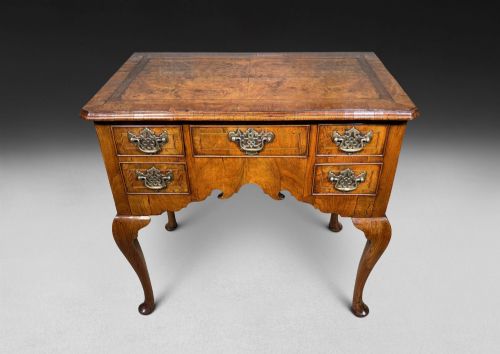
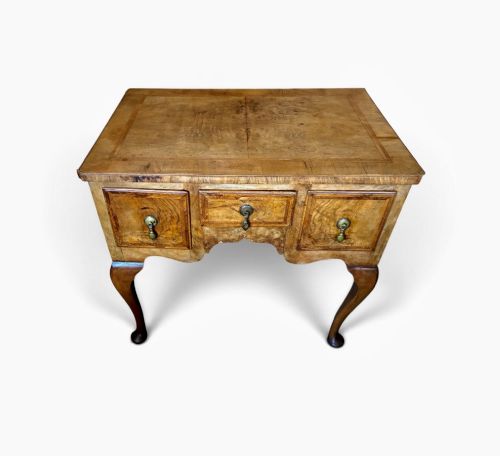
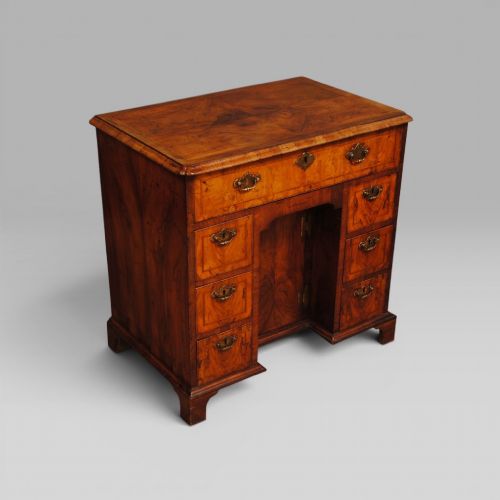


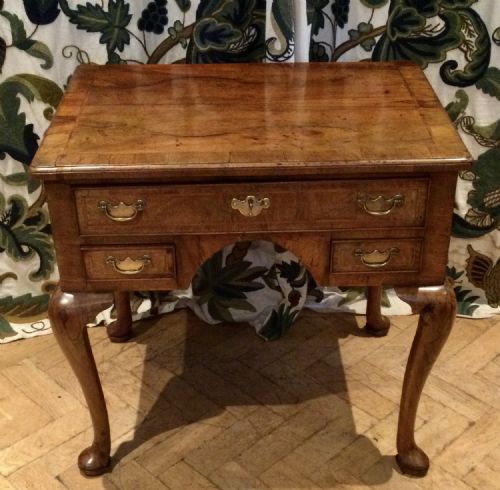
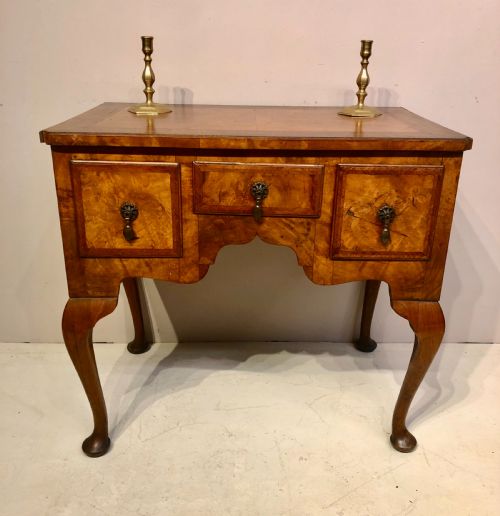


Feather Banded Walnut Desk
A feather banded walnut desk unites figured timber with delicate stringing to frame a workspace of quiet distinction.
Feather Banded Walnut Desk
A feather banded walnut desk encompasses writing furniture fashioned primarily during the eighteenth century, including lowboys, bureaux, kneehole desks, and secretaire cabinets. These forms serve as functional writing surfaces and compact storage pieces defined by figured timbers.
The versions most frequently encountered on this page belong to the Queen Anne, George I, and George II periods, alongside nineteenth-century interpretations and Edwardian revivals. They employ walnut, burr walnut, and oak carcases finished with distinctive decorative banding around the drawer fronts and edges.
How they were made
Cabinetmakers utilised walnut and burr walnut veneers laid over solid secondary woods such as oak, securing the construction with brass hardware like handles and escutcheons. The characteristic feather banding involves cutting thin slices of veneer across the grain to form herringbone patterns that frame the drawer perimeters.
Surfaces were brought to a finish that highlighted the natural figure of the timber, whilst structural joints relied on traditional cabinetmaking techniques suited to the handling of burr and figured veneers.
Many an early bureau conceals a secret central slide behind the pigeonholes for hiding letters from prying eyes.
What varies in quality
The visual hierarchy of a piece depends on the choice of timber, where intensely figured burr walnut and symmetrical grain patterns elevate the overall presence. Craftsmanship shows in the precision of the feather banding and the integrity of the original surfaces.
Proportions also dictate the standing of an example, with smaller scales and untouched patination distinguishing finer works from standard production or later revivals.
The Feather Banded Walnut Desk Glossary
- Feather banding
- A decorative inlay technique using two strips of veneer cut diagonally to form a continuous central spine resembling a feather or herringbone pattern. This framing detail typically borders drawer fronts on eighteenth-century case furniture.
- Lowboy
- A small dressing table or side table featuring one or more rows of drawers beneath a flat top, often raised on cabriole legs. These pieces frequently double as compact writing desks in domestic settings.
- Bureau
- A slant-front desk that opens to reveal an interior arrangement of small drawers and pigeonholes above further drawer tiers. The fall-front provides a sloping writing surface when closed.
- Kneehole desk
- A flat-top writing table featuring a central recessed cupboard flanked by banks of small drawers. This compact pedestal form became popular during the late seventeenth and early eighteenth centuries.
- Burr walnut
- Timber taken from the growth excrescences on walnut trees, yielding highly figured and swirling grain patterns. Cabinetmakers sliced this wood into veneers for decorative surface work on high-status furniture.
Feather Banded Walnut Desk: Frequently Asked Questions
What is feather banding?
Feather banding is a decorative inlay technique formed by cutting thin strips of veneer diagonally to create a herringbone pattern. This intricate border frames the edges of drawer fronts and tabletops.
Cabinetmakers used this detail to enhance the visual appeal of walnut furniture during the early eighteenth century.
How do I identify a lowboy?
A lowboy is a small table with drawers, typically standing on four legs, which served as a dressing table or writing surface. They share proportions similar to the base section of a tallboy.
Most examples date from the eighteenth century and feature matching walnut or oak construction.
Where should I place a bureau?
A bureau suits a study, drawing room, or hallway where its compact footprint and fold-down writing flap can function practically. The enclosed writing slope keeps correspondence out of sight when not in use.
Keep such furniture away from direct heat sources to protect the delicate walnut veneers.
How do I care for walnut veneer?
Protect walnut veneer by maintaining stable room humidity and avoiding placement in direct sunlight, which fades the timber figure. Dust gently with a dry cloth and apply appropriate wax sparingly.
Avoid liquid polishes that can seep into historic grain structures and loosening veneer edges.