





Famille Rose Floor Vases
Famille rose floor vases command space through scale and enamel work, bringing nineteenth-century porcelain presence into large interiors.
Famille Rose Floor Vases
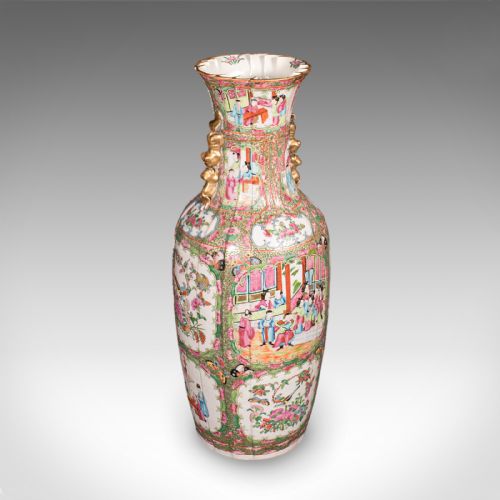
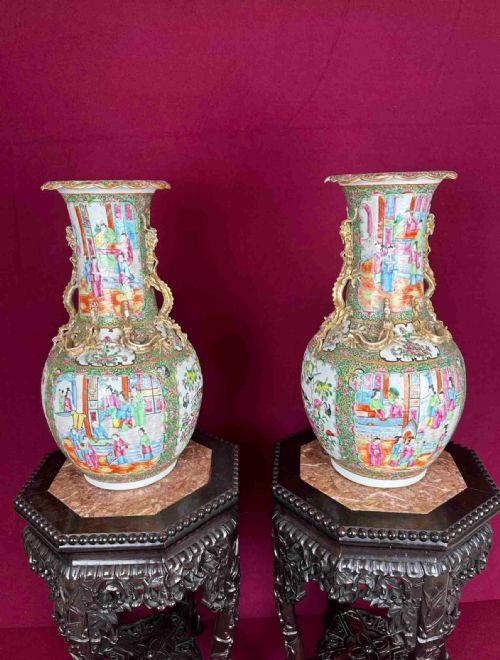
Famille rose floor vases represent monumental Chinese porcelain produced primarily during the nineteenth century, including Qing Dynasty and Victorian periods. These large vessels take the form of tall baluster vases and centrepiece urns, frequently accompanied by matched pairs or fitted stands.
Buyers encountering this group will mostly find nineteenth-century Cantonese and Rose Medallion production alongside twentieth-century Chinese export examples. The forms are designed specifically for grand placement on the floor rather than table surfaces, measuring up to ninety-two centimetres in height.
Materials and construction
Makers utilised ceramic porcelain bodies finished with polychrome and overglaze enamels to achieve the signature opaque pink and pastel palette. Artisans applied hand-painted details supplemented by gold leaf and giltwood elements, creating rich surface decoration across the ceramic form.
The firing process bonded the intricate enamel pigments to the glaze, followed by the addition of wooden stands or giltwood mounts for display stability. This combination of ceramic potting and detailed enamel painting defines the technical execution of the pieces.
One monumental nineteenth-century piece carries a historic house monument name, proving that even porcelain occasionally needs an estate title.
Evaluating quality and execution
Quality rests in the precision of the hand-painted enamels and the crispness of the porcelain potting across monumental scales. Superior examples display dense, meticulously rendered figural or botanical scenes that retain their original colour intensity without fading.
The presence of intact gold leaf detailing and matching pairs further separates exceptional vessels from standard production. Structural integrity across such large ceramic forms remains a key differentiator for collectors.
The Famille Rose Floor Vases Glossary
- Famille rose
- A ceramic palette defined by opaque pink enamel introduced during the Qing Dynasty. The term derives from the French classification for these rose-dominant colours.
- Rose medallion
- A specific decorative style featuring panels of figures alternating with birds, butterflies, and flowers. These repeating segments cover the exterior surface in intricate detail.
- Canton
- A major export port in China where porcelain was decorated for Western markets. Cantonese workshops produced distinct patterns identifiable by crowded polychrome enamel scenes.
- Baluster
- A vase shape characterised by a rounded body that tapers toward the base and flares at the neck. This silhouette provides stability for tall floor pieces.
- Overglaze enamel
- Pigments applied on top of a fired glaze and fixed with a second, lower-temperature firing. This technique allows for bright, varied colour placement.
Famille Rose Floor Vases: Frequently Asked Questions
Where should I place a floor vase?
These monumental vessels suit large hallways, entryways, or reception rooms with high ceilings where their scale can be appreciated properly.
They function well as freestanding focal points or positioned on sturdy stands away from heavy traffic areas to ensure safety.
How do I identify nineteenth-century pieces?
Nineteenth-century examples show hand-painted overglaze enamel work typical of Qing Dynasty and Victorian export production.
Look for the characteristic weight of the porcelain and traditional Cantonese or Rose Medallion decorative motifs across the body.
Are these vases always sold as pairs?
While many listings feature matched pairs of baluster vases or urns, individual floor vases also appear frequently.
Pairs often include fitted stands that complement the height and proportion of the ceramic bodies.
What is the difference between Canton and Rose Medallion?
Canton describes broader nineteenth-century export porcelain originating from the region, encompassing various figural and floral compositions.
Rose Medallion is a specific subset defined by distinct geometric panels framing alternating scenes of people and nature.