
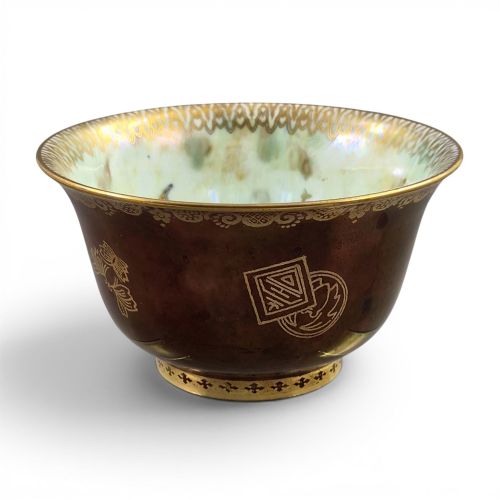
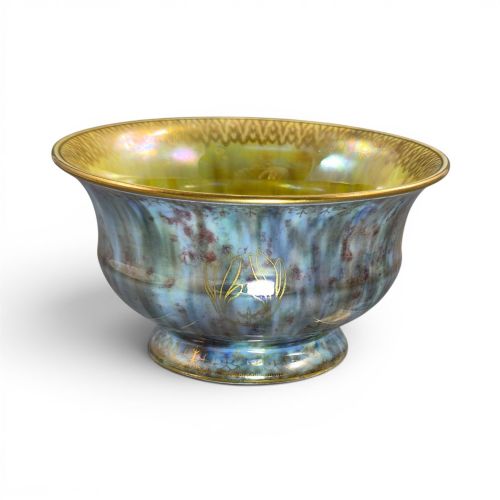
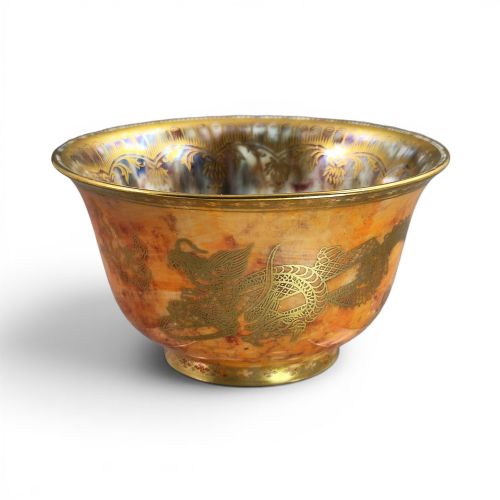


Fairyland Lustreware Bowl
A fairyland lustreware bowl brings otherworldly myth and vibrant iridescent colour straight to a room.
Fairyland Lustreware Bowl
A fairyland lustreware bowl is an ornamental porcelain or bone china vessel decorated with intricate mythical scenes and rich iridescent glazes. The pieces found here date from the Edwardian era through to the 1920s, capturing the height of this imaginative ceramic design.
Buyers will most frequently encounter decorative bowls and miniature cups featuring dragon, butterfly, phoenix, and celestial motifs. These forms range from standard rounded vessels to striking octagonal shapes.
The aesthetic bridges late Art Nouveau sensibilities with early Art Deco geometric tendencies. Every item reflects the distinctive vision of its creator through elaborate patterns rendered in metallic glazes and gold gilding.
How they were made
The foundation of each piece is porcelain or bone china, shaped into bowls and miniature cups before glazing. Artisans then applied complex metallic and lustre glazes to achieve the characteristic shimmering surface effect.
Decoration relied heavily on meticulous hand application of gold leaf, gold gilding, and gilt detailing to bring out dragons, butterflies, and abstract diapers. Multiple firings were necessary to set the iridescent metallic glaze without losing the fine illustrative work beneath.
Listings span the Edwardian period, 1910, and 1920, utilising porcelain, bone china, lustre glaze, and gold leaf.
What varies in quality
The visual depth of the lustre glaze determines much of the overall impact, with richer iridescence commanding greater attention. The precision of the gilt work and the complexity of motifs such as coiling dragons or celestial patterns separate standard pieces from more ambitious designs.
Structural variety also influences the piece, moving from simple rounded decorative bowls to sharply defined octagonal bowls and delicate miniature cups. The presence of detailed subsidiary patterns, such as lighting diaper work, adds layers of visual complexity.
Daisy Makeig Jones·Wedgwood
The Fairyland Lustreware Bowl Glossary
- Lustre glaze
- A type of metallic glaze fired onto ceramics to produce an iridescent, pearl-like sheen that catches the light from different angles.
- Octagonal bowl
- A vessel possessing eight distinct sides, offering a structured geometric alternative to traditional rounded bowls.
- Gilt
- A thin layer of gold applied to the surface of the porcelain to highlight borders and decorative motifs.
- Bone china
- A type of soft-paste porcelain incorporating animal bone ash, providing strength and a bright white body for colourful glazes.
- Diaper pattern
- A repeating geometric or semi-abstract surface ornament used to fill background spaces on decorative ceramics.
Fairyland Lustreware Bowl: Frequently Asked Questions
What are fairyland lustreware bowls?
These are ornamental porcelain and bone china bowls decorated with iridescent metallic glazes and fantastical scenes of dragons, phoenixes, and butterflies.
Produced primarily during the Edwardian period and the 1920s, they serve purely as decorative display items rather than utilitarian tableware.
How were these bowls used?
They were designed as cabinet pieces and decorative ornaments for the home, intended to catch the light and display imaginative artistry.
Due to their delicate metallic glazes and gold gilding, they were kept on display surfaces rather than utilised for food or drink.
How do I style a bowl at home?
Place the piece on an open shelf, cabinet, or table where ambient light can strike the metallic and lustre glazes.
Keep surrounding objects minimal so the complex dragon, phoenix, or butterfly motifs remain the visual focus of the space.
How do I tell periods apart?
Look to the stylistic transition from flowing Art Nouveau lines towards the sharper geometries of the 1920s Art Deco movement.
Edwardian pieces often share shelf space with later 1920s variants, distinguished primarily by their overarching pattern complexity and vessel shapes like octagonal forms.