



English Weather Glass
An English weather glass offers a practical mechanical record of atmospheric pressure, combining domestic utility with traditional craftsmanship.
English Weather Glass
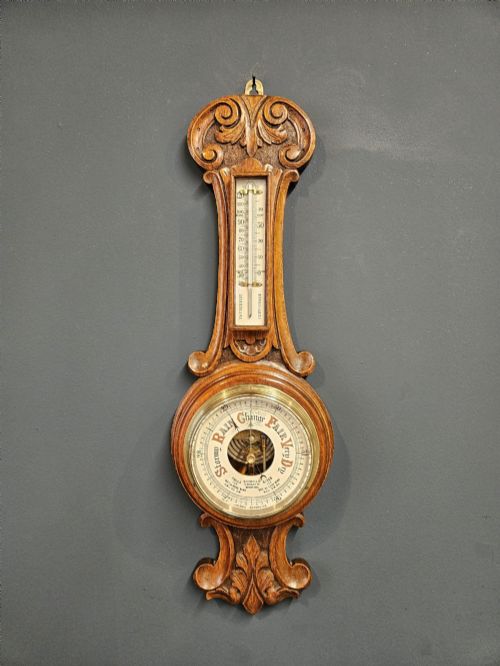
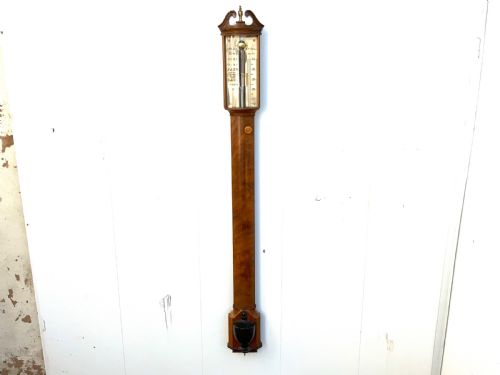
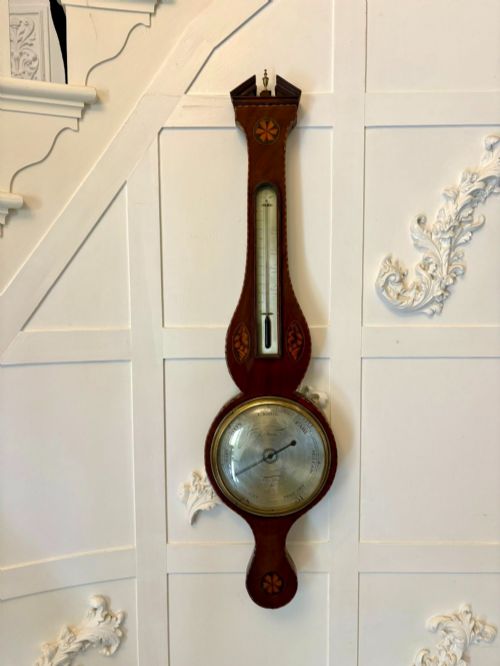
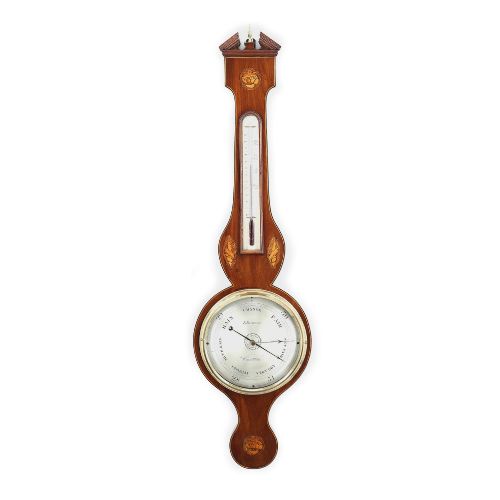
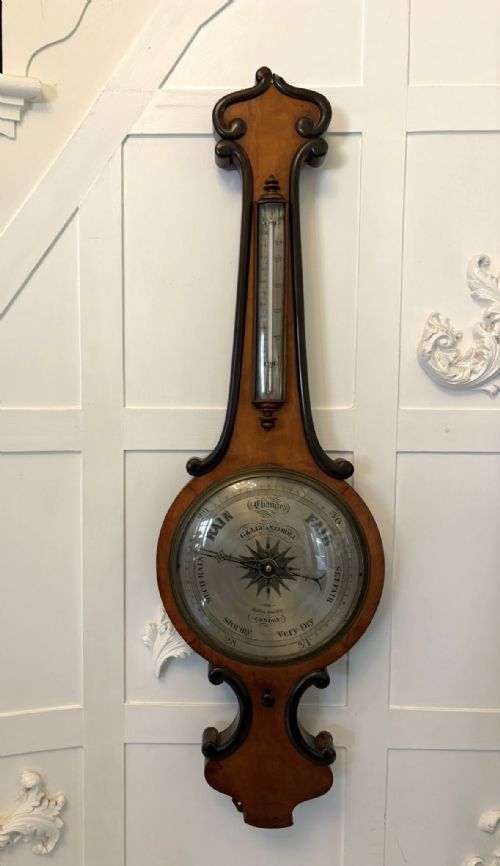
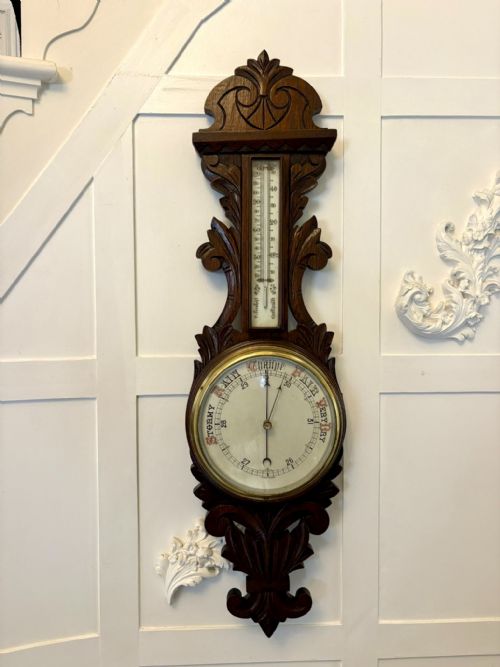
The english weather glass encompasses various atmospheric recording instruments, with wheel barometers and stick barometers appearing most frequently in domestic interiors. These pieces take the form of wall-mounted instruments designed to measure barometric pressure changes.
The selection ranges from George III mahogany wheel barometers to Edwardian oak-cased barographs. Makers across London, Weymouth, Norwich, and other towns produced these items across the Victorian, Georgian, and Edwardian periods.
Materials and construction
Cases utilise dense hardwoods such as mahogany, oak, walnut, and rosewood, frequently incorporating bone inlay, brass fittings, and bevelled glass. Woodworkers shaped these materials into wheel, stick, and bow-fronted configurations.
Internal mechanisms rely on sealed glass tubes containing mercury or aneroid capsules linked to silvered metal dials. Makers mounted thermometers and chart drawers directly into the timber casings.
Listings feature instruments spanning the eighteenth, nineteenth, and early twentieth centuries, constructed in mahogany, oak, walnut, and rosewood.
Assessing quality and execution
The standard of timber selection and cabinetmaking dictates the division between basic production and finer examples. Richly figured mahogany, precise shell inlay, and carved decoration elevate the casework.
Precision in the engraved silvered metal dials and the clarity of the maker signature mark the distinction in instrument quality. Maker signatures from known workshops indicate higher standards of mechanical assembly.
B Besozzi of Weymouth·G and L Guanziroli London·W Watson and Sons·Molton of Norwich·Luisetti of London·Hayward of Ashford·Gilbert London·Bianchi Ipswich·Charles Aiano London·Joseph Somalvico and Co·George Dollond of London·Short and Mason Limited
The English Weather Glass Glossary
- Wheel barometer
- An instrument featuring a large round dial where a pointer indicates atmospheric pressure changes via a pulley system connected to a siphon tube. This form became common in domestic halls during the Georgian and Victorian periods.
- Stick barometer
- A tall, narrow instrument displaying a direct mercury column against a scaled board. This format offers high reading precision.
- Barograph
- A mechanical weather recording apparatus that plots barometric pressure onto a rotating drum holding a paper chart. These instruments typically reside in glass-panelled mahogany or oak cases.
- Aneroid barometer
- A barometer that measures pressure using a flexible metal capsule rather than liquid mercury. This design allows for more compact casing shapes.
- Silvered metal
- A brass or copper dial plate treated to achieve a bright metallic finish before engraving. Lettering and calibration scales stand out sharply against this surface.
English Weather Glass: Frequently Asked Questions
How do I read a wheel barometer?
The pointer moves clockwise as atmospheric pressure rises, indicating fair weather, and counter-clockwise as pressure falls, pointing towards rain. Matching the needle position against the engraved scale provides the current reading.
Secondary pointers, often operated by a knob on the glass cover, allow you to mark the existing pressure to track whether conditions improve or deteriorate over the day.
Where should I hang a barometer?
Barometers require stable interior locations away from direct heat sources, open windows, and strong vibrations. Hallways and studies provide suitable environments.
Mounting the instrument securely to a solid wall ensures the internal mechanism remains level and responds accurately to atmospheric shifts.
What is the difference between stick and wheel barometers?
Stick barometers display the direct height of a mercury column in a vertical tube, offering immediate and precise readings. They occupy a narrower profile on the wall.
Wheel barometers translate mercury movement through a mechanical pulley to turn a dial hand. They present a larger face that is easier to read from a distance.
How can I date an antique barometer?
Stylistic details in the timber case, such as string inlay, onion tops, or carved oak motifs, often align with specific periods like the Georgian or Victorian eras. Examining the shape and proportions helps narrow the timeframe.
Maker signatures engraved on the dial plate provide a direct reference to historical trade directories and active working dates.