


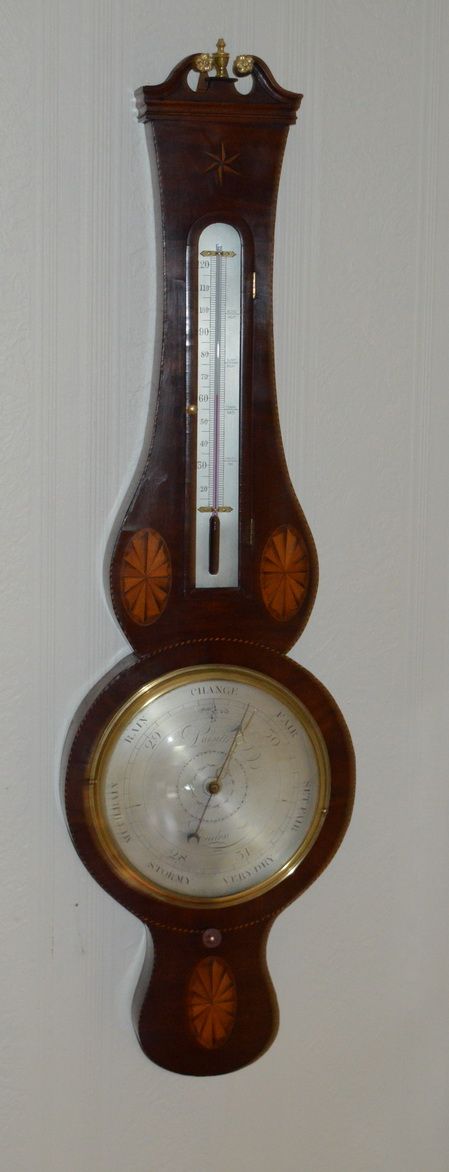


Brass Inlaid Barometer
A brass inlaid barometer measures atmospheric pressure while bringing rich timber cases and intricate brass work into your hallway or study.
Brass Inlaid Barometer
When you search for a brass inlaid barometer, you look at domestic weather instruments housed in wooden cases that feature metallic ornamentation. These instruments record atmospheric changes using mercury or mechanical movements.
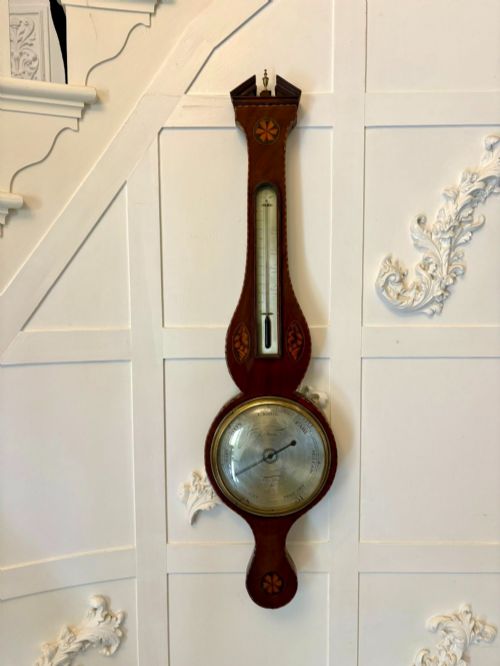
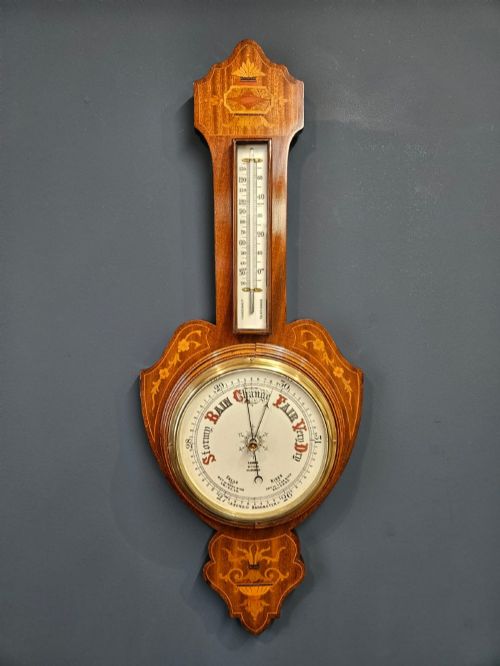
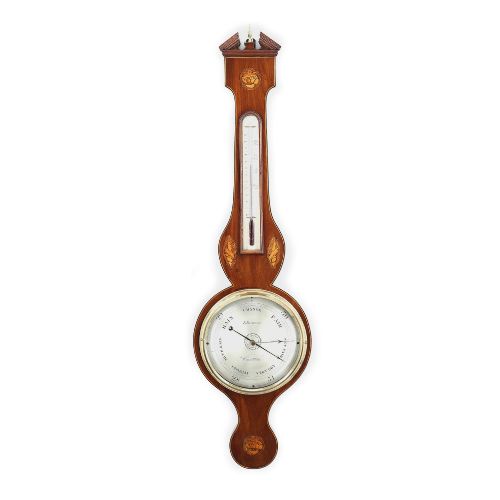
The versions you meet most frequently on this page take the form of banjo barometers and wheel barometers dating from the Georgian, Victorian, and Regency periods. These wall-hanging examples often combine mahogany, rosewood, or oak with contrasting light wood stringing and brass dials.
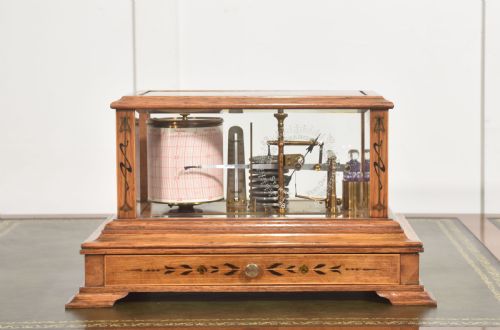
Makers from London, provincial towns, and cities across Britain signed these dials, recording names such as Fagioli, Besozzi, and Rivolta. Alongside standard wall instruments, the evidence includes specialised forms like angle barometers and barographs.
How they were made
Cabinetmakers constructed the main body using solid and veneered timbers such as mahogany, rosewood, and oak, often incorporating satinwood or bone for decorative contrast. They channelled the wood surfaces to receive delicate brass inlay and stringing.
Dial faces were typically fashioned from silvered metal, protected behind curved glassbezels, and engraved with weather descriptions alongside barometric scales. Instrument makers then fitted mercury tubes or mechanical barograph drums into the prepared wooden chassis.
At least one maker operated out of High Wycombe, a town better known for turning out wooden chairs than meteorological instruments.
What varies in quality
The distinction between ordinary and superior instruments lies in the crispness of the brass engraving on the dial and the precision of the cabinetwork. Finer examples display meticulous shell or floral inlay integrated smoothly into figured mahogany or rosewood veneers.
Makers' signatures also influence character, with signed London and provincial workshop pieces demonstrating higher standards of mechanical and decorative execution than unsigned equivalents.
B Besozzi of Weymouth·Ganthony of London·Prada of High Wycombe·Fagioli of Clerkenwell London·Vecchio and Co of Shaftsbury·A Rivolta·Luisetti of London·Charles Aiano London·F Salteri and Co Nottingham·Schiavi of Chesham·A Abraham of Liverpool
The Brass Inlaid Barometer Glossary
- Banjo barometer
- A wall barometer shaped with a circular dial head above a long tapered trunk, popular from the late eighteenth century onward. This silhouette allows space for thermometers, hygrometers, or damp levels.
- Wheel barometer
- An instrument that uses a concealed glass siphon tube and a float connected to a pulley wheel to drive the pointer around a large dial. It functions on the same mercurial principle as a standard stick barometer.
- Barograph
- A self-recording aneroid barometer that charts atmospheric pressure continuously onto a revolving paper drum. These mechanical instruments often sit within protective wood and glass cases.
- Silvered metal
- A brass or copper dial plate treated with a silver solution to create a reflective, readable surface for engraved graduations. This finish tarnishes gently with age if exposed to damp air.
- Stringing
- Narrow lines of contrasting timber or light-coloured inlay set flush into the primary wood veneer of the case. It defines the edges and geometric panels of the barometer body.
Brass Inlaid Barometer: Frequently Asked Questions
How do I read a brass inlaid barometer?
Read the main pointer against the engraved weather words and pressure numbers on the silvered dial face. If the instrument includes a secondary pointer, set it manually over the current reading to track whether pressure rises or falls.
Changes in the mercury column or mechanical linkage drive the main hand clockwise for fair weather and anticlockwise for foul. Comparing consecutive readings gives the basic forecast for the coming hours.
Where should I hang a wall barometer?
Hang your barometer on an interior wall away from direct sunlight, central heating radiators, and damp exterior stone. Stable indoor temperatures prevent the timber case from warping and protect the delicate mechanical joints inside.
Ensure the fixing point is secure because traditional wood-cased barometers carry considerable weight, particularly examples featuring heavy mercury tubes and glass bezels.
Did these barometers record accurate weather?
Georgian and Victorian barometers served as reliable domestic indicators of impending storms or settled conditions based on local atmospheric weight. While they lack the electronic calibration of modern instruments, their mechanical responses to barometric pressure remain fundamentally sound.
Periodic adjustment via the setting screw allows you to align the pointer with known local pressures for general forecasting purposes.
How do I tell a Georgian barometer from a Victorian one?
Georgian barometers from the late eighteenth and early nineteenth centuries often feature simpler architectural proportions, flame mahogany veneers, and delicate line inlay. Makers from this era frequently signed directly onto the damp-scale plates or convex mirror surrounds.
Victorian instruments tend to show heavier mouldings, broader brass bezels, and sometimes incorporation of more eclectic decorative styles like Art Nouveau alongside traditional mahogany or oak bodies.