
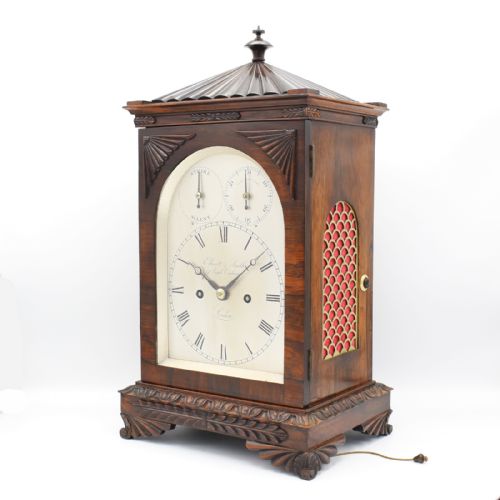
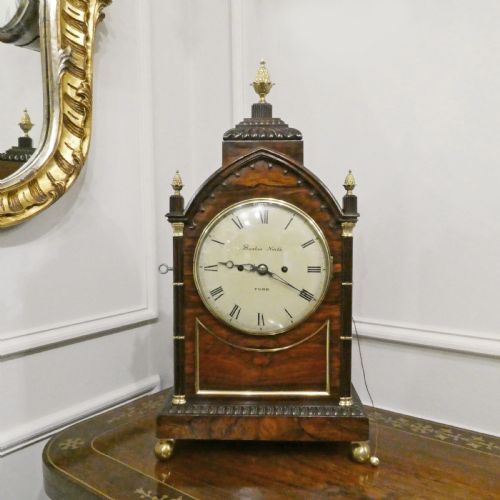
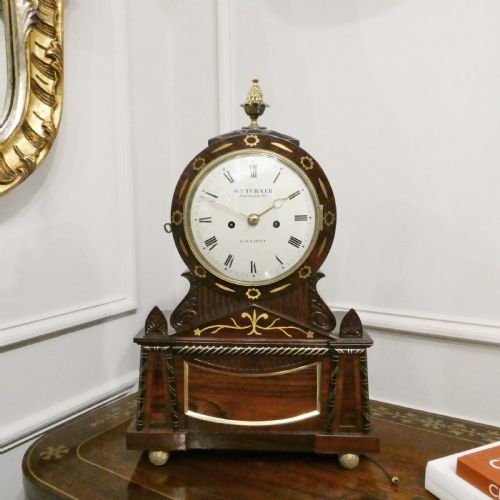


English Spring Driven Clock
An English spring driven clock is a portable timekeeper powered by a mainspring, combining precise mechanical movement with fine cabinetry.
How they were made
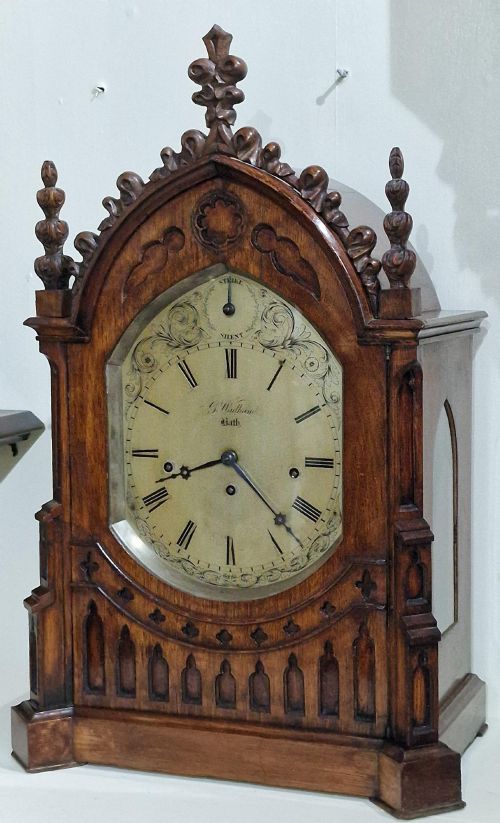
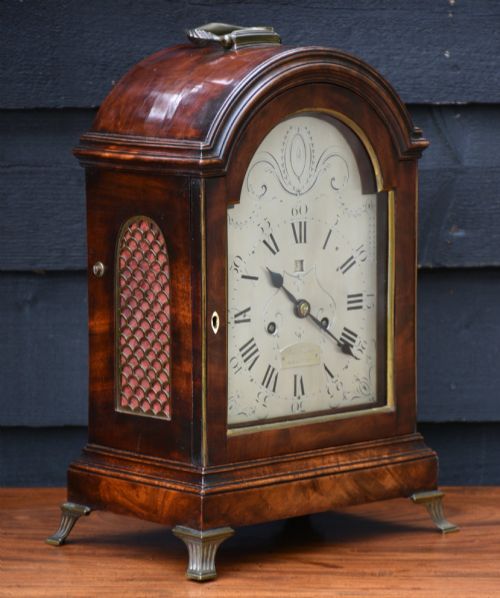
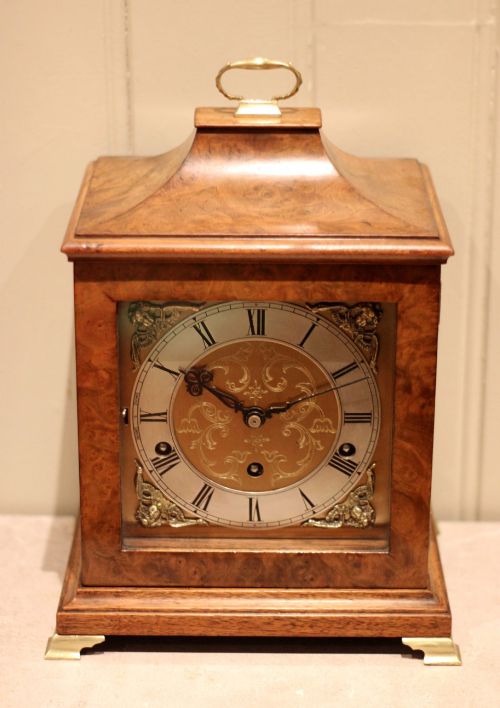
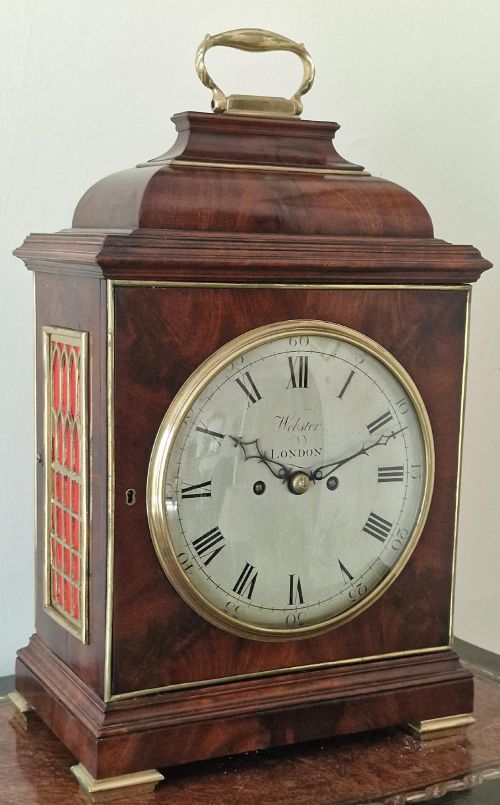
Cases were constructed from dense cabinet timbers such as mahogany, rosewood, ebony, burr walnut, and pollard oak, often featuring brass mounts, glass panels, and intricate inlay work. These materials provided the structural rigidity and aesthetic weight required for high-end domestic horology.
Movements relied on complex brass gear trains driven by steel mainsprings, frequently utilising fusee cones to equalise the power output as the spring uncoiled. Early examples employed verge escapements, while later pieces incorporated various improved regulation methods to ensure steady timekeeping.
What varies in quality
The distinction between standard and exceptional pieces rests on the integrity and sophistication of the internal movement and the crispness of the cabinetry. Master horologers engineered intricate quarter-striking or chiming complications that elevate a timepiece well beyond a simple time-only mechanism.
Cabinetwork quality shows in the selection of figured veneers, the precision of brass inlay, and the retention of original matching components rather than later replacements. Pieces bearing the signatures of noted makers demonstrate superior finishing throughout both the woodwork and the brass gear train.
Listings feature pieces spanning the seventeenth, eighteenth, and nineteenth centuries, utilising materials like ebony, rosewood, mahogany, and ormolu.
George Wadham·Mappin & Webb·Ellicott & Smith·Barber & North·John Pepys·William Speakman·Paul Philip Barraud·Brockbanks·Payne & Co
The English Spring Driven Clock Glossary
- Fusee
- A conical pulley used in spring-driven clocks to equalise the diminishing power of the mainspring as it unwinds. This mechanical device ensures consistent torque reaches the gear train for accurate timekeeping.
- Bracket clock
- A portable domestic clock designed to sit on a bracket or table. Despite the name, many stood directly on mantelpieces or chests rather than wall brackets.
- Verge escapement
- An early type of escapement mechanism that controls the release of power in the gear train. It works with a crown wheel to regulate the swings of the pendulum or balance.
- Bell-top
- A distinctive case shape where the top of the wooden enclosure curves upwards in a bell-like profile. This stylistic feature is frequently seen on Georgian and earlier bracket clocks.
- Triple fusee
- A complex movement design that drives the going train, the striking train, and the chiming train separately. It allows the clock to play musical tunes or chime quarters on bells.
English Spring Driven Clock: Frequently Asked Questions
How do spring driven clocks work?
These clocks operate by storing energy within a tightly coiled steel mainspring housed inside a barrel. As the spring gradually unwinds, it drives a train of brass gears that turn the hands and power the striking mechanism.
In many examples, a fusee cone regulates this transferred power so that the force remains steady even as the spring loses tension, ensuring more reliable timekeeping throughout the running period.
Where were bracket clocks placed?
Historically, bracket clocks sat upon matching wooden wall brackets that raised them off furniture to help project their sound through the room. Over time, many were simply placed directly onto tables, mantelpieces, or chests of drawers.
Their portable nature meant owners could easily move them between rooms as household needs changed, though their substantial weight required stable surfaces.
What is a fusee movement?
A fusee is a specially cut conical pulley connected to the mainspring by a fine cord or chain. When the clock is wound, the cord pulls from the barrel onto the wider base of the fusee, compensating for the dropping tension of the spring.
This clever mechanical device maintains even pressure across the gear train, which stands as a hallmark of higher-quality British horology.