




English Skeleton Clock
These English skeleton clock examples strip away the traditional case to expose the intricate brass and steel mechanism beneath, bringing mechanical theatre straight to the mantelpiece.
Understanding the English Skeleton Clock
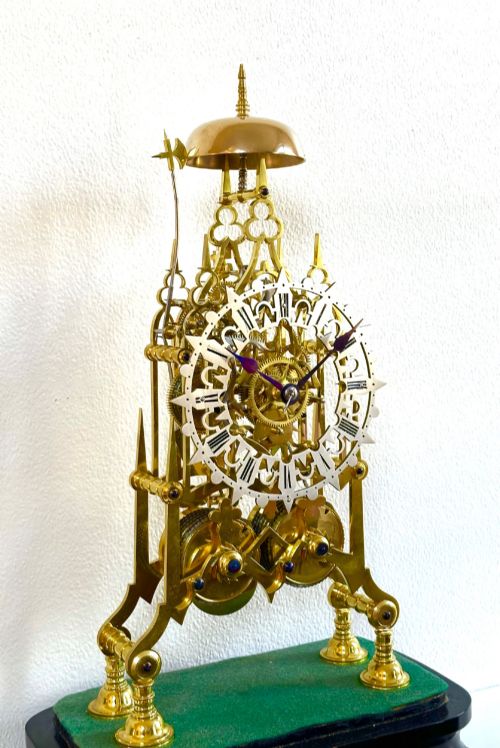
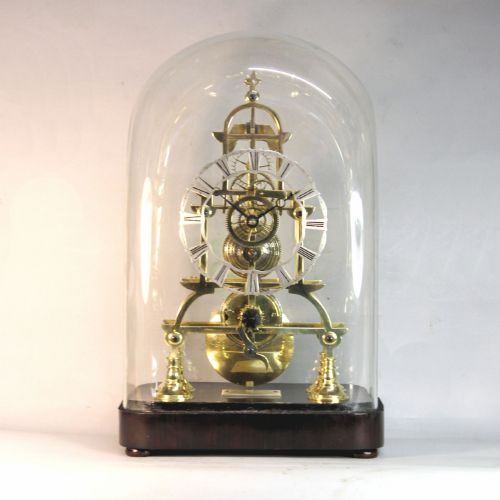
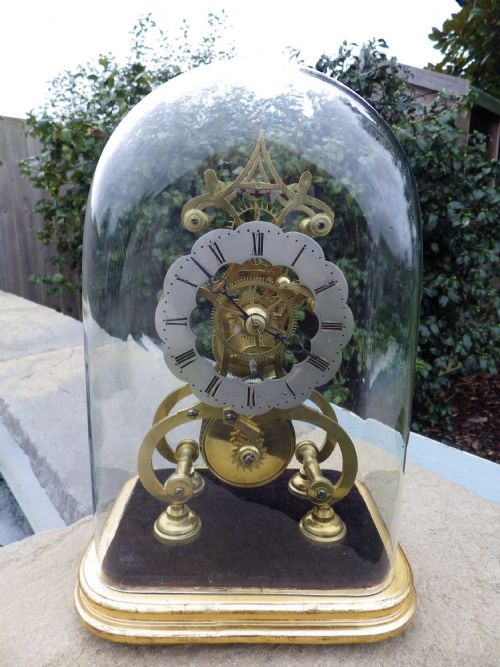
An English skeleton clock displays its gear train, wheels, and escapement openly between brass frames, often housed beneath a protective glass dome. Collectors encounter forms with lyre-shaped or square plates, seconds dials, and distinct architectural silhouettes.
The material palette visible across these pieces relies on brass, steel, silvered metal, and enamel, frequently mounted upon ebonised wood or mahogany bases with glass covers. Victorian Gothic and Regency Revival styles dominate the design vocabulary, alongside later twentieth-century rolling ball movements.
Examples range from compact fusee miniature timepieces to double fusee models and specialised escapement configurations like coup perdu detent or rolling ball mechanisms. Most date to the nineteenth century, particularly the Victorian era, though modern limited editions also appear.
Materials and Construction
Makers constructed the open frameworks primarily from brass and steel, cutting and shaping plates into architectural, lyre, or scrollwork patterns to maximise visibility of the gear train. Dials are frequently silvered metal with delicate enamel chapters and fine hands.
Power relies on fusee or double fusee movements that maintain equal force as the mainspring unwinds, driving precision escapements such as platform or coup perdu detent systems. Bases utilise solid timbers like mahogany and ebonised wood, sometimes incorporating marble elements to anchor the heavy movement.
Retail Price Guide 2026
Typical UK retail prices for english skeleton clock, calculated from the Sellingantiques database of over a million retail prices indexed since 2003. This retail price guide relies exclusively on Sellingantiques data; no external sources or auction records are used, so the figures do not describe the wider market.
Recorded styles span Victorian, Victorian Gothic, and Regency Revival, alongside twentieth-century rolling ball variations.
Assessing Quality and Execution
Finer examples distinguish themselves through the precision and complexity of the movement, such as double fusee trains or specialised escapements like coup perdu detent, rather than simple time-only layouts. The delicacy of the frame piercing and the crispness of the wheel cutting separate ordinary production from superior workshop output.
Richard Winter Of Chieveley·William Evans Of Handsworth·E White Of Manchester·Thwaites & Reed
The English Skeleton Clock Glossary
- Fusee
- A conical pulley used with a cord or chain to maintain equal power as the mainspring unwinds. This device ensures the clock maintains steady timekeeping as the spring loses tension.
- Escapement
- The mechanism that controls the release of the gear train, giving impulses to the pendulum or balance. It creates the characteristic ticking sound of the clock.
- Platform escapement
- A self-contained escapement unit mounted on a small platform, allowing a clock to run without a traditional pendulum. Miniature models frequently employ this space-saving configuration.
- Double fusee
- A movement incorporating two separate fusee cones, typically driving both the timekeeping train and the striking train independently. This setup ensures even power delivery across multiple functions.
- Coup perdu detent escapement
- A specialised high-precision escapement mechanism found in advanced horological work. It controls the drop of the pallet with minimal friction to improve accuracy.
Frequently Asked Questions
What is an english skeleton clock?
An English skeleton clock is a timepiece designed without a traditional wooden or metal case, exposing the gear wheels and plates directly to view. They are typically protected from dust by a blown or square glass dome.
These pieces were produced primarily during the Victorian period, serving as decorative and scientific centerpieces for the home. Their open design showcases the mechanical ingenuity of British horology.
How do fusee movements work?
A fusee movement uses a conical pulley connected to the mainspring via a chain or cord to regulate power delivery. As the mainspring unwinds and loses tension, the chain moves to a wider part of the cone, maintaining constant torque.
This mechanical cleverness ensures the clock runs with consistent force from the moment it is fully wound until it needs winding again. It represents a hallmark of better quality British clockmaking.
Why do some models have glass domes?
Glass domes protected the exposed, delicate brass and steel mechanisms of skeleton clocks from airborne dust, soot, and accidental damage. Because the gear trains lacked a conventional outer case, the dome was essential for daily preservation.
Many original domes sit upon mahogany, ebonised wood, or marble plinths that match the footprint of the clock base. Finding a clock with its period glass intact adds significantly to its completeness.
What is a rolling ball clock?
A rolling ball clock, such as the Congreve design, uses a ball rolling along a zigzag track to regulate the escapement instead of a pendulum or balance wheel. The weight of the ball tripping the tilt mechanism at the end of each run drives the timekeeping.
This hypnotic motion turns the clock into a kinetic sculpture as well as a timekeeper. Modern limited editions continue this fascinating nineteenth-century mechanical tradition.
How do you date an english skeleton clock?
Dating relies on stylistic clues such as the shape of the brass plates, the design of the dial, and the type of escapement utilised. Victorian Gothic and Regency Revival motifs point toward specific decades in the nineteenth century.
Maker signatures engraved on the movement plates or dials also help anchor pieces to specific historical periods. Comparing plate geometry like lyre or square forms offers further chronological guidance.