





English Regency Center Table
An English Regency centre table anchors a room with architectural presence, combining bold timber grains and classical forms.
English Regency Center Table
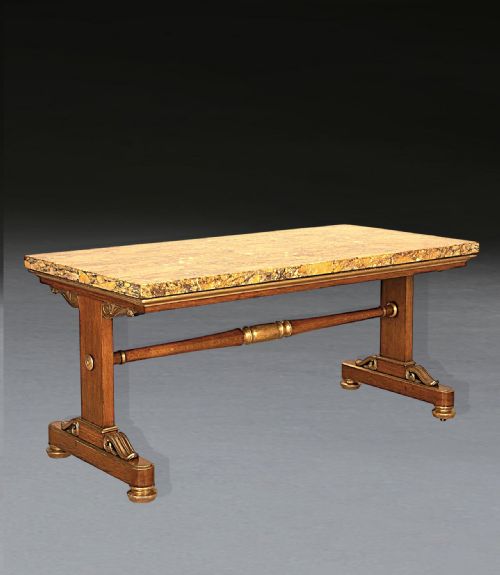
An English Regency centre table serves as a freestanding focal point within a room, designed to be viewed from all sides rather than pushed against a wall. The pieces listed across this selection encompass dedicated centre tables alongside related breakfast, tilt-top, and dining forms from the period.
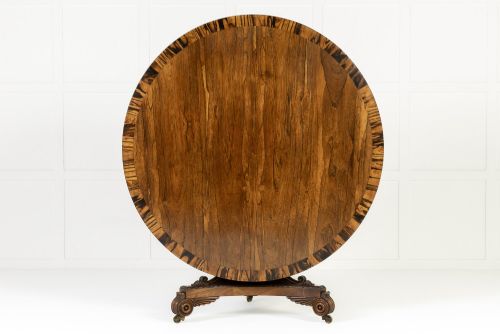
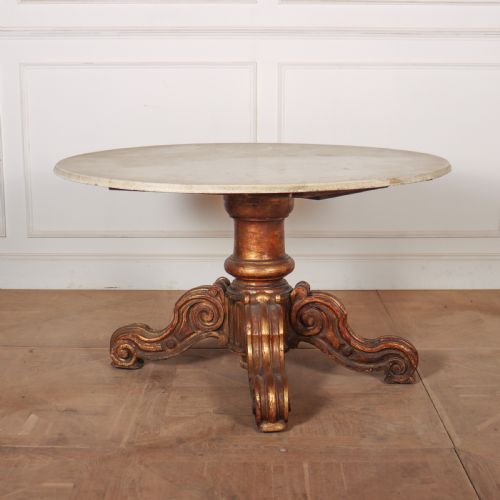
Most examples hail from the Regency and William IV eras, utilising rich timbers like mahogany, rosewood, and pollard oak. These tables frequently appear with circular or rectangular tops supported on central pedestals or robust pillar structures.
Makers of the period adapted classical architectural motifs for domestic interiors, resulting in freestanding tables that balance sculptural weight with functional surface area.
Materials and construction
Cabinetmakers selected dense, highly figured hardwoods including rosewood, figured mahogany, and pollard oak to create striking visual movement across large surface areas. These timbers were expertly veneered over stable secondary woods like oak to prevent warping.
Pedestal constructions relied on robust internal framing and weighted bases to support heavy stone or timber tops, particularly on tilt-top and breakfast variants where mechanical stability was essential.
Listings span the Regency, William IV, and George IV periods, incorporating mahogany, rosewood, pollard oak, and marble.
Judging quality and execution
Quality reveals itself in the selection of timber veneers, where book-matched grains create symmetrical patterns across the table top. Superior examples demonstrate meticulous attention to structural joinery and the crispness of carved or gilded ornamentation.
The sophistication of secondary woods and the integration of specialised materials like Siena marble or Macassar ebony distinguish high-ranking workshop output from standard domestic production.
Gillows of Lancaster and London
The English Regency Center Table Glossary
- Tilt top
- A table mechanism allowing the surface to pivot vertically for storage against a wall when not in use. This clever engineering was standard on many breakfast and occasional tables of the era.
- Pollard oak
- Timber harvested from trees that were cut back close to the trunk to encourage dense, knotty, and highly figured growth rings. Cabinetmakers prized this wood for its dramatic mottled appearance.
- Giltwood
- Timber that has been coated with a thin layer of gold leaf or gilt gesso to highlight carved architectural details. It provides a striking contrast against dark tropical hardwoods.
- Siena marble
- A yellow-gold decorative marble quarried in Italy, featuring dark grey or purple veins. Regency makers imported this stone for high-status table tops.
English Regency Center Table: Frequently Asked Questions
How do I use a centre table?
Place the table in the middle of a room where it can be approached from all sides, using the surface for lamps, books, or floral arrangements.
Because these pieces lack a designated front or back, they help break up large floor plans and improve traffic flow.
How do I tell Regency from William IV?
Regency pieces tend to feature refined classical proportions, delicate inlay, and restrained classical ornamentation drawn from Greek and Roman precedents.
William IV furniture typically displays heavier proportions, bolder pedestal bases, and more robust carving reflecting a transition toward early Victorian tastes.
Can I use a breakfast table for dining?
Breakfast tables provide a sturdy surface and comfortable height well suited for casual meals or smaller dining settings.
Their central pedestal design also ensures that diners have ample legroom without colliding with traditional corner table legs.