

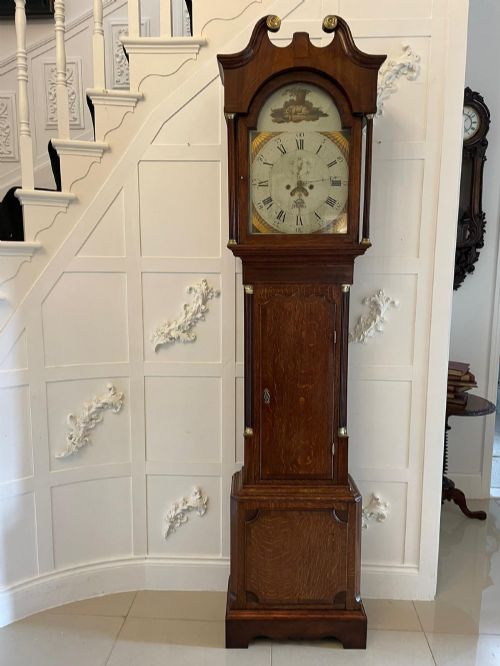
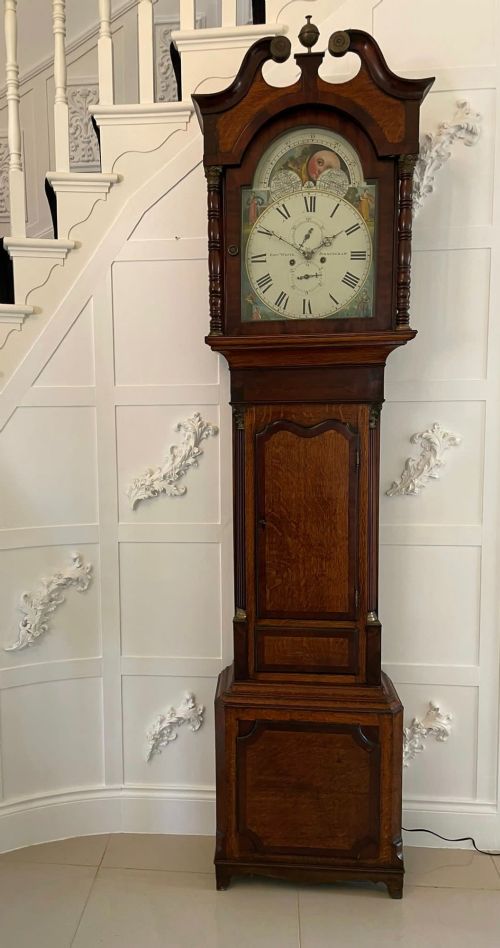
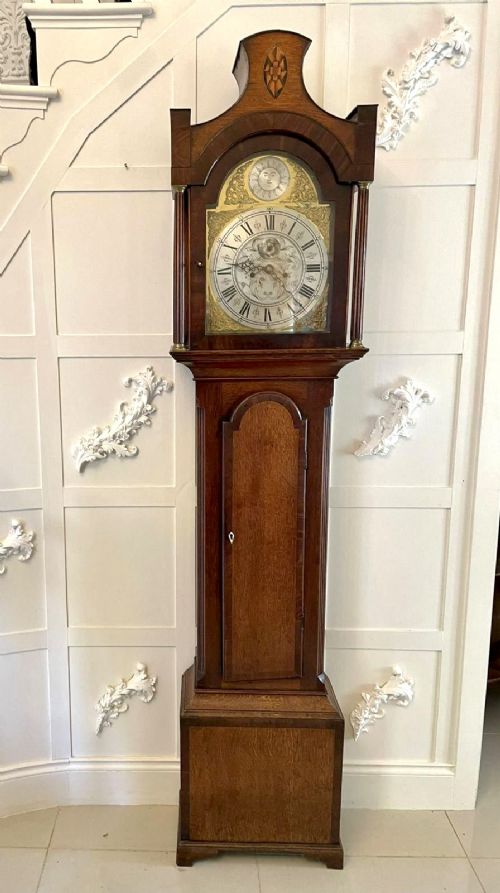
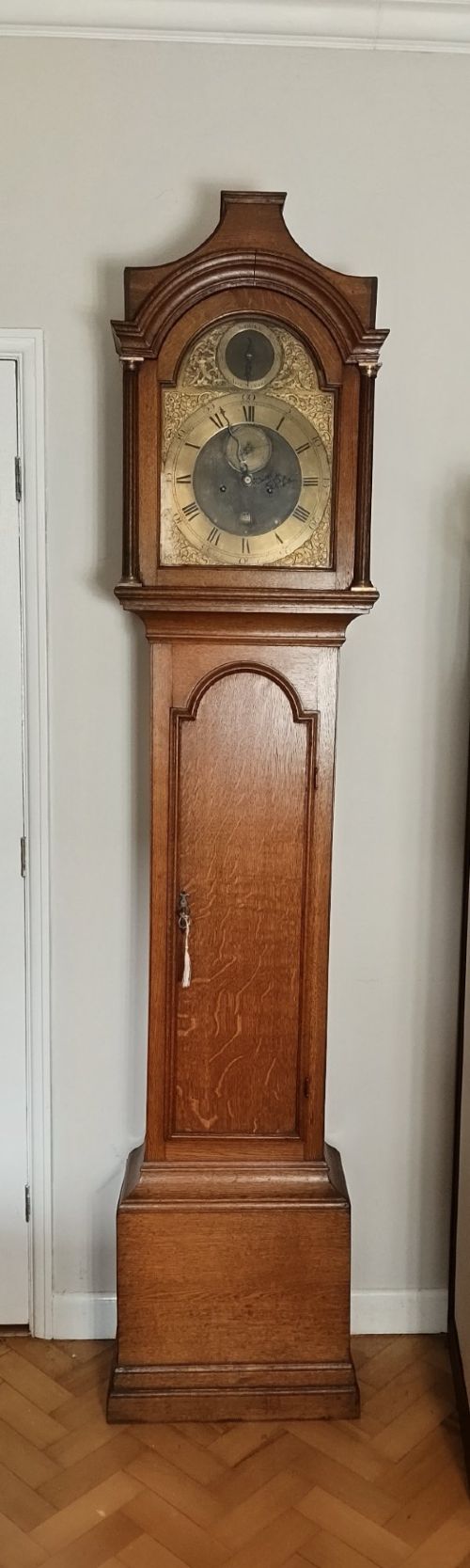





English Oak Tallcase Clock
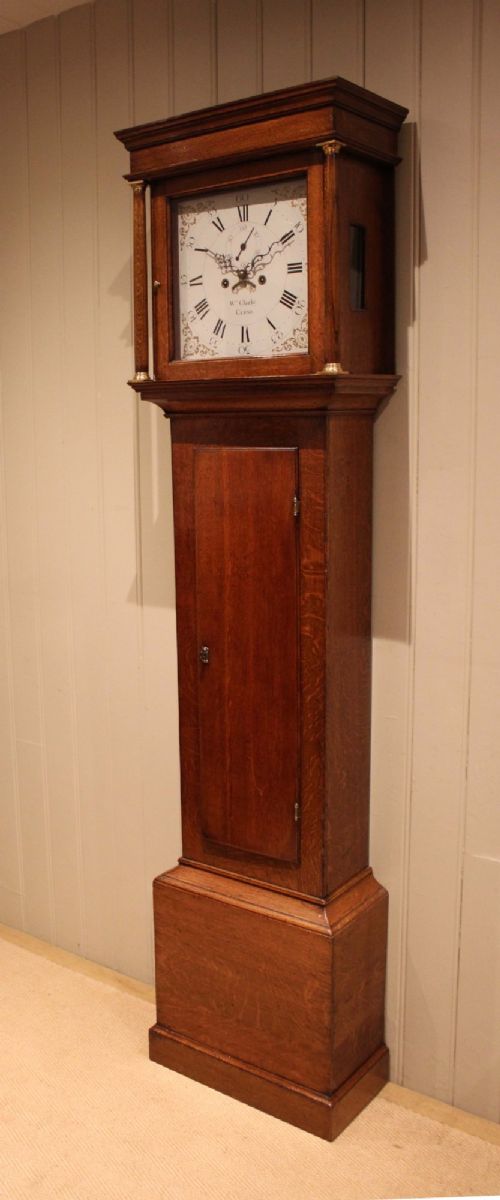
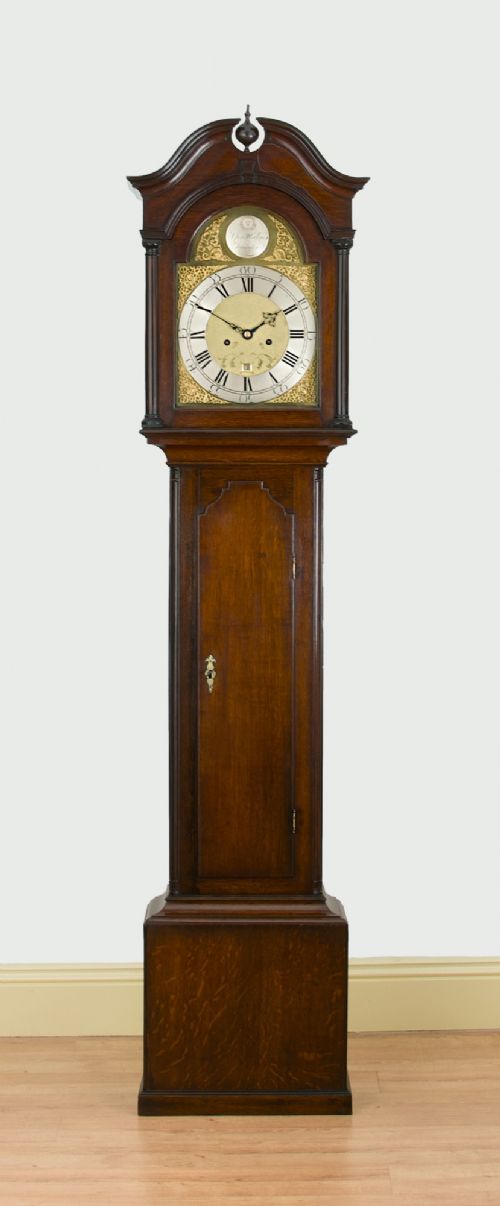
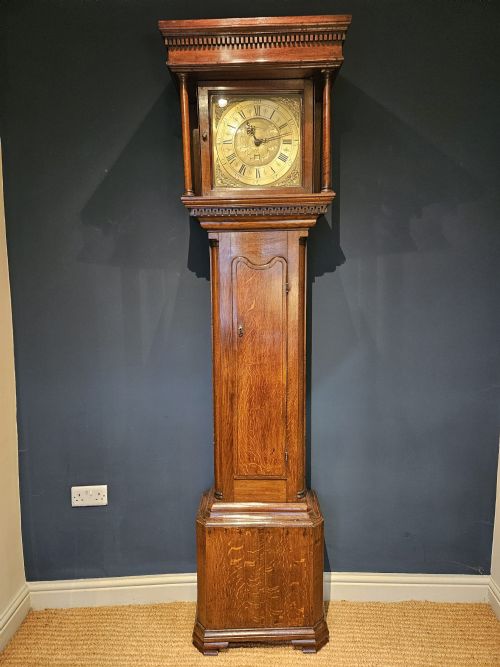
An english oak tallcase clock brings provincial cabinet-making and intricate mechanical movement together in a single upright case.
English Oak Tallcase Clock
An english oak tallcase clock stands as a substantial timekeeper, housing a weight-driven movement inside a protective wooden trunk. These pieces appear frequently from the Georgian era and the eighteenth century, showing regional variation across English towns.
Most examples combine an oak primary wood with brass dial components, often featuring glass panels protecting the face. Makers ranged from local provincial clockmakers to later commercial firms, incorporating dial sizes from compact eleven-inch faces upwards.
Materials and construction
Cabinet-makers constructed the tall cases primarily using solid oak, occasionally integrating mahogany or walnut elements, while iron and steel formed the internal wheel trains and arbours. Brass provided the foundation for engraved dials, spandrels, and movement plates.
Movements operated through suspended weights and cords or chains, occasionally controlled by a pendulum beating seconds or shorter intervals. Dial faces combined cast brass ornamentation with silvered or painted chapter rings for hour and minute indication.
English Oak Tallcase Clock Retail Price Guide 2026
Typical asking prices for english oak tallcase clock among the pieces listed under this phrase on Sellingantiques today, from the lower quarter to the upper quarter. They describe what is for sale here now, not the wider market.
Listings feature oak tallcase clocks spanning the eighteenth and nineteenth centuries alongside twentieth-century examples by makers such as Enfield and Bravingtons.
Assessing quality and execution
The refinement of the brass dial and the crispness of the engraved signature indicate the skill of the original maker. Regional provincial makers produced varied dial work, from simple thirty-hour movements to complex eight-day strike-silent mechanisms.
George Hallifax Of Doncaster·Thomas Utting of Yarmouth·John Wylde·Richard Alexander·Richard Northen·William Harley·James Draycot Wells·Herbert of Haversham·John Bishop of Sherborne·Vurley of Wisbech·Winstanley Wigan·Ed Hemmins of Bicester
The English Oak Tallcase Clock Glossary
- Tallcase clock
- An alternative term for a grandfather clock, describing a weight-driven timekeeper housed in a tall wooden case. These upright clocks protected the pendulum and weights from dust and accidental disturbance.
- Chapter ring
- The circular ring on the clock face that displays the numerals for the hours and minutes. On brass dial examples, this ring was typically silvered to contrast with the dark cast brass background.
- Spandrel
- The ornamental corner piece situated between the dial chapter ring and the outer edge of the square or arched dial. Early examples often feature cast brass cherub or scroll designs.
- Strike-silent
- A mechanism allowing the striking train of the clock to be disengaged so the clock remains quiet during the night. This complication required additional wheelwork behind the dial.
- Thirty-hour movement
- A clock mechanism designed to run for approximately one day before requiring the weights to be pulled up again. These movements were simpler and less expensive than eight-day variants.
English Oak Tallcase Clock: Frequently Asked Questions
How do I wind the clock?
Most eight-day movements require the weights to be manually drawn up using a crank key inserted into winding holes on the dial face once a week. Thirty-hour chain-driven versions are wound by pulling the hanging chains downwards until the single weight reaches the top.
Care must be taken not to overwind the movement, stopping as soon as resistance is felt on the key or chain.
Where should I place it?
Tallcase clocks require a stable, dry interior wall with a solid floor to prevent vibrations from disturbing the pendulum swing. Placing the case away from direct sunlight and heat sources protects the oak timber and internal wooden components from excessive drying.
Sufficient vertical clearance is essential to accommodate the height of the case and the suspended weights inside the trunk door.
How do I set the correct time?
The minute hand can be moved forward gently to the correct time, allowing the striking train to complete its sequence at each hour. Moving the hands backward should generally be avoided unless the specific movement design explicitly permits it.
Allowing the pendulum to settle after moving the hands ensures the beat remains even and the clock keeps steady time.
What is the difference between thirty-hour and eight-day?
A thirty-hour clock utilises a simpler movement train that needs winding daily or weekly depending on the specific weight drop, often driven by a single cord or chain. An eight-day movement incorporates two or more separate gear trains for timekeeping and striking, requiring winding only once a week.
Eight-day dials frequently feature two winding holes on the face, whereas thirty-hour examples typically show a single central hole or operate via exposed drop chains.