


English Georgian Corner Cupboard
When searching for an english georgian corner cupboard, you encounter timber cabinets designed to utilise forgotten room angles efficiently.
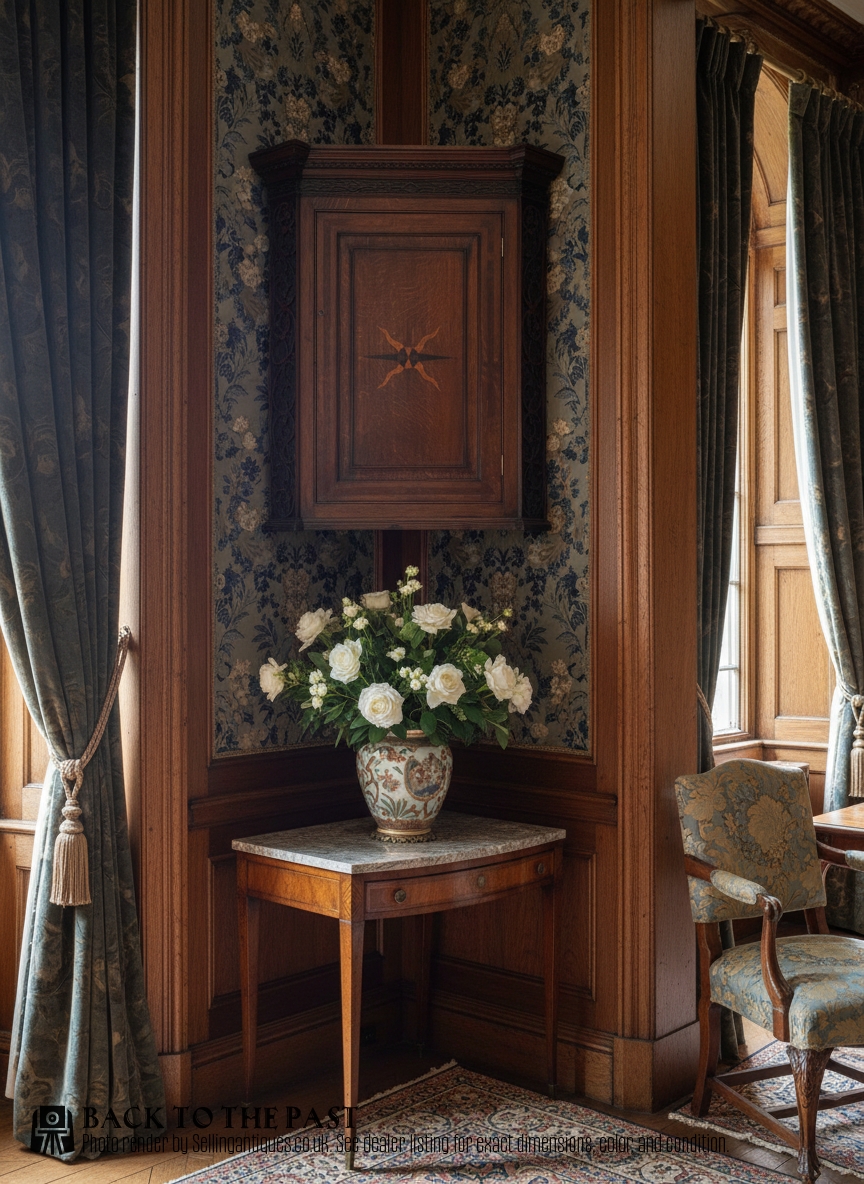
English Georgian Corner Cupboard
An english georgian corner cupboard provides storage designed specifically to fit into the right-angled junction of a room. These pieces appear primarily as wall-hanging cabinets or tall floor-standing cupboards dating from the eighteenth century into the nineteenth century.
The dominant forms on this page include bow-fronted hanging units and two-part floor-standing cabinets. Makers constructed these items to maximise domestic space while displaying porcelain or concealing household stores.
Examples span the reigns of the Georges, including George III Sheraton styles alongside later Edwardian revivals. Oak and mahogany serve as the primary timbers encountered across these domestic storage forms.
Materials and Construction
Cabinet makers utilised solid oak and rich mahogany timbers, frequently incorporating flame mahogany veneers and contrasting satinwood inlays. Brass hardware provides hinges and key escutcheons on doors securing the internal shelving.
Glazed doors often incorporate astragal bars dividing the glass panes for display purposes. Construction methods rely on traditional joinery to build rigid panelled carcasses capable of supporting wall-hanging loads or standing upright on floor plinths.
Surviving examples demonstrate glazing variations from plain timber panels to intricate astragal glass bars.
Evaluating the Pieces
Quality separates standard utilitarian storage from finer architectural cabinetwork through the selection of timber veneers and decorative details. Flame mahogany figuring and precise crossbanding elevate the visual impact of the facade.
Internal elements such as shaped shelving, painted interiors, and fine astragal glazing bars distinguish superior pieces. The crispness of carved mouldings and the retention of original brass fittings further divide the range.
The English Georgian Corner Cupboard Glossary
- Bow front
- A convex curved cabinet front that projects outward from the corner walls. This profile softens the rigid geometry typical of standard corner furniture.
- Astragal
- Moulded timber bars dividing glass panes within a cabinet door. These delicate divisions form geometric patterns typical of display pieces.
- Crossbanding
- A decorative border of veneer laid with the grain running perpendicular to the surrounding panel. This technique frames drawer fronts and door panels.
- Satinwood inlay
- Contrasting light-toned timber inserted into darker primary wood surfaces. Artisans arrange these elements into geometric or floral motifs.
- Flame mahogany
- A veneer cut from the fork of the mahogany tree producing a wavy, flame-like grain pattern. Cabinet makers utilised this prized timber on primary display surfaces.
English Georgian Corner Cupboard: Frequently Asked Questions
How do I hang a heavy corner cupboard?
Wall-hanging corner cupboards require secure fixing directly into masonry or substantial timber wall studs using appropriate heavy-duty brackets. The weight of solid oak or mahogany combined with internal contents demands robust structural support.
Professional installation prevents the cabinet from pulling away from the corner angles over time. Ensure the wall structure bears the load before loading shelves with heavy porcelain or glass.
Were these cabinets meant for kitchens or parlours?
Georgian corner cupboards served multiple domestic spaces, appearing in dining rooms, parlours, and bedrooms. Floor-standing versions stored china and glassware, while smaller hanging cupboards held precious provisions or medicines.
Display variants with glazed doors allowed owners to exhibit imported ceramics. Plain timber doors suited private spaces where contents required concealment rather than display.
What is the difference between hanging and standing models?
Hanging models attach directly to wall surfaces and typically feature single doors with internal shelving. Standing models rest upon the floor, often constructed as two-part units with a lower cupboard base beneath an upper display section.
Floor-standing versions offer significantly greater storage capacity and a commanding architectural presence. Hanging cabinets provide space-saving storage without occupying valuable floor area.
How do I identify a George III piece?
George III pieces date from the mid to late eighteenth century and display characteristic restraint and proportion. Look for straight lines, mahogany or oak timbers, and subtle string inlay rather than heavy carving.
Astragal glazed doors and swan neck pediments often accompany pieces from this era. Construction details like hand-cut dovetails help confirm the eighteenth-century period of manufacture.