



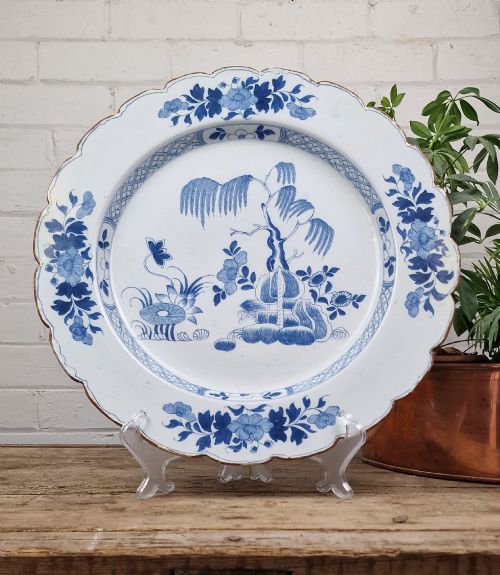


English Delftware Platter
An english delftware platter is a tin-glazed earthenware dish from the eighteenth century, sought after for its hand-painted blue and white or polychrome surfaces.

English Delftware Platter
An english delftware platter takes the form of a large charger or decorative plate produced during the eighteenth century. These substantial round dishes served primarily as display pieces on sideboards or walls rather than for daily dining.
Most examples found here date across the eighteenth century, featuring the characteristic tin glaze applied over an earthen clay body. Makers utilised cobalt pigment and polychrome colours to paint scenes influenced by Georgian styles and Chinese export porcelain.
The assortment relies heavily on chargers and decorative plates attributed to English production centres such as Bristol. Buyers encounter both blue and white compositions and richer multi-coloured palettes characteristic of the period.
How they were made
Potters shaped earthenware clay into broad, shallow platters before firing the body to create a porous base. This earthenware foundation received an opaque white tin glaze that dried to a smooth, slightly undulating surface ready for decoration.
Artists painted directly onto the unfired tin glaze using cobalt pigment for blue designs or various metallic oxides for polychrome work. The piece then underwent a high-temperature kiln firing that fused the pigments into the molten glaze.
English Delftware Platter Retail Price Guide 2026
Typical asking prices for english delftware platter among the pieces listed under this phrase on Sellingantiques today, from the lower quarter to the upper quarter. They describe what is for sale here now, not the wider market.
The selection spans the eighteenth century, featuring earthenware bodies finished with tin glaze and cobalt pigment.
What varies in quality
Quality depends upon the clarity and control of the painted brushwork across the tin-glazed surface. Rapidly executed floral motifs contrast with finely detailed chinoiserie scenes that demand greater skill from the decorator.
The stability and coverage of the tin glaze itself distinguish finer platters from simpler utilitarian output. An even, glossy white ground provides a better contrast for the cobalt pigment and polychrome details.
The English Delftware Platter Glossary
- Tin Glaze
- An opaque white glaze containing tin oxide applied to earthenware bodies. It creates a smooth surface that accepts painted cobalt pigment.
- Charger
- A large ornamental plate or platter designed for display rather than table service. These pieces measured significantly wider than standard dining plates.
- Polychrome
- Decoration employing multiple colours rather than a single pigment. On these wares, it typically includes combinations of iron red, yellow, green, and blue.
- Chinoiserie
- European artistic styles inspired by Chinese design motifs. Eighteenth-century potters frequently painted imaginary oriental landscapes on their tin-glazed platters.
English Delftware Platter: Frequently Asked Questions
What is an english delftware platter?
An english delftware platter is a tin-glazed earthenware dish made during the eighteenth century. These large chargers feature hand-painted cobalt blue or polychrome designs.
Potters produced them across England, with notable output from centres like Bristol. They functioned primarily as decorative wall or sideboard pieces.
How do I care for my platter?
Keep tin-glazed earthenware away from moisture and damp environments to protect the porous clay body. Display the charger securely on a stable wall hanger or stand.
Dust the surface gently with a soft, dry cloth. Avoid washing these historic ceramic pieces in water or using modern cleaning agents.
Are these platters safe for food?
Historic english delftware platters are not suitable for serving food today. The historic tin glaze and earthenware body can absorb moisture and food acids.
Furthermore, eighteenth-century glazes may contain materials that are unsuitable for modern culinary use. Enjoy these chargers purely as decorative works of art.
How do I date an eighteenth-century charger?
Dating relies on stylistic clues, potting characteristics, and pigment application. Eighteenth-century pieces exhibit specific tin-glaze formulations and brushwork styles typical of Georgian production.
Examining the foot ring and the back of the earthenware body also reveals manufacturing traits unique to this period.