



English Carriage Clock
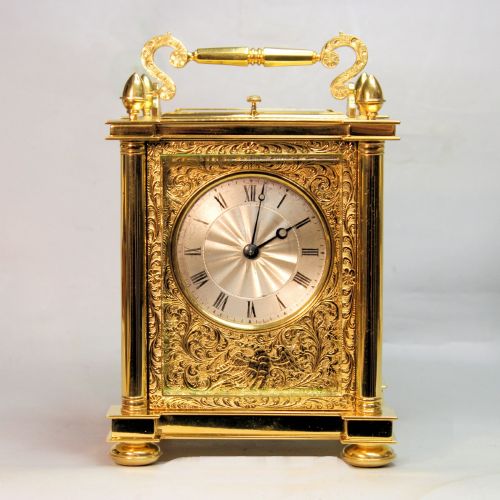
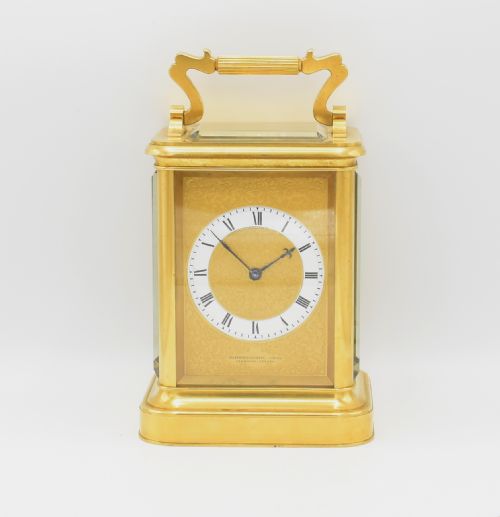
An english carriage clock is a portable timepiece housed in a glass and metal case, prized for its mechanical ingenuity and handsome desk presence.
English Carriage Clock
An english carriage clock is a portable timepiece designed for travel or domestic desk use, enclosed in a protective metal and glass framework. These pieces range from substantial nineteenth-century fusee movements to twentieth-century editions.
The version most frequently met on this page is the brass cased model from the Victorian period, often featuring white enamel dials and bevelled glass panels. Miniature formats and silver cases also appear across various decades.
Makers housed these mechanisms in sturdy brass, silver, or tortoiseshell housings, sometimes pairing them with protective glass display domes. They function as both reliable timekeepers and decorative objects of substantial weight.
What varies in quality
Quality rests upon the complexity of the internal movement, distinguishing simple timepieces from those with quarter striking or grande sonnerie capabilities. Fusee movements generally represent superior mechanical ambition compared to standard barrel springs.
The craftsmanship of the exterior case dictates standard, with hand-engraved brass, solid silver, or tortoiseshell housings showing greater artistry than plain cast brass boxes. Maker attribution also elevates a piece considerably.
English Carriage Clock Retail Price Guide 2026
Typical asking prices for english carriage clock among the pieces listed under this phrase on Sellingantiques today, from the lower quarter to the upper quarter. They describe what is for sale here now, not the wider market.
Some travel clocks came with velvet lined leather cases so bumpy Victorian carriage rides would not disturb the delicate balance wheel.
Cousens And Whiteside·John Morley·J Batson And Son·Arnold And Frodsham·Thomas Cole·James Cole·Henry Matthews·Dent·Matthew Norman
The English Carriage Clock Glossary
- Fusee
- A conical pulley used in a clock to maintain even power from the mainspring as it unwinds. This mechanism ensures more consistent timekeeping throughout the power reserve.
- Grande-Sonnerie
- A complex striking train that chimes the hours and quarters automatically on every quarter hour. It represents a high achievement in horological engineering.
- Gorge case
- A distinctively shaped rectangular brass carriage clock case with moulded top and bottom cornices. It is a classic housing style for fine nineteenth-century movements.
- Escapement
- The mechanism that controls the rotation of the gear train by releasing the wheel at regular intervals. It produces the characteristic ticking sound of the clock.
- Carriage clock
- A small, portable spring-driven clock originally built for travellers in the nineteenth century. They usually feature a folding handle on top.
English Carriage Clock: Frequently Asked Questions
How do I wind an english carriage clock?
Most models require a specialised key inserted into the rear dust cover to tension the mainspring barrels or fusee chain. Care must be taken not to overwind the mechanism.
Some fusee movements require particular attention to direction and frequency to avoid damaging the delicate internal gearing.
Why does my clock have a platform escapement?
The platform escapement mounts the balance wheel and regulating components on a small removable plate above the movement. This innovation allowed portable clocks to keep accurate time despite motion.
Invented to replace pendulums, this platform enables the clock to function reliably on uneven surfaces and during travel.
What is the difference between a timepiece and a clock?
In horological terms, a timepiece is a clock that measures hours and minutes without any striking or chiming mechanism. It performs only the basic function of telling time.
A clock includes additional gear trains to strike the hours or quarters, requiring extra winding barrels and bells or gongs inside the case.
How do I date a silver carriage case?
British silver cases carry hallmark stamps denoting the assay office, standard mark, and a specific date letter corresponding to the year of manufacture. These small stamped marks provide precise chronological information.
Examining these stamps alongside the maker's mark allows collectors to trace the exact origin and production year of the housing.