
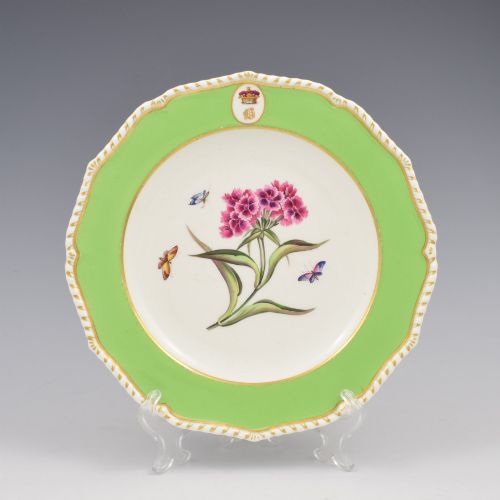


English Armorial China
English armorial china carries the crests and coats of arms of historic families, offering tangible links to aristocratic provenance through fine porcelain.
English Armorial China
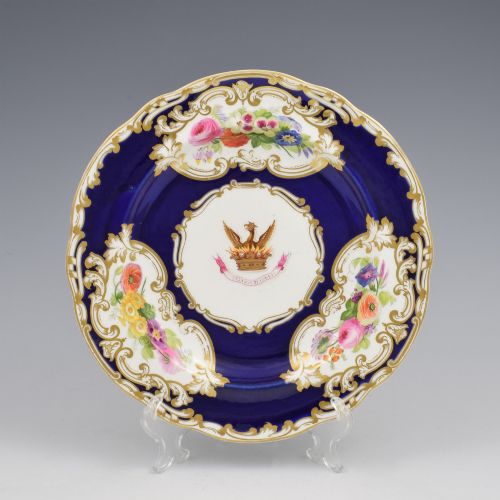
When you search for English armorial china, you are looking at plates, teacups, saucers, servingware, and tureens painted with family crests and heraldic devices. These wares were commissioned by nobility, bishops, and landed families for grand dining and formal service.
The pieces on this page span the 18th century, the Georgian and Regency periods, and the Victorian era. You are most likely to encounter dessert plates and teacups bearing hand-painted crests from factories operating around 1800 and the early 19th century.
Surviving examples connect directly to specific historic commissions, such as services made for noblemen, the Prince Regent, or the Nawab of the Carnatic. Each piece serves as a surviving fragment of a larger aristocratic dining service.
How they were made
These items are formed from porcelain, bone china, and soft-paste porcelain, shaped into plates, dishes, and hollowware. Potters shaped the clay bodies before firing them to create the white ceramic base.
Decorators applied cobalt enamel, polychrome enamel paints, and gold leaf or gilt accents by hand. Heraldic crests were meticulously painted to record the exact heraldry of the commissioning family, then fired to fuse the pigments onto the glaze.
A stately phoenix rising in flames guards the family crest on a mid-19th century plate, proving that heraldry loves dramatic theatricality.
What varies in quality
Quality rests upon the precision and detail of the hand-painted heraldry and botanical or decorative borders. Finer pieces display crisp brushwork in the crests and intricate gilding that remains bright and well-defined.
The prestige of the original maker and the historical significance of the service elevate certain items. Works from notable workshops like Worcester, Derby, or Copeland carrying documented aristocratic provenances stand at the upper end of the range.
Bloor Derby·Copeland·Coalport·Flight Barr And Barr·Chamberlain Worcester·Minton
The English Armorial China Glossary
- Armorial
- Bearing a coat of arms or heraldic crest. This term describes porcelain commissioned to display a family's specific heraldic insignia.
- Soft-Paste Porcelain
- An early form of ceramic composed of clay and glass frit, fired at lower temperatures than hard-paste porcelain. It produces a warm, slightly translucent body common in 18th-century pieces.
- Bone China
- A porcelain type containing bone ash, developed to provide strength and whiteness. It became a standard material for fine tableware in the 19th century.
- Gilt
- Applied gold used to embellish rims and borders. This decorative finish catches the light and highlights the edges of plates and tureens.
- Soup Plate
- A wide plate with a shallow well, designed for serving soup at formal dinners. They often feature armorial decorations on the rim.
English Armorial China: Frequently Asked Questions
How do I identify the family on armorial china?
You identify the family by researching the heraldic crest, motto, or coat of arms painted on the ceramic surface. Reference books on heraldry help match these visual elements to historic peerage records.
Many pieces also include clues within the titles or provenance notes recorded by dealers, linking specific services to titled figures and landed gentry.
Were these pieces used daily or displayed?
Most armorial services were created for important dining occasions, political banquets, and hosting high-ranking guests. They formed part of large working services rather than purely decorative cabinet displays.
Over time, surviving items transitioned from active dining rooms into cabinet plates and curated collections preserved by later owners.
How can I tell Regency pieces from Victorian ones?
Regency pieces often exhibit neoclassical shapes, delicate floral borders, and soft enamel palettes typical of the early 19th century. Maker marks from Worcester or Derby during this era follow specific historic patterns.
Victorian pieces, particularly those from the mid-19th century onward, frequently feature heavier gilt work, bolder colours, and denser decorative borders reflecting changing aesthetic tastes.