


Empire Gilt Bronze Chair
An empire gilt bronze chair brings commanding neoclassical weight and rich mounts to a room.
Empire Gilt Bronze Chair
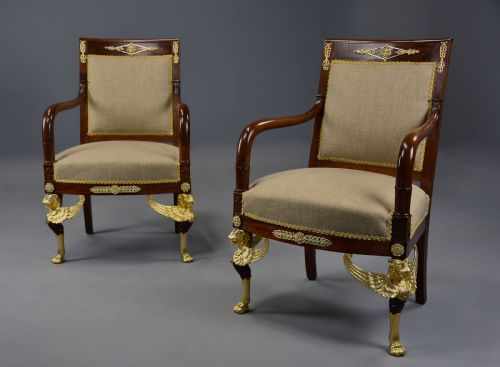
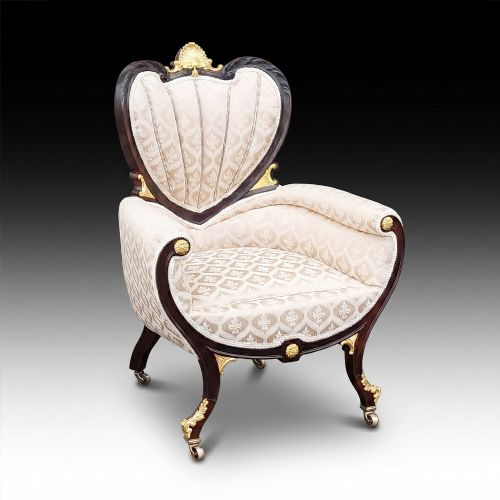
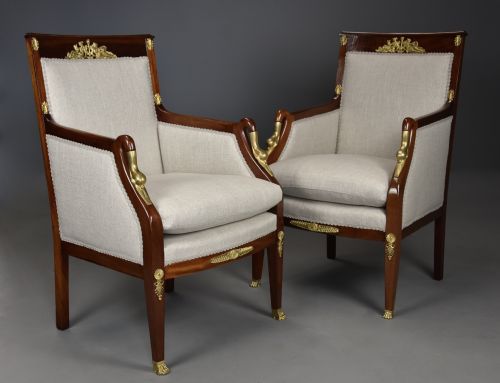
An empire gilt bronze chair delivers formal neoclassical presence through architectural mahogany frames and gleaming metal mounts. These seats range from grand open armchairs to dedicated desk chairs and complete lounge suites.
Most examples encountered here date from the nineteenth century, including revival pieces produced through the later decades up to nineteen twenty. French Empire and Swedish Empire revival iterations dominate the selection.
Makers drew on classical antiquity for structural lines, creating substantial seating designed to project authority and refined taste. Buyers encounter both single armchairs and matched pairs built for formal interiors.
Materials and construction
Frames are constructed primarily from solid mahogany or bronzed wood, providing a dark, dense foundation that contrasts sharply with bright metal. Upholstery employs traditional textiles including leather, linen, and patterned fabric.
Cast ormolu and gilt bronze mounts are meticulously applied to accent structural joints, crest rails, and arm terminals. Brass details frequently supplement the gilt bronze elements to complete the decorative scheme.
Periods represented span from the Regency era through late nineteenth century French production up to nineteen twenty.
Assessing quality
Quality rests in the crispness of the cast bronze or ormolu mounts and the depth of the mahogany grain. Finer examples display sharp chisel work on the metal and seamless integration between wood and ornament.
Proportion and structural rigour separate standard production from superior pieces, particularly in revival works where casting weight and timber selection dictate overall presence.
George Smith
The Empire Gilt Bronze Chair Glossary
- Ormolu
- Gilded bronze applied as a decorative mount on furniture. This technique creates a rich golden finish that highlights architectural details.
- Fauteuil
- An open-framed armchair with upholstered back and armrests, typically featuring exposed wood. The style originated in France and remains central to neoclassical seating.
- Regency
- A British design period spanning the early nineteenth century characterised by classical revival motifs. Pieces from this era often incorporate bronzed and parcel-gilt finishes.
- Fauteuil du bureau
- A specialised desk chair designed for administrative or library use. These chairs combine supportive upholstered backs with mobility and desk-height proportions.
Empire Gilt Bronze Chair: Frequently Asked Questions
What defines an empire gilt bronze chair?
These chairs combine heavy mahogany or bronzed wood frames with distinct classical proportions and bright metallic mounts. They draw directly on ancient Roman and Greek design vocabulary.
Craftsmen utilised cast ormolu and gilt bronze to accentuate structural elements, creating a formal seating form intended for libraries, studies, and grand reception rooms.
How do I date a revival piece?
Revival pieces from the late nineteenth and early twentieth centuries adopt the vocabulary of earlier French and Swedish models. Examining the timber preparation and casting style helps distinguish original nineteenth century production from later revivals.
Makers working in eighteen seventy or nineteen twenty often applied revival styles with distinct local joinery methods and specific upholstery textiles of their own era.
Were these chairs used at desks?
Specific forms such as the fauteuil du bureau were constructed precisely for writing tables and library desks. Their proportions allow for comfortable seated work while maintaining formal neoclassical dignity.
These desk variants feature supportive upholstered backs and sturdy armrests designed for prolonged use in private studies or formal offices.
How should I integrate one into a modern room?
An empire gilt bronze chair works effectively as a statement piece in a contemporary interior, contrasting clean modern walls with rich mahogany and warm metal. Pairing a single armchair with simpler furnishings lets the architectural lines stand out.
Consider placing a desk chair at a minimalist workspace or positioning an open armchair in a reading corner where the gilt bronze mounts catch natural light.