
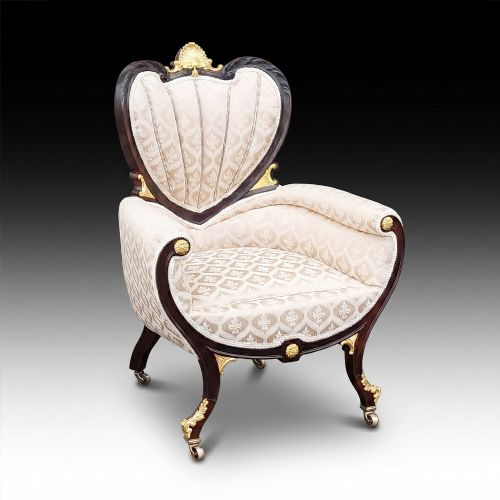

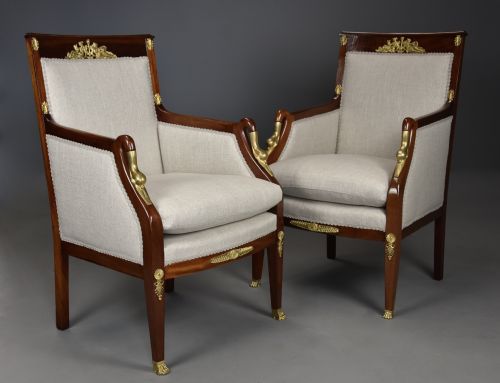


Empire Style Fauteuil
An empire style fauteuil brings classical authority and commanding presence to a room, offering structured seating rooted in monumental design.
Empire Style Fauteuil
When you search for an empire style fauteuil, you look at seating derived from the grand neoclassical vocabulary of early nineteenth-century France. These armchairs typically feature open arms, upright stances, and rectilinear or curule frames designed to project dignity and power.
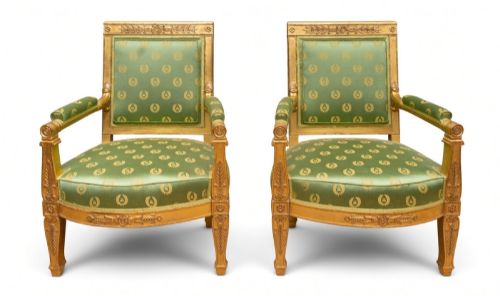
The versions most common on this page span the nineteenth century and the later revival periods of the late nineteenth and early twentieth centuries. These pieces appear in forms ranging from standard salon open armchairs and desk chairs to complete salon suites.
Makers and workshops adapted the initial French Empire idiom across subsequent decades, producing variations that include French Restauration, Italian Neoclassical, and Grand Regency interpretations. Each iteration retains the core architectural gravity that defines the type.
Materials and Construction
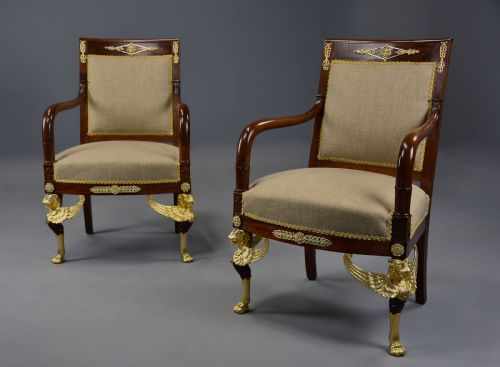
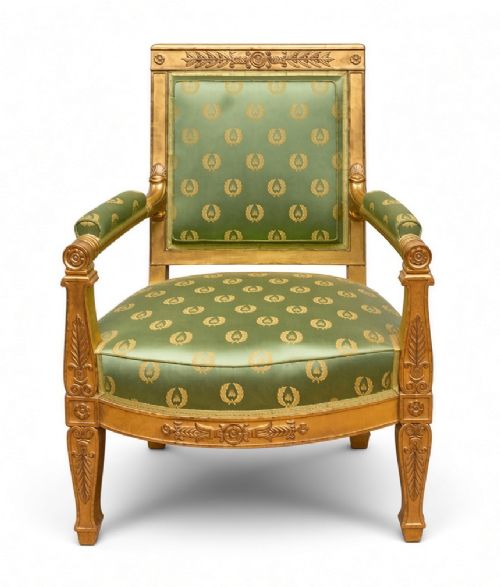
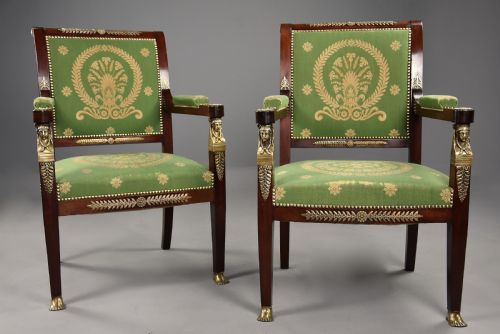
Makers built the primary frame of an empire style fauteuil in solid mahogany, often complemented by carved and painted or giltwood surfaces. This dense timber provided the structural integrity required for the assertive profiles and broad members characteristic of the style.
Ornate metal mounts in ormolu and brass punctuate the wood structure, accentuating structural junctions and classical motifs. Upholstery utilises traditional textiles including silk, linen, and decorative fabric to finish the seating surfaces.
Empire Style Fauteuil Retail Price Guide 2026
Typical asking prices for empire style fauteuil among the pieces listed under this phrase on Sellingantiques today, from the lower quarter to the upper quarter. They describe what is for sale here now, not the wider market.
The furniture forms represented include standard salon armchairs, specialised desk chairs, and multi-piece salon suites.
Judging Quality and Execution
The distinction between tiers of execution rests in the crispness of carved wooden details and the precision of the gilt bronze or ormolu mounts. Superior examples display sharply defined mounts and deeply rendered carving that integrate seamlessly with the timber frame.
Proportion and structural harmony also separate standard production from exceptional pieces, as finer chairs maintain balanced classical lines without heavy or clumsy joinery. The authority of the silhouette dictates the overall success of the chair.
Jacob Desmalter
The Empire Style Fauteuil Glossary
- Fauteuil
- An open-arm armchair originating in France, characterised by upholstered back and seat panels with exposed wooden arms. This form became a cornerstone of formal seating arrangements.
- Ormolu
- Gilt bronze mounted upon furniture pieces to provide gleaming neoclassical decorative highlights. The technique involves applying a finely ground gold-mercury amalgam to bronze.
- Restauration
- A stylistic period bridging the initial Empire idiom and later revivals, marked by refined proportions and understated classical restraint. Pieces from this era often soften the severe military stance of earlier designs.
- Giltwood
- Timber coated with a thin layer of gold leaf over a prepared gesso ground. This treatment creates a brilliant reflective surface suited to formal neoclassical interiors.
- Curule
- A distinctive X-shaped furniture form derived from ancient Roman magistrate seats. It appears frequently in the base structures and supports of Empire seating.
Empire Style Fauteuil: Frequently Asked Questions
How do I identify an empire style fauteuil?
An empire style fauteuil is identified by its strict neoclassical geometry, rectilinear or subtly curved mahogany frame, and classical bronze or ormolu mounts.
Look also for architectural arm supports and an upright stance that reflect ancient Roman and Egyptian design influences.
Where were empire style fauteuils placed?
These armchairs served primarily in formal salons, libraries, and withdrawing rooms where their commanding presence reinforced the decor.
Desk chair variants, known as fauteuils du bureau, were specifically constructed for studies and administrative spaces.
Can I use an empire fauteuil daily?
These historic armchairs function well for everyday seating provided the internal frame and upholstery webbing remain sound and stable.
Their robust mahogany construction offers durable support for regular use in contemporary living environments.
What is the difference between original and revival pieces?
Original pieces date from the early nineteenth-century Napoleonic and Restauration periods, carrying period construction methods and patination.
Revival pieces originate from later nineteenth and twentieth-century interpretations, replicating the classical vocabulary with alternative dating markers.