
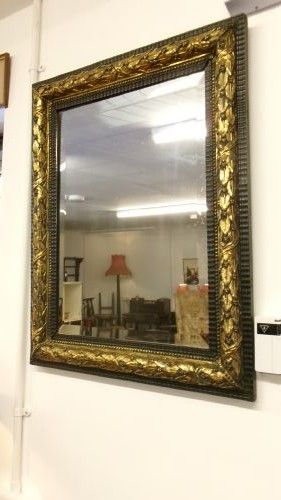


Embossed Brass Frame Mirror
An embossed brass frame mirror brings warmth and reflective depth to a room through richly patterned metalwork.
Embossed Brass Frame Mirror
An embossed brass frame mirror is a decorative looking glass defined by its metalwork border, originating primarily across the nineteenth and early twentieth centuries. These pieces appear in forms such as wall mirrors and dressing table mirrors, shaped as rectangular, circular, oval, or cushion-framed designs.
The aesthetic draws heavily on historical revivals and regional styles, ranging from Flemish Renaissance and Dutch Baroque revivals to Victorian Rococo, French nineteenth-century designs, and Glasgow Style arts and crafts. Buyers are most likely to encounter Victorian and later examples incorporating repoussé work, hand embossing, or cast brass mounts.
Origins span British, French, and Dutch workshops, with construction frequently pairing the brass frame with wood, leather backing, and bevelled glass. Each style offers a distinct visual weight, from simple small wall frames to deep cushion frames flanked by detailed motifs.
Materials and construction methods
The manufacture of these looking glasses relies primarily on sheet brass manipulated through repoussé and hand embossing techniques to raise patterns from the reverse or front. Artisans frequently mounted these thin metal sheets onto wooden substrates or leather backings to provide structural rigidity.
Frames incorporate varied glass forms, including standard mirror glass and bevelled glass edges that catch the light. Patinated brass and enamel details complete the surface finish, while secondary materials like wood and leather secure the glass safely within its metal housing.
Design revivals recorded in the inventory include Flemish Renaissance, Dutch Baroque, and Victorian Rococo, alongside Glasgow Style arts and crafts.
Assessing quality in metalwork and glass
Quality rests in the depth and crispness of the hand-embossed or repoussé decoration, where sharp, deliberate chasing distinguishes superior metalwork from flat, mechanical stamping. The weight of the brass and the integrity of its patination indicate the care taken during the original workshop production.
The integration of the frame with its wooden or leather backing and the presence of original bevelled glass plates further separate standard utilitarian items from finer decorative examples. Stronger pieces display harmonious proportions between the brass border and the central glass, without distortion in the metalwork.
The Embossed Brass Frame Mirror Glossary
- Repoussé
- A metalworking technique where the metal is hammered from the reverse side to create a raised design in relief. This method defines the ornamented borders seen on many nineteenth-century frames.
- Cushion frame
- A frame style with a rounded, swelling profile that slopes outward from the glass towards the edge. This form creates a volumetric, reflective border typical of seventeenth-century Dutch styles revived in later periods.
- Bevelled glass
- Mirror glass with an angled, polished edge tapering down to the thickness of the plate. This treatment adds a prismatic sparkle when light hits the perimeter of the looking glass.
- Glasgow Style
- A distinctive British arts and crafts movement from around nineteen hundred characterised by stylised natural forms and linear motifs. Pieces from this circle often feature symbolic imagery such as peacocks flanking the glass.
- Patinated brass
- Metal that has developed a darkened or mellowed surface finish through age and oxidation. This weathered skin provides visual depth to the embossed details.
Embossed Brass Frame Mirror: Frequently Asked Questions
How do I hang a heavy brass mirror safely?
Heavy brass and wooden frames require secure wall fixings anchored directly into structural studs or masonry using appropriate wall plugs and screws. Weight distribution must rely on sturdy picture wire or integrated metal brackets rather than decorative top mounts.
Ensuring the backing board and fixings holding the glass remain tight prevents shifting when the mirror hangs vertically or horizontally.
How should I clean embossed brass frames?
Dust the textured metal gently with a soft, dry brush to remove particles trapped within the embossed recesses without disturbing the patination. Avoid harsh chemical polishes that strip away age and flatten the distinct character of hand-worked brass.
Glass cleaner applied to a cloth rather than sprayed directly prevents moisture from seeping behind the mirror plate or staining the wood and leather backing.
How do I distinguish Victorian from Edwardian pieces?
Victorian brass mirrors often lean towards heavier historicism, including Rococo revival scrolls or deep Dutch cushion profiles, sometimes paired with cast brass mounts. Edwardian examples tend to introduce lighter repoussé dressing table accessories and refined arts and crafts aesthetics.
Examining the construction of the wooden backing and the style of the metalwork helps anchor the piece within its respective nineteenth or early twentieth-century period.