




Bevelled Round Mirror
A bevelled round mirror brings depth and a sharp geometry to a room, catching the light in ways a standard flat pane simply cannot.
Bevelled Round Mirror
A bevelled round mirror is a circular looking glass defined by an angled edge that refracts light and frames the reflection with subtle dimensionality. When you search for a bevelled round mirror, you encounter forms that span several distinct decorative movements from the nineteenth century onward. These circular wall hangings appear most frequently in Art Deco iterations from the nineteen twenties and thirties, often stripped of heavy ornament to favour clean lines and geometric impact.
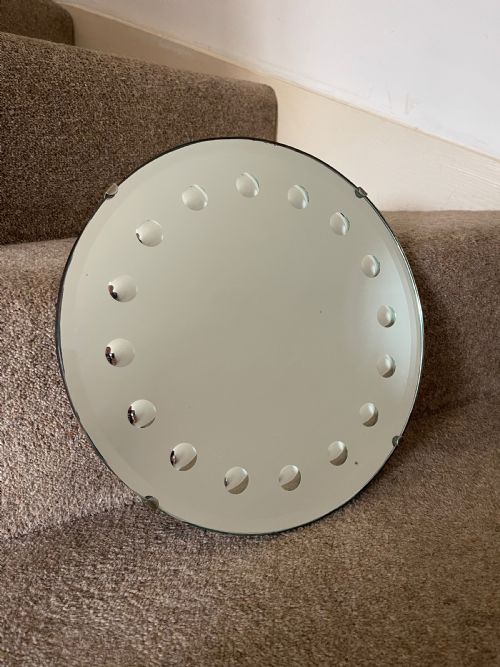
Beyond the interwar pieces, the selection encompasses earlier Victorian, Edwardian, and Georgian designs, alongside specialist variations like mirror plateaus and wall clocks. Materials range from solid timber surrounds in mahogany and giltwood to cast brass, copper, chrome, and alabaster. While wall mirrors dominate the listings, you also find pieces with easel backs and distinctive etched glass surfaces.
How they were made
The construction of these mirrors relies on combining heavy glass plates with robust structural frames made of wood or cast metal. Artisans ground down the perimeter of the glass plate by hand or machine to create the characteristic sloping bevel, which added considerable weight to the finished object. Frames were then built to securely house these heavy panes, utilising solid mahogany, carved gesso, cast brass, or copper.
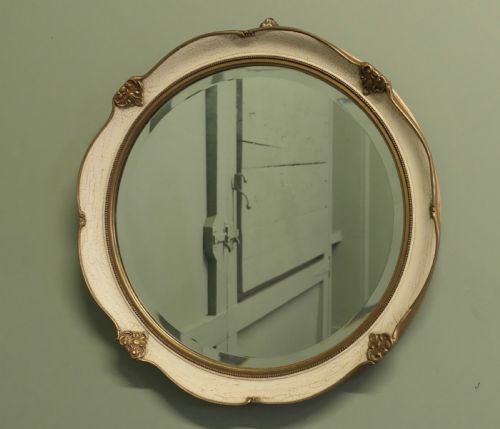
Surface decoration varied according to the prevailing style of the period, from hand-etched floral motifs on Edwardian glass to the stark geometry of French Art Deco frames in gilt and cream. Some models incorporated specialised tinted glass, such as rose tones or silvered finishes, requiring precise chemical silvering techniques applied to the rear of the plate.
One unusual variant listed is the sorcerer type mirror, offering a delightfully curved, wide-angle distortion of the room.
What varies in quality
Quality in a bevelled round mirror is determined by the depth and precision of the bevel on the glass plate and the integrity of its housing. Superior examples feature thick glass with a wide, cleanly angled bevel that catches ambient light crisply, whereas lesser pieces use thin glass with a shallow, indistinct slope.
The materials of the surrounding frame also dictate the calibre of the piece, distinguishing finely cast brass, solid mahogany, or detailed giltwood from simpler construction. The crispness of etching on the glass surface and the structural soundness of the hanging mechanism further separate standard domestic items from finer decorative works.
The Bevelled Round Mirror Glossary
- Bevel
- An edge that is ground and polished to an angle other than a right angle. This sloping border creates a prism effect that catches and refracts light around the perimeter of the glass.
- Gesso
- A plaster-like mixture applied to wood frames before gilding or painting. It provides a smooth surface for intricate carving and moulding work.
- Mirror Plateau
- A mirrored tray traditionally used as a table centrepiece to reflect candlelight or decorative objects. They share the heavy glass construction and bevelled edges seen in wall mirrors.
- Sorcerer type mirror
- A convex mirror that creates a wide-angle, distorted reflection of the room. These circular looking glasses were designed to capture the entire space in a single curved pane.
- Giltwood
- Timber that has been coated with a thin layer of gold leaf. It appears frequently on frames from the Georgian and Edwardian eras.
Bevelled Round Mirror: Frequently Asked Questions
How do I hang a heavy round mirror?
Hanging a heavy circular mirror safely requires identifying the wall construction and using fixings rated for the weight of the glass and frame. Most pieces use sturdy wire or bracket systems attached directly to the back of the surround.
Ensure you anchor the primary fixing into a wall stud or use heavy-duty wall plugs rather than relying solely on plasterboard. Due to the substantial weight of thick bevelled glass, professional installation is often recommended for larger examples.
How do I clean antique mirror glass?
Cleaning antique glass requires a gentle approach to protect the silvered backing and any delicate etched details. Use a soft, lint-free cloth and a mild glass cleaner sprayed onto the cloth rather than directly onto the mirror.
Avoid getting moisture behind the glass plate or along the edges where the silvering may have degraded over time. Aggressive scrubbing can permanently damage the original reflective coating.
What defines an Art Deco mirror?
Art Deco mirrors are characterised by geometric shapes, clean lines, and a deliberate absence of fussy Victorian ornamentation. They frequently employ circular formats, stepped wooden frames, or contrasting materials like chrome and alabaster.
Many feature stylised etched motifs or coloured glass sections, reflecting the modernist design ethos of the nineteen twenties and thirties.