



Elm Rush Seat Armchair
An elm rush seat armchair brings honest regional craftsmanship and tactile organic textures into a room.
Elm Rush Seat Armchair
An elm rush seat armchair is a robust vernacular seating form built by regional makers across the eighteenth, nineteenth, and early twentieth centuries. These chairs rely on sturdy timber frames and woven seating beds designed for daily domestic use in farmhouses and country houses. Buyers seek them out for their honest construction and the warm patina that develops on the wood over generations.
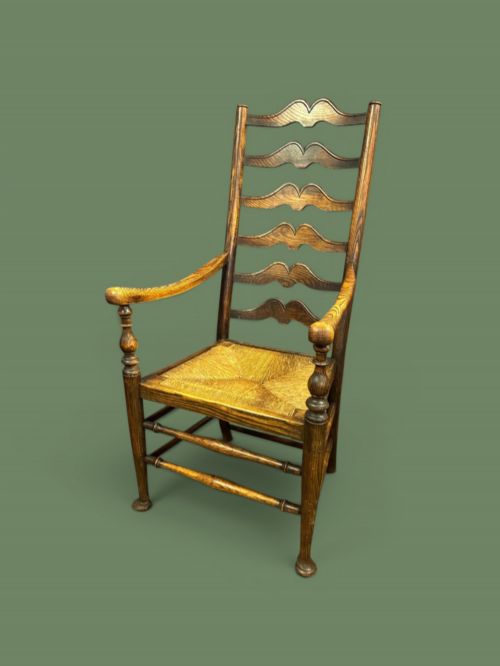
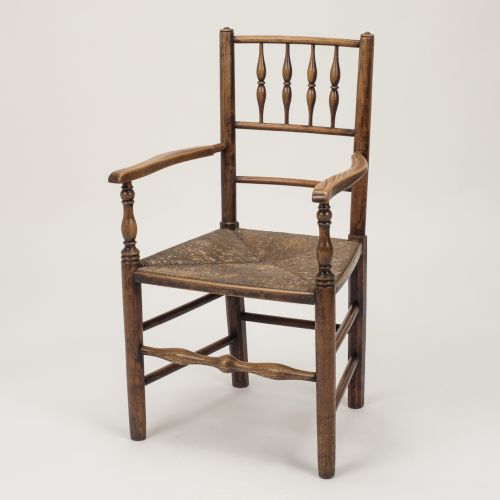
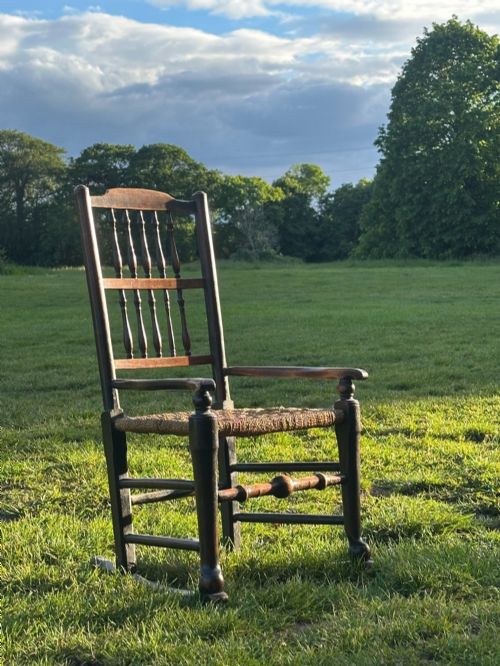
The versions most commonly met on this page span Georgian country workshops up to Victorian and later regional interpretations. Examples often arrive as spindlebacks or ladderbacks, sometimes taking the form of low-slung rockers or substantial carvers. The underlying design prioritises functional comfort and local materials over courtly ornamentation.
Materials and construction
The primary frame structure combines solid elm for seats and main rails with ash, fruitwood, or beech used for spindles, uprights, and legs. Elm provides a tough, interlocking grain that resists splitting under the stress of heavy use, whilst secondary timbers offer straightness for turned members.
Seats are tightly woven from natural rush, a pliable marsh plant twisted into strong cords and wound around the seat rails to create a supportive, resilient platform. Frame assembly typically employs traditional mortise and tenon joinery secured with wooden pegs.
Elm Rush Seat Armchair Retail Price Guide 2026
Typical asking prices for elm rush seat armchair among the pieces listed under this phrase on Sellingantiques today, from the lower quarter to the upper quarter. They describe what is for sale here now, not the wider market.
Listings feature regional variations spanning the eighteenth century through to nineteen-twenty, incorporating ash, beech, and fruitwood alongside elm.
Evaluating quality and proportion
Quality in these rural chairs rests on the balance of the proportions and the crispness of the turned details on the ladderbacks or spindlebacks. Better examples maintain their original framing timbers without excessive replacement parts, showing careful selection of timber grain by the maker.
The integrity of the rush weaving also dictates the standard of the piece, as tightly packed, uniform cords indicate skilled handwork. Furthermore, a rich, undisturbed surface finish across the elm and its supporting woods marks a well-preserved survivor from the country workshop.
The Elm Rush Seat Armchair Glossary
- Rush seat
- A seating surface woven from dried marsh rushes wound tightly around wooden rails. This traditional technique yields a resilient, textured platform that flexes slightly with weight.
- Carver armchair
- A sturdy wooden armchair designed with arms, historically positioned at the head of a dining table or used as a principal fireside seat. These pieces match the simpler side chairs in a set.
- Spindleback
- A chair back constructed with a series of slender turned vertical wooden spindles set between horizontal rails. This regional design provides back support while keeping the frame relatively light.
- Ladderback
- A chair back featuring several horizontal curved wooden slats resembling the rungs of a ladder. It is a common vernacular form found across various English counties.
- Elm
- A dense, tough native hardwood prized for its irregular grain pattern and resistance to splitting. It serves as the primary timber for the seats and structural components of these rustic chairs.
Elm Rush Seat Armchair: Frequently Asked Questions
What is an elm rush seat armchair?
An elm rush seat armchair is a traditional country seating piece made from solid elm timber featuring a woven rush seating pad. These chairs were produced in regional workshops for everyday domestic use.
They combine robust structural timbers with tactile natural cordage, reflecting local furniture-making traditions across the eighteenth and nineteenth centuries.
How were these armchairs used historically?
These armchairs served as practical seating around farmhouse dining tables or beside hearths in country homes. Their sturdy construction suited active daily life.
The inclusion of arms provided extra support, making them principal seats for the head of the household or for resting near the fire.
How do I live with a rush seated chair?
Living with a rush seated chair involves keeping the piece away from direct heat sources and damp environments, which can dry out or rot the natural fibres. Regular dusting helps preserve the timber surface.
Weight should be applied evenly, and sharp objects kept clear of the woven rush to prevent fraying or puncturing the cords over time.
How can I tell different periods apart?
Earlier pieces from the eighteenth century often display hand-turned elements and specific regional vernacular details associated with makers in Lancashire or Cheshire. The timber grain and tool marks help indicate age.
Later Victorian and turn-of-the-century examples frequently show more standardised turning methods while maintaining the traditional ladderback or spindleback framework.