
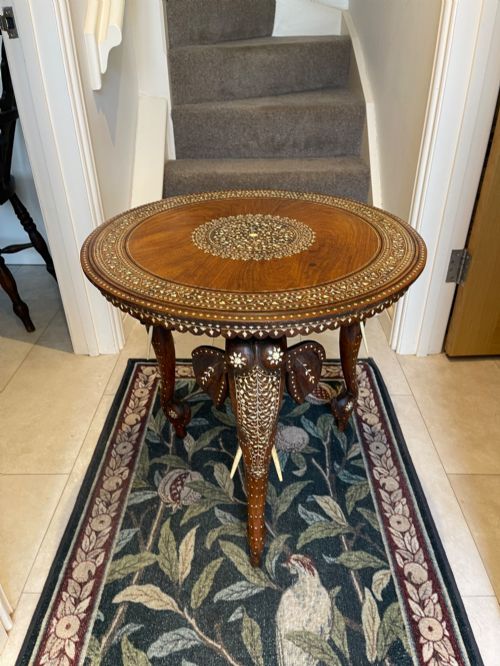


Elephant Head Table
An elephant head table brings a striking Anglo-Indian or colonial presence into a room through carved supports and dense timber.
Elephant Head Table
An elephant head table combines functional surface space with sculptural animal supports, typically appearing in forms such as side tables, occasional tables, coffee tables, and plant stands. The versions met most often on this page originate from nineteenth and early twentieth century workshops, spanning Anglo-Indian, Anglo-Indian Colonial, and Anglo-Burmese Colonial styles.
Buyers encounter a variety of shapes including octagonal, rectangular, and circular tops supported by intricately carved legs representing elephants. These pieces function well as accent furniture in reception rooms, providing a distinctive focal point that reflects colonial craftsmanship and regional design traditions from places like Bombay and Hoshiarpur.
How they were made
Makers utilised dense timbers such as teak, rosewood, and hardwood, which provided a stable foundation for deep, detailed carving. These tropical woods were often finished with contrasting inlay work using bone or ebony to create geometric and floral patterns across the surface.
Materials recorded on this site comprise teak, rosewood, hardwood, bone inlay, ebony inlay, and brass.
What varies in quality
The depth and crispness of the carving dictate the visual impact of the piece, with superior examples showing well-defined tusks, eyes, and trunk details rather than softened contours. The choice of timber also sets pieces apart, as solid rosewood or finely figured teak carries a richer grain and heavier weight than simpler hardwoods.
The precision of the inlay work marks the distinction between standard production and master craftsmanship, particularly in complex geometric Hoshiarpur panels. Additionally, the proportion and stability of the elephant leg supports relative to the top determine how successfully the table balances sculpture and utility.
The Elephant Head Table Glossary
- Anglo-Indian
- Furniture made in India during the British colonial period, combining traditional local craftsmanship with European forms. These pieces often feature dense carving and regional timber.
- Hoshiarpur
- A town in Punjab renowned for intricate woodwork and micro-mosaic inlay. Artisans there used bone and ebony set into teak to create elaborate geometric patterns.
- Occasional table
- A small, movable table designed for specific, intermittent use rather than central dining. They appear frequently in colonial interiors as plant stands or side surfaces.
- Bone inlay
- A decorative technique where small pieces of shaped bone are pressed into recesses cut into wood. This method produces high-contrast patterns across table tops and friezes.
Elephant Head Table: Frequently Asked Questions
What is an elephant head table?
An elephant head table is a piece of colonial furniture featuring structural legs carved to represent the heads and trunks of elephants. These tables usually take the form of small occasional, side, or coffee tables.
They serve as decorative accent pieces in a room, combining practical surface space with ornate sculptural carving from the nineteenth and early twentieth centuries.
Where were these tables made?
These tables were produced primarily during the nineteenth and early twentieth centuries in workshops across the Indian subcontinent and Burma. Regions such as Bombay and Hoshiarpur developed distinct regional styles.
Craftsmen adapted traditional local carving methods to suit British colonial tastes, utilising native timbers like teak and rosewood for export and domestic use.
How do I clean a carved wooden table?
Cleaning requires a soft, dry cloth to remove dust from the recessed areas of the intricate carving without snagging the wood fibres. Avoid using harsh chemical polishes that can build up within the detailed relief work.
Occasional application of natural wax helps maintain the lustre of dense timbers like rosewood and teak while protecting the dry surface from atmospheric changes.
How do I date an antique table?
Dating relies on examining the timber species, construction methods, and stylistic indicators such as regional carving patterns. Nineteenth-century examples often display heavier solid hardwoods and hand-cut joinery details.
Comparing the specific motifs, such as the style of the elephant carving or the complexity of any bone inlay, helps place the piece within a particular colonial era.