


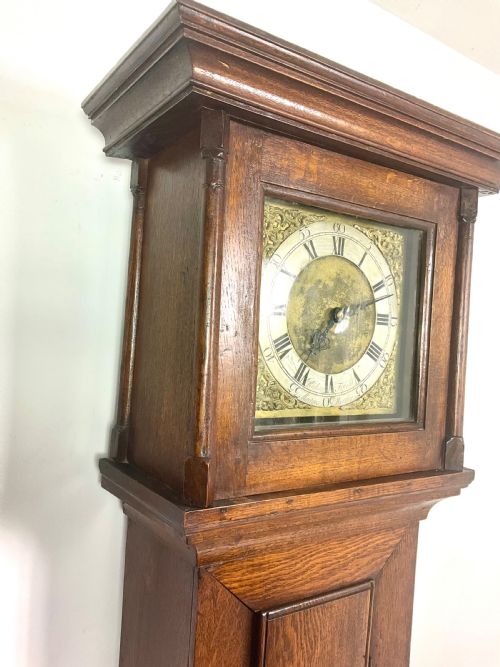


Eighteenth Century Grandfather Clock
An eighteenth century grandfather clock is a tall floor-standing timepiece that anchors a room with mechanical gravity.
Eighteenth Century Grandfather Clock
When you search for an eighteenth century grandfather clock, you are looking at tall floor-standing timepieces that dominate a domestic interior with their vertical presence. These objects are most frequently encountered in regional oak or polished mahogany finishes, hailing from the Georgian and George III eras.
The regional examples often feature brass dials and simpler oak cases, while metropolitan pieces from London makers exhibit more elaborate mahogany or lacquered wood surfaces. Longcase clocks and long case clocks appear interchangeably across the listings, housing mechanical movements that regulate hours and minutes.
Dial variations include rolling moon phases, penny moons, and rocking ship automata that add kinetic movement to the static architectural case. Buyers encounter everything from provincial country pieces to signed London works with silvered break arch dials.
Standards of execution
The distinction between ordinary and superior pieces rests on the crispness of the movement and the integration of the case. London makers often achieved greater refinement in their brass engraving and the proportion of their mahogany veneers than provincial joiners.
Dial complexity alters the character of the object, with rocking ships, rolling moons, and painted phases representing higher tiers of craftsmanship. Originality of the surface finish and the retention of signed dial work separate standard provincial clocks from important maker-stamped examples.
Father Time occasionally rocks back and forth above the dial, keeping an unblinking watch over the passing hours.
Gillows Cased·Richard Biggs Romsey·Stanyer Nantwich·Dwerrihouse and Carter·Samuel Buxton Diss·James Rayner Hull·John Jackson London·Robert Darling Melrose·Archibald Collier Bond Street
The Eighteenth Century Grandfather Clock Glossary
- Longcase clock
- The formal term for a tall pendulum clock housed in a wooden case standing on the floor. Most examples measure over six feet in height.
- Break arch dial
- A dial shape where the upper edge forms a central arched projection above the square dial face. This space frequently houses a moon phase or rocking automaton.
- Penny moon
- A simple mechanism displaying the phases of the moon through a small circular aperture in the dial. It uses a painted disc that rotates behind the brass face.
- Silvered dial
- A brass dial treated with a chemical solution to produce a frosted silver finish upon which the numbers are engraved and blackened. It provides high contrast for reading the time in low light.
- Chinoiserie
- European decorative style inspired by Chinese art, featuring painted figures, pagodas, and landscapes on a lacquered ground. On these clocks, the dark green or black painted cases display raised gilt decoration.
Eighteenth Century Grandfather Clock: Frequently Asked Questions
How do grandfather clocks work?
These timepieces rely on heavy weights suspended inside the trunk by cords, which pull on gear trains as they slowly descend. An anchor escapement and a swinging pendulum regulate the release of power, turning the hands at a measured pace.
To keep the clock running, the weights must be periodically pulled back to the top using a key or winding cord. The pendulum must hang plumb and level for the escapement to maintain an even beat.
Where were these clocks placed?
Historically, tall clocks stood in hallways, stairwells, or principal living rooms where their chimes could be heard throughout the house. Their height required ceilings taller than standard modern doorways.
Placing them against an interior wall protected the wood from damp exterior masonry and shielded the pendulum from floor vibrations. The ticking served as a constant domestic heartbeat.
How do I tell oak from mahogany cases?
Oak exhibits a pale brown tone with visible medullary rays and an open, coarse grain structure. It typifies earlier regional pieces from the Georgian period.
Mahogany displays a denser, reddish-brown grain that darkens gracefully with age and polish. It is more commonly associated with fine London workshops and later eighteenth century styles.