



Egyptian Revival Ornament
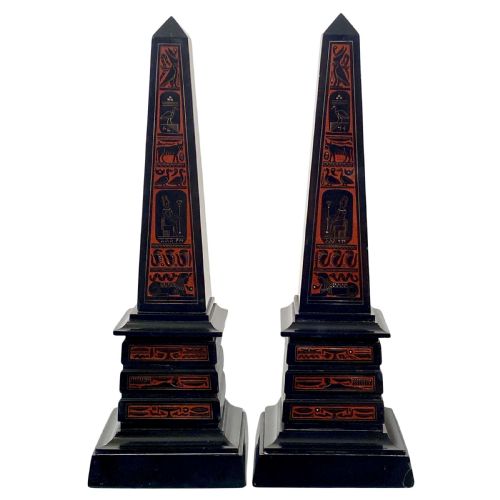
These pieces of egyptian revival ornament capture centuries of fascination with the Nile valley, offering dramatic sphinxes, obelisks, and figures that anchor any mantelpiece or desk.
Egyptian Revival Ornament
When you search for egyptian revival ornament, you encounter a distinct category of sculptural objects spanning the nineteenth and twentieth centuries. These works draw directly on the artistic motifs of ancient Egypt, reinterpreting them through various European decorative movements.
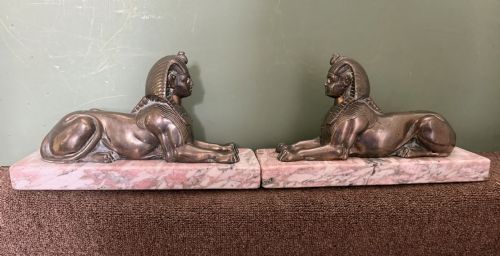
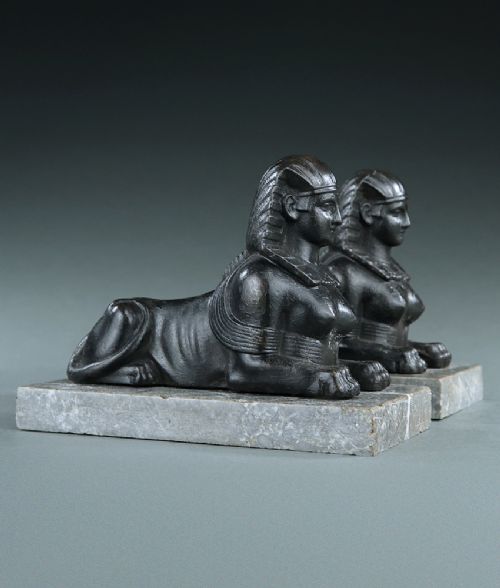
The objects most frequently met on this page include bronze and cast iron sphinxes, decorative stone obelisks, and figural sculptures. Makers adapted these forms into pairs of mantel ornaments, desktop pieces, and Grand Tour souvenirs.
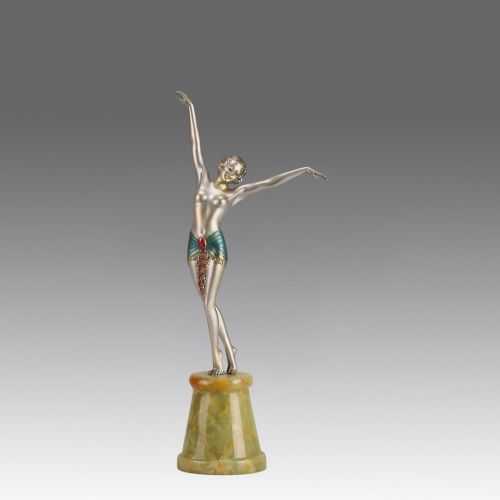
Examples range from Regency period pieces to Art Deco creations, reflecting shifting European tastes for archaeological themes. Materials shift from carved marble and onyx to cold-painted and patinated bronze.
How they were made
Carvers shaped blocks of black Rouge Griotte marble, green Egyptian onyx, and Ashford marble into slender obelisks and sarcophagi. Artisans polished these stone surfaces to a high sheen, occasionally incorporating incised hieroglyphic decoration.
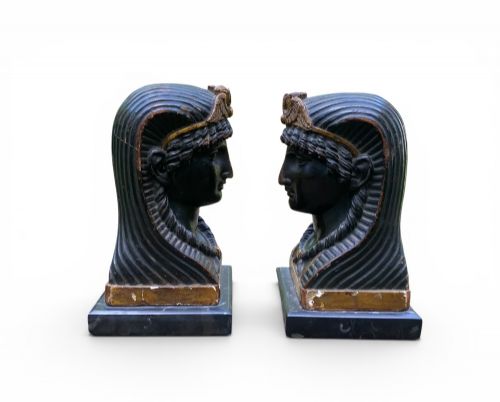
Object forms include free-standing sculptures, decorative obelisks, stone sarcophagi, and figural bookends.
What varies in quality
The standard of a casting dictates much of its visual impact, separating crisp, finely chased bronze details from softer, commercially produced metalwork. Weight and material selection also play a major role, particularly in stone objects where dense marbles and onyx command greater presence.
Proportion and fidelity to period design influence the success of each piece, whether dealing with a Regency sphinx or an Art Deco dancer. The quality of the original finish, from cold-painted enamel to hand-applied patination, determines the remaining character of the surface.
Josef Lorenzl·Thomas Hope·D.H. Chiparus
The Egyptian Revival Ornament Glossary
- Sphinx
- A mythical creature with the body of a lion and the head of a human or animal. These figures frequently appear in pairs as decorative supports or guards.
- Obelisk
- A tall, four-sided, narrow tapering monument which ends in a pyramid-like shape at the top. In these listings, they appear reduced in scale as decorative desk and mantel ornaments.
- Grand Tour
- A traditional trip of Europe undertaken by upper-class European young men of sufficient means. Souvenirs from these travels included small bronzes and stone obelisks.
- Cold-painted
- A method of applying paint to bronze without firing the piece in a kiln. The paint remains somewhat fragile and is prone to flaking over decades.
- Rouge Griotte
- A deep red, mottled French marble often used for decorative bases and obelisks. It provides a striking contrast to patinated bronze figures.
Egyptian Revival Ornament: Frequently Asked Questions
What materials are used in these pieces?
These decorative works utilise a range of hardstones and metals. Bronze, brass, and cast iron provide the structural medium for figural sculptures and sphinxes.
Stones such as black Rouge Griotte marble, green Egyptian onyx, and Ashford marble form the bases and obelisks. Enamel and gilt highlights occasionally enhance the surface decoration.
How do I date an obelisk?
Dating relies heavily on the type of stone and the manufacturing marks present on the piece. Nineteenth century examples often link directly to Grand Tour travel collections and classical revival interiors.
Later twentieth century pieces reflect Art Deco influences or simplified industrial casting methods. Examining the underside and the polish of the stone helps confirm the era of production.
Where were these ornaments placed originally?
Owners typically displayed these items upon mantelpieces, library desks, and entrance hall tables. Pairs of sphinxes often flanked clocks or candelabra as part of a formal garniture.
Smaller obelisks served as desktop paperweights or decorative accents in study rooms. Their dramatic silhouettes suited the grand interior schemes of the nineteenth and early twentieth centuries.
Are these items antique?
The selections span from the early nineteenth century through the mid twentieth century. Pieces originate from periods including the Regency era, the Victorian epoch, and the Art Deco years.
Each object carries the manufacturing characteristics and material patination of its specific decade of origin. None of these items are modern reproductions.