

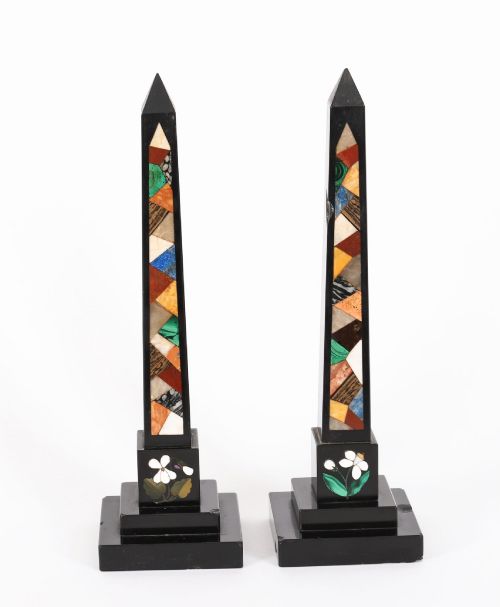

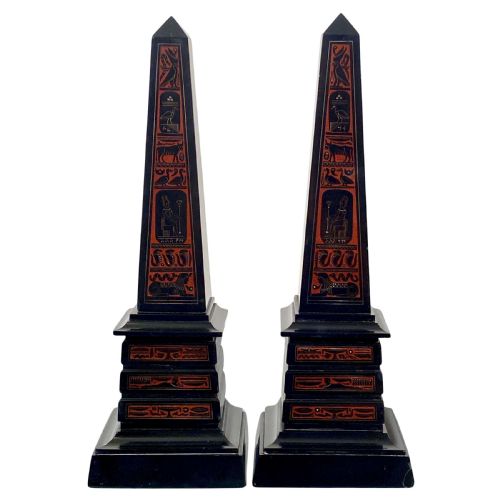


Black Marble Obelisk
These black marble obelisk pieces are sharp, heavy decorative objects shaped from dark stone, prized by collectors for their striking geometric silhouette.
Black Marble Obelisk
When you search for a black marble obelisk, you encounter decorative objects taking the tapered, four-sided form of ancient monuments. The versions met most frequently on this page span the nineteenth century and the early twentieth century, originating from periods such as the Victorian era, the Art Deco movement, and the Egyptian Revival.
Forms range from simple standalone stone shafts to sophisticated desk accessories equipped with thermometers. Makers constructed these monuments in pairs or as single display pieces, utilising influences from Grand Tour travels and classical archaeology.
Origins stretch across specific regional British workshops working with local stone, Italian studios producing pietra dura inlay, and broader European decorative traditions. Each piece serves primarily as a mantel or desk ornament, bringing a solemn architectural presence into a room.
Materials and construction
Craftsmen shaped these objects from dense dark stones, recording materials such as black marble, Ashford black marble, black slate, and rouge griotte marble. The solid stone bodies provide substantial weight and a deep, light-absorbing finish.
Many examples incorporate intricate surface decoration using specimen stones, jasper, malachite, and pietra dura inlay. These colourful mineral fragments create floral or geometric patterns that contrast sharply against the dark background of the main shaft.
Black Marble Obelisk Retail Price Guide 2026
Typical asking prices for black marble obelisk among the pieces listed under this phrase on Sellingantiques today, from the lower quarter to the upper quarter. They describe what is for sale here now, not the wider market.
The records show materials spanning standard black marble, Ashford black marble, rouge griotte marble, and specimen stones including malachite and jasper.
Markers of quality
The distinction between ordinary and superior pieces rests on the precision of the stonecutting and the complexity of the surface ornament. Sharp, clean edges along the tapering pyramid and precise joints demonstrate superior stonemasonry.
Integration of high-grade inlay work, such as finely fitted malachite, jasper, and multi-coloured specimen marbles, elevates a piece significantly. The presence of integrated functional elements like desk thermometers or matching pairs also marks out the more ambitious examples of the form.
The Black Marble Obelisk Glossary
- Ashford Black Marble
- A dark limestone quarried in Derbyshire, England, capable of taking a high polish and serving as a base for inlay work. Craftsmen often utilised this dense material for nineteenth-century desk ornaments.
- Pietra Dura
- An artistic technique involving the cutting and fitting together of highly polished coloured stones to create pictorial or geometric designs. Artisans embedded these stone mosaics directly into the black marble surface.
- Grand Tour
- A traditional trip of Europe undertaken by upper-class young men in the eighteenth and nineteenth centuries to absorb classical culture. Travellers frequently returned home with small decorative obelisks and architectural models.
- Egyptian Revival
- An artistic style drawing inspiration from the motifs and architecture of ancient Egypt. This aesthetic influenced nineteenth-century and Art Deco decorative objects including tapered stone monuments.
- Rouge Griotte Marble
- A deep red, mottled limestone variety often featuring white fossil inclusions. This striking material appears alongside black marble in classical and revival decorative pieces.
Black Marble Obelisk: Frequently Asked Questions
What is a black marble obelisk used for?
These stone objects served primarily as decorative ornaments for desks, mantelpieces, and display tables during the nineteenth and early twentieth centuries. Some specific examples also incorporated functional instruments like thermometers into their tapered shafts.
Today, they function purely as decorative display items that add architectural gravity and historic character to interior spaces.
How do I date a black marble obelisk?
Dating relies on identifying stylistic markers, manufacturing techniques, and the specific types of stone and inlay present. Victorian and mid-nineteenth-century pieces frequently feature Ashford black marble with detailed pietra dura inlay or integrated thermometers.
Later pieces from the early twentieth century often reflect Art Deco or Egyptian Revival aesthetics with cleaner lines and different material combinations.
What is Ashford black marble?
Ashford black marble is actually a dark, fine-grained limestone quarried in the Derbyshire region of England. It earned its name because it could be polished to a deep, lustrous black finish resembling true marble.
Artisans valued this stone because its dark surface provided a dramatic contrasting background for inlaid coloured specimen stones.
Are these objects found in pairs?
Many examples on record were created and kept as matching pairs, particularly those associated with Grand Tour souvenirs and mantel garnitures. Single obelisks also appear frequently as standalone cabinet or desk pieces.
Pairs generally command higher interest among collectors who wish to use them symmetrically on mantelpieces or bookcases.
What is pietra dura?
Pietra dura is a meticulous technique where artisans cut and tightly fit polished coloured stones into a contrasting background slab. In these pieces, floral or geometric motifs made from malachite, jasper, and specimen stones are embedded into the black marble.
This painstaking mosaic work creates a smooth, flat surface with enduring colour that does not fade over time.