



Grand Tour Obelisks
Grand tour obelisks bring neoclassical architecture home in miniature, offering travellers and collectors portable monuments to classical antiquity.
What grand tour obelisks are
Grand tour obelisks are decorative sculptures modeled after ancient Egyptian and Roman monuments, collected by travellers during the nineteenth and twentieth centuries as souvenirs of their travels through Europe and Italy. These ornamental pieces capture the monumental scale of classical sites in miniature forms suited for domestic display.
How they were made
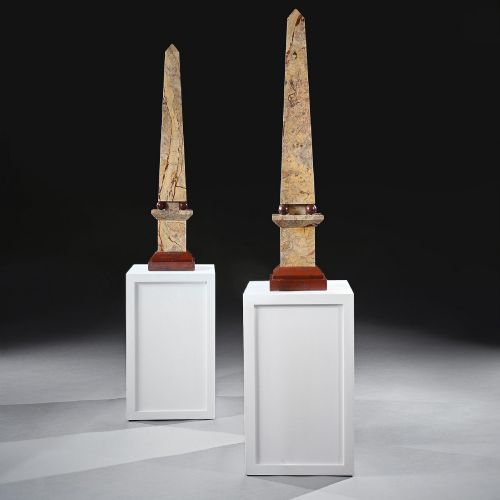
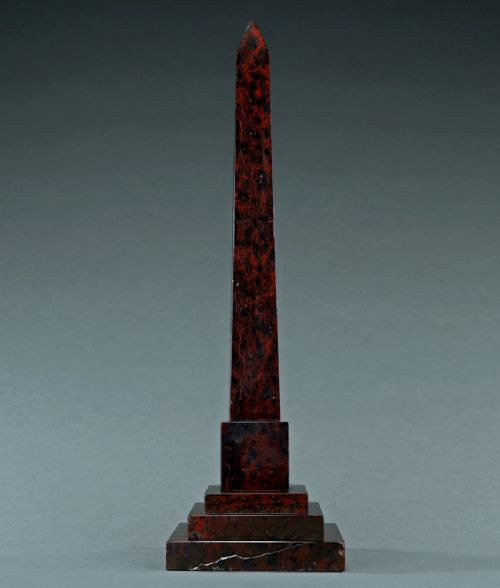
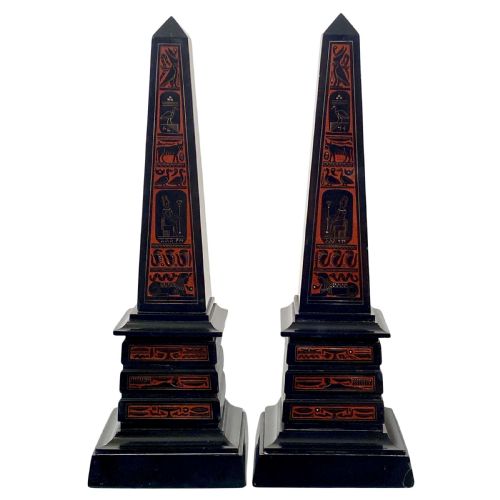
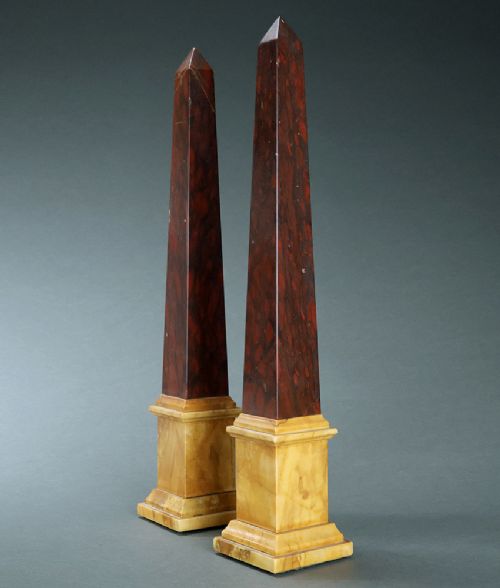
Masons shaped these decorative objects from dense mineral materials such as black marble, portasanta marble, rosso antique marble, rouge griotte marble, and amethyst, often incorporating contrasting ebonised trim or satinwood mounts. Craftsmen turned and polished the stone shafts on lathes to achieve smooth, tapering facets that reflected light uniformly.
Selected examples integrate pietra dura inlay work, embedding precise geometric or floral motifs directly into the marble faces using meticulously cut semiprecious stones. Other workshops cast bronze elements, including miniature renderings modelled after specific historic structures like the Luxor obelisks.
Retail Price Guide 2026
Typical UK retail prices for grand tour obelisks, calculated from the Sellingantiques database of over a million retail prices indexed since 2003. This retail price guide relies exclusively on Sellingantiques data; no external sources or auction records are used, so the figures do not describe the wider market.
Listings incorporate multiple marble varieties including black, portasanta, rosso antico, and rouge griotte.
What varies in quality
The distinction between standard souvenirs and superior examples lies in the selection and assembly of the mineral materials. Finer pieces utilise rarer stones like portasanta and rosso antico with striking natural veining, and incorporate intricate pietra dura work rather than plain polished surfaces.
Proportion and symmetry determine visual success, as the tapering shaft must maintain precise geometric balance from base to apex. The quality of execution in secondary details, such as bronze mounts and subsidiary plinths, separates commercial workshop output from exceptional decorative objects.
The Grand Tour Obelisks Glossary
- Grand Tour
- A traditional trip through Europe, primarily undertaken by upper-class young European men of means in the eighteenth and nineteenth centuries to flourish their cultural education. This travel culture generated a steady demand for portable souvenirs like architectural models and marble obelisks.
- Pietra dura
- An artistic technique of inlaying cut and fitted polished coloured stones to create images or geometric patterns. Artisans use this laborious method to decorate the bases and shafts of select marble decorative objects.
- Portasanta marble
- A distinctive variety of decorative limestone featuring a variegated breccia pattern of pink, red, and white fragments set in a darker matrix. Italian masons favoured this colourful stone for architectural elements and decorative sculptures.
- Egyptian Revival
- An artistic style dating from the nineteenth century that draws inspiration from the motifs, architecture, and deities of ancient Egypt. Obelisks produced under this influence often incorporate hieroglyphic decoration or associated classical plinths.
- Rosso antico
- A deep red marble prized by classical sculptors and later nineteenth-century revivalists for its rich colour and fine grain. This material appears frequently in high-status decorative obelisks.
Frequently Asked Questions
How were they used historically?
Wealthy travellers displayed these souvenir obelisks in their homes as tangible proof of their cultural travels and classical education. They functioned as conversation pieces in studies, libraries, and formal drawing rooms.
Placed on architectural pedestals or matching pairs on either side of a fireplace, they anchored interior decorative schemes. Their presence signalled both scholarly taste and substantial financial means to visiting guests.
How do you style them today?
These obelisks integrate easily into contemporary interiors by providing vertical contrast against horizontal surfaces like sideboards, bookshelves, and mantelpieces. Displaying them in pairs creates a sense of architectural symmetry and formal balance.
Pairing marble or bronze obelisks with modern art or natural curiosities highlights their sculptural qualities. They work well when grouped with other decorative objects of varying heights and materials.
How do you identify different materials?
Identifying the stone requires observing the natural colouration, grain, and veining patterns visible across the polished facets. Materials like portasanta and rouge griotte show distinct brecciated fragments, while black marble offers a uniform dark ground.
Closer inspection under good lighting reveals whether decorative motifs are inlaid through pietra dura or merely painted onto the surface. Bronze models present distinct cast textures and patination consistent with nineteenth-century metalwork.