
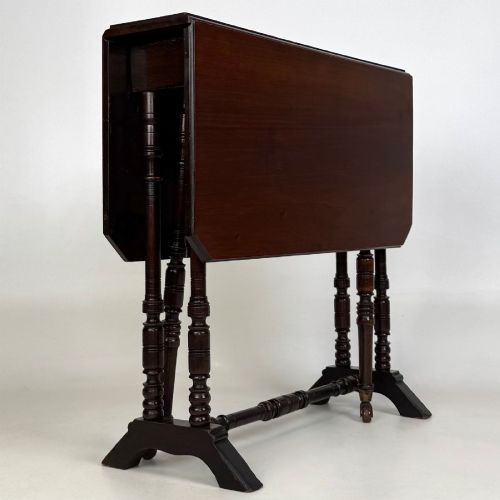
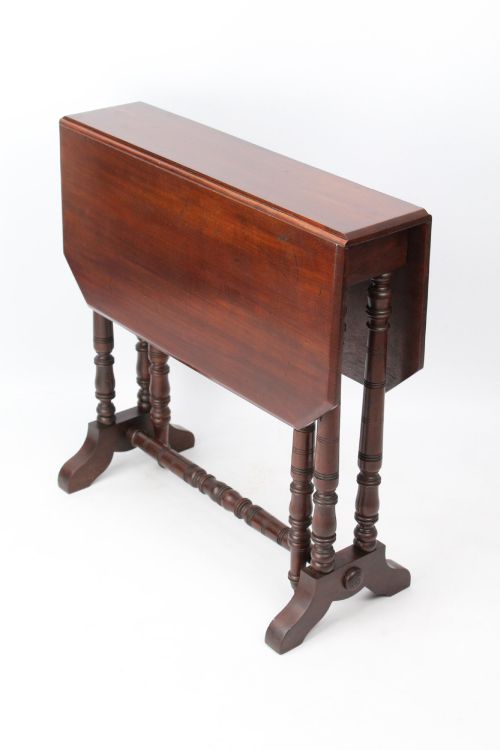


Edwardian Wooden Gateleg Table
These edwardian wooden gateleg table examples combine practical folding design with period charm, offering compact surfaces that expand gracefully for dining or tea.
Edwardian Wooden Gateleg Table
An edwardian wooden gateleg table primarily manifests as a Sutherland table, occasional table, or drop leaf dining table originating from the Edwardian and Victorian eras. These versatile pieces utilise hinged flaps supported by swing legs to save space while providing ample surface area when fully extended.
Materials and Technique
Cabinetmakers utilised dense timbers like mahogany and oak for structural integrity, supporting the pivoting gate legs that carry the drop leaves. Brass hardware frequently appears on hinges and castors, ensuring smooth movement for the folding leaves.
Decorative embellishments rely on contrasting veneers, including satinwood inlay and boxwood banding, applied to tabletops and friezes. Joinery techniques from the period prioritized stability in folding mechanisms, allowing slender spider legs to support substantial leaves.
Several tables feature canted corners designed specifically to prevent bumped knees during afternoon tea.
Judging Quality
Superior examples distinguish themselves through the precision of their timber matching and the subtlety of their satinwood inlay or crossbanding. The integrity of the gateleg hinge mechanism and the straightness of slender spider legs also determine the overall standard.
Finer pieces maintain structural tightness in their pivot joints and feature well-figured mahogany or burr walnut grains. Lesser iterations display simpler construction with plain timber surfaces and heavier, less refined framing.
The Edwardian Wooden Gateleg Table Glossary
- Gateleg table
- A table with hinged leaves supported by legs that swing outward like a gate. This clever design allows the surface area to expand or contract according to domestic needs.
- Sutherland table
- A specific type of narrow drop leaf table where the leaves comprise a very large proportion of the top, and the folded leaves hang almost vertically. They were originally popular for afternoon tea.
- Satinwood inlay
- A decorative technique using contrasting light-coloured exotic wood set into the primary timber of the tabletop or border. It creates geometric or floral patterns typical of the Sheraton Revival style.
- Spider leg
- An exceptionally slender turned wooden leg utilised on light occasional tables of the period. Despite their delicate appearance, they provide stable support when properly joined.
- Crossbanding
- A strip of veneer applied to the edge of a table top with the grain running perpendicular to the main surface. This provides a neat framing effect favoured by period cabinetmakers.
Edwardian Wooden Gateleg Table: Frequently Asked Questions
How do I use a gateleg table daily?
Keep the leaves dropped against the sides to use the piece as a narrow console or occasional surface in a hallway or living room. Raise one or both leaves and swing out the supporting legs whenever you need extra space for dining or writing.
Ensure items placed near the folding edges are balanced properly across the central fixed top and the movable leaves. Avoid placing excessive weight on the unsupported outer corners of extended leaves.
What is the difference between a Sutherland and a gateleg?
A Sutherland table is actually a specific, narrower sub-type of gateleg table designed to fold down into an exceptionally compact footprint. Standard gatelegs often feature wider central fixed sections and heavier structural frames.
Sutherland tables typically utilise much slimmer legs, including spider legs, and leaves that drop down almost completely vertically. They were traditionally wheeled out for afternoon tea rather than heavy dining.
How do I date an Edwardian table?
Examine the timber, secondary woods, and construction methods used in the underframe and hinge mechanisms. Edwardian pieces often display lighter timbers like satinwood inlay and refined Sheraton Revival influences.
Compare the style of the turned legs and any brass castors against documented cabinetmaking catalogues from the period. Victorian predecessors generally tend to feature heavier proportions and darker mahogany finishes.
Can these tables fit in modern small rooms?
The folding mechanism makes these drop leaf tables exceptionally well suited for compact modern living spaces and flats. You can tuck them against a wall with both leaves down until surface space is required.
Their narrow profile when closed ensures they do not obstruct walkways while still offering full dining capacity when opened.